
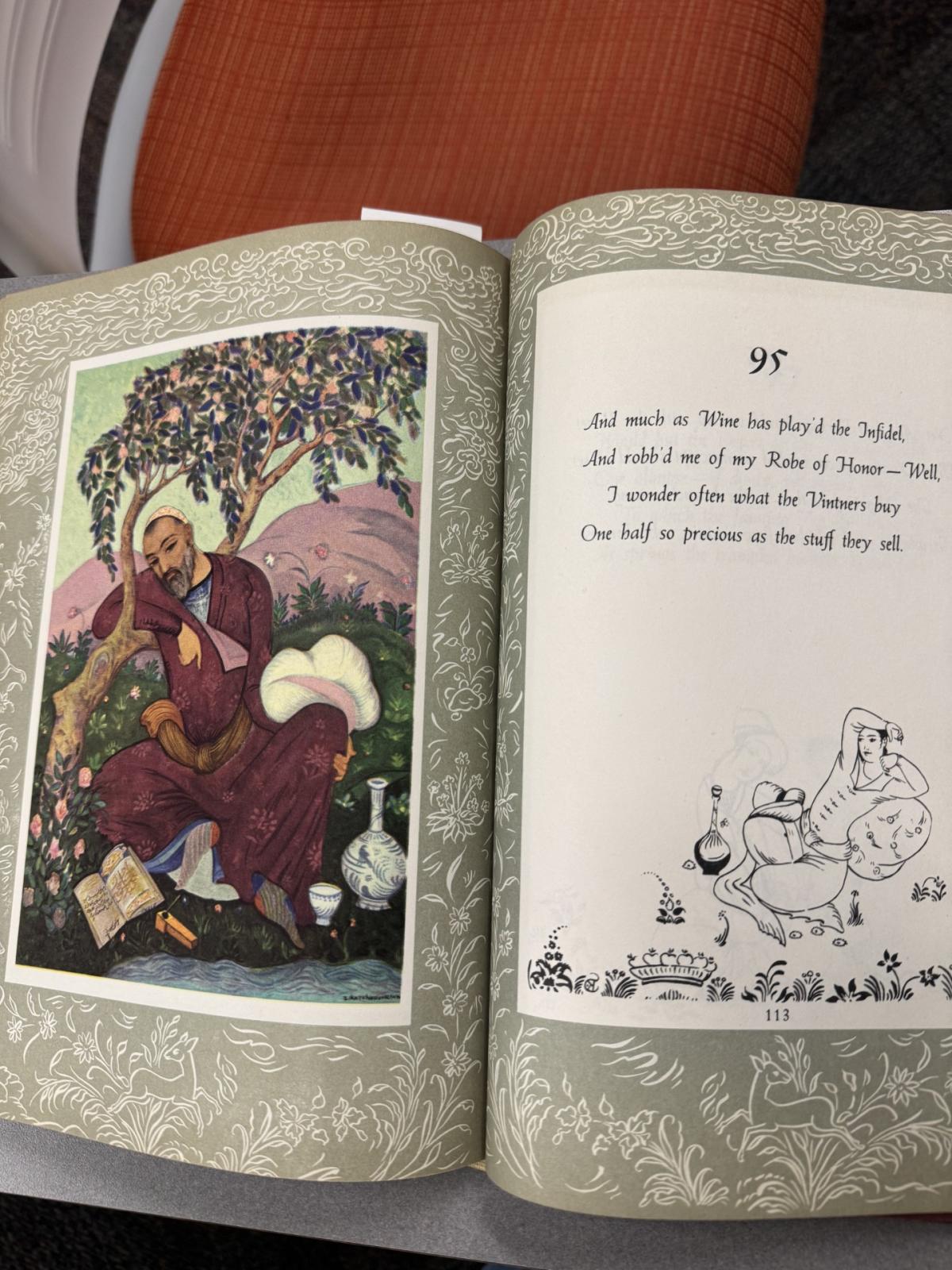
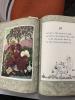
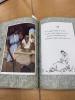
Within stanza 95 Khayyam writes, "And much as Wine has play'd the Infidel,/And robb'd me of my Robe of Honor - Well,/I wonder often what the Vitners buy/One half so precious as the stuff they sell". Adjacent to these phrases, Katchadourian has illustrated a man lounging beside the riverbed. He is accompanied by a cask of wine, a tome, and the setup to burn incense. This verse follows the greater theme of the Rubáiyát in that it tackles the pull between earthly pleasures and viewing oneself as a man who has spent his life well.
Wine is frequently written about within the pages of the Rubáiyát, and as Khayyam conveys the drink as something which "robb'd me of my Robe of Honor" it can be understood that he is discussing the rejection of cultural norms in which quickly follows the loss of status and piety. The escape from these expectations are seemingly liberating to the author, as he tells readers that the wine being sold to him is more valuable than anything else money can buy. Wine's utilization as the repetetive urge to bask in the enjoyments life offers is across most pages in this edition, as nearly every illustration has wine somewhere within the colors and depictions. Alongside Khayyam's heavy-handed allusion, Katchadourian also readily leans into the theme. The image alongside stanza 95 is no exception, and the artist's other inclusion are very intentional when analyzed.
In this illustration, the subject is lounging on a tree near the water's edge. The support and comfort provided by nature creates a relaxed scene, as he has removed his hat as well as his shoes. The lack of shoes ties in with the stanza's point that indulgence may rob you of status and direction, for without shoes where may one be headed? The foil created beside the figure is also artfully done, as to his left lies the wine, while texts and incense fall to his right side. The book and incense represent a scholarly, focused, upstanding lifestyle, as one who would take the time to fulfill their duty to improve themselves. Oppositely, wine makes a man into an "infidel", someone who has no faith or disagrees with the religion of his people. While the image itself paints the scene of a choice to be made, readers know by the context of the words which decision Khayyam is encouraging. Lost to the wildnerness, disrobed and relaxed, this figure has embraced the transcendence of the bottle's call.
The bright colors alongside this stanza are encouraging and inviting, as many scenes discussing love and wine are within this edition. The stanzas spent pondering the expectations or intentions of the Creator/God are the few pages in which muted earth tones make up the illustration's palette. One such example is the painting which accompanies stanza 37, in which Khayyam likens God to a potter, and examines the act of prayer. In such a heavily illustrated edition, choices for color and mood are deliberate selections of the artist and Katchadourian's selection of vibrance for stanzas encouraging liberation as opposed to the muffled saturation of theological inquiries says much even without Khayyam's verbage.
Sarkis Katchadourian expertly weaves his art with the themes of Omar Khayyam's Rubáiyát as he utilizes color and the symbolism of nature, wine, and earthly objects into his illustrations. Beside Khayyam's stanza 95, these two artistic works bear the message that although partaking in the pleasures of life may cost you status and honor, the enjoyment you receive in return is well worth the exchange.