
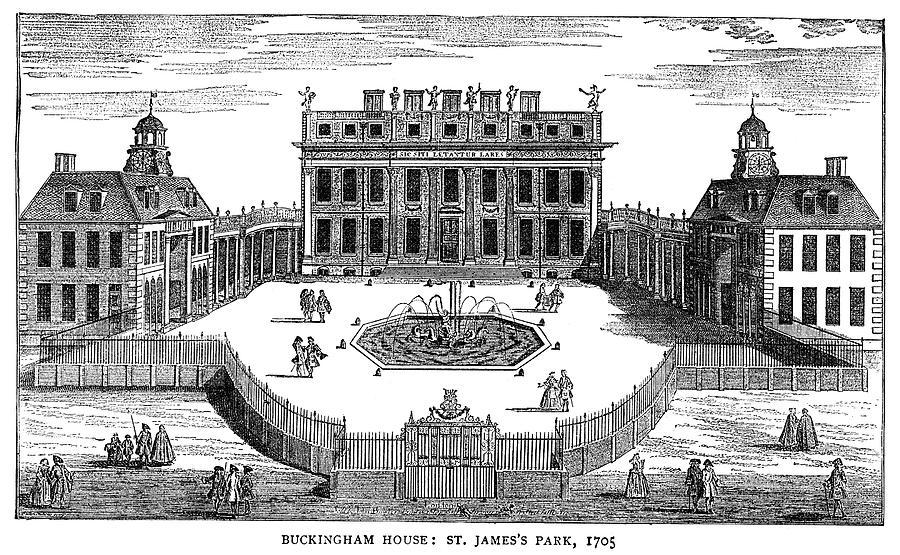
Buckingham Palace is one of the most notable London destinations, primarily because it is the residence of the current monarch of the United Kingdom, since 1837. As the years go on, there are more and more people immigrating to the United Kingdom. For some immigrant fleeing their country, England can be seen as a place of safety and prosperity. In “Brick Lane,” by Monica Ali, Nazneen, an immigrant from Bangladesh, looks upon Buckingham Palace, and notices that it isn’t as grand as the Taj Mahal. The Taj Mahal is a stunning mausoleum located in India. With its marble and its large pond, It is the epitome of beautiful architecture. When Buckingham Palace is compared to the Taj Mahal, it doesn’t stand anywhere near it in terms of beauty. Where the Taj Mahal is beautifully and intricately shaped, Buckingham Palace is, quite simply, a large box. According to Chapter fourteen of Brick Lane, “The avenue that swept down to Buckingham palace was as wide as forty bullock carts and it was the grandest of roads. … It was big and white and, as far as she could see, extraordinary only in its size. The railings she found impressive but the house was only big. Its face was very plain. Two pillars (in themselves plain) sat at the main doorway, but there was little else in the way of decoration. If she were the queen she would tear it down and build a new house, not this flat-rooted block but something elegant and spirited, with minarets and spires, domes and mosaics, a beautiful garden instead of this bare forecourt. Something like the Taj Mahal.” (Ali). Because of Nazneen's culture, she has different expectations of what a beautiful building should be. She sees Buckingham Palace as a big home surrounded by tourists.
Buckingham House was purchased by George III in 1761 for his wife, Queen Charlotte. Buckingham Palace was then known as the Queen's House. He did this so they can use it as a comfortable home. The location was perfect because it was close to St James Palace, where there were many important functions held. During the reign of George III, fourteen of his fifteen children were born at the magnificent home. During the accession of George IV in 1820, he decided to reconstruct the house, however in 1826, he changed his mind and decided to transition the home into the palace that we know it as today (Royal). It was doubled in size and altered to reflect a French neo-classical influence. However, after some complications caused by a lack of space, the decision to increase the size was made (Royal). This led to a fourth wing being added, which created a quadrangle. The renovations were completed in 1847. By 1913, there were signs of deterioration, which led to another renovation on the façade of the palace. This updated façade is where the current Changing of the Guards takes place. This renovation ended in 1914, just before the beginning of World War One (Royal). Today, during the summer months and for a limited time during December, January, and Easter, the palace is open to the public for tours. It serves as an reminder to all, visitors and residences, of the stability of the monarch, and is still one of the more famous landmarks in the entire world (Royal).
Works Cited
Ali, Monica. Brick Lane. Penguin, 2023.
FineArtAmerica. "Buckingham Palace, 1705." 16 October 2018. https://fineartamerica.com/featured/buckingham-palace-1705-granger.html…;
Flickr. "Buckingham Palace and the Victoria Monmunent - January 1985." 29 April, 2011. https://www.flickr.com/photos/johncowper/5668679421.
Royal. https://www.royal.uk/royal-residences-buckingham-palace.
The Shirley Bassey Blog. "Party at the Palace - 2002." 11 March, 2016. https://shirleybassey.wordpress.com/2016/03/11/party-at-the-palace-2002…;