
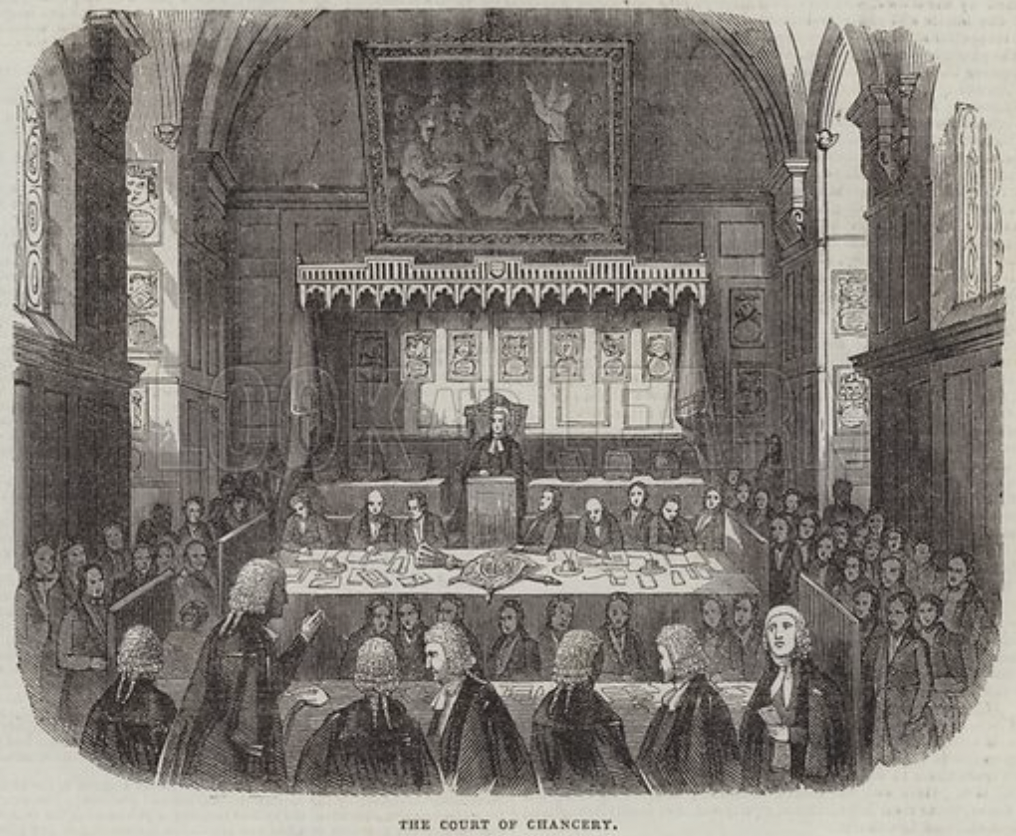
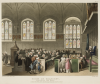
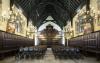
Lincoln’s Inn, in which the High Court of Chancery was located, is one of London’s four Inns of Court, which have existed since at least 1344. From 1737 until the opening of the Royal Courts of Justice in the 1870s, the court operated out of the Old Hall within Lincoln’s Inn (Barton and others). Today, Lincoln’s Inn Hall is used for holding exams, lectures, and social functions, but evaluating its history regarding the High Court of Chancery is particularly vital to the theme of upper-class London (“Honorable Society”).
The High Court of Chancery was a court established in 1450 during England’s feudal/medieval period and originally dealt mostly with common-law land disputes (“Chancery”). In the early 1600s, efforts were made by then-Lord High Chancellor Ellesmere to give the court power to override other common-law courts. This is the point where the High Court of Chancery began to expand past its more simplistic reach, covering a wider variety of cases and having more legal power (Kerly). Thereafter, the court became increasingly unresponsive to the more complex nature of the cases being brought to them, refusing to offer relief beyond what the existing inflexible system allowed.
By the 1800s, in addition to land disputes, the High Court of Chancery also heard cases on administration of trusts and estates, handling estates in cases of insanity, and orphan guardianship (“Chancery”). Cases covering this wider range of topics were taken on in larger numbers than the court could handle, causing congestion to the system. The court became notorious for egregiously delayed proceedings--sometimes lasting for decades--which caused often already financially troubled clientele to acquire vast amounts of legal fees, including fees to Commissioners and solicitors and fees for the required purchase of copies of documents, only to often conclude their cases unsatisfied (Matthews). The High Court of Chancery became synonymous with inefficiency and corruption (Matthews).
The justices of the court and, particularly, its High Chancellor were members of the upper rank in society and often did not empathize with the plight they were bringing onto lower-class citizens (Matthews). Such is the central criticism in Charles Dickens’ Bleak House, in which from the very first chapter he likens the High Court of Chancery at Lincoln's Inn Hall to a foggy haze subduing the entire city, while “at the very heart of the fog, sits the Lord High Chancellor in his High Court of Chancery." Dickens himself once brought a case to Chancery and ended up paying more in fees than he won in damages, but though he did gain financial security in his lifetime, his focus in writing Bleak House was with the poor citizens affected by these court proceedings (Matthews). On a tour of high-society London, this intertwined nature between the rich and the poor is often unavoidable, displaying the economic extremes of the city at this time, often worsened by the upper-class through systems such as Chancery.
The courts were a distinct area of concern for reformers due to the widespread impact of their inefficiency. As early as 1833, before the writing of Bleak House, efforts were made to investigate the proceedings at Chancery. Eventually, the Chancery Regulation Act of 1862, which required the court to determine and specify every issue of fact or law presented in the case, along with internal reform from later High Chancellors, helped soothe some of the issues of the court (Lobban).
The High Court of Chancery exists today in a different form as the Chancery Division of England’s High Court of Justice, formed in 1875. It now oversees business and property disputes (“Chancery Division”). Many courts of chancery are kept throughout Britain and some have even taken root in the United States, though these modern courts are more efficiently run than their historical counterpart (“Chancery Division”).
Works Cited
Barton, Dunbar Plunket; Benham, Charles; Watt, Francis (1928). The Story of the Inns of Court. Boston: Houghton Mifflin. OCLC 77565485.
“Chancery Division.” Encyclopædia Britannica, Encyclopædia Britannica, Inc., https://www.britannica.com/topic/Chancery-Division.
“Chancery.” Legal Information Institute, Legal Information Institute, https://www.law.cornell.edu/wex/chancery.
“The Court of Chancery.” Look and Learn History Picture Library, https://www.lookandlearn.com/history-images/U301893/The-Court-of-Chance….
Dickens, Charles. Bleak House. Alma Classics, 2021.
“The Honourable Society of Lincoln's Inn.” Lincoln's Inn, 27 Sept. 2022, http://www.lincolnsinn.org.uk/.
“Illustration of the Court of Chancery, Lincoln's Inn Hall .” British Library, https://www.bl.uk/collection-items/illustration-of-the-court-of-chancer….
Kerly, Duncan (1890). An historical sketch of the equitable jurisdiction of the Court of Chancery. Cambridge University Press. ISBN 0-8377-2331-0. OCLC 213543694.
Lobban, M. (2004b). "Preparing for Fusion: Reforming the Nineteenth-Century Court of Chancery, Part II". Law and History Review. University of Illinois.
Matthews, Mimi. “Law Meets Literature: Bleak House and the British Court of Chancery.” Mimi Matthews, 14 July 2021, https://www.mimimatthews.com/2015/04/06/law-meets-literature-bleak-hous…-of-chancery/.
“The Old Hall, Lincoln.” MICA, https://micaarchitects.com/projects/the-old-hall-lincolns-inn-.