
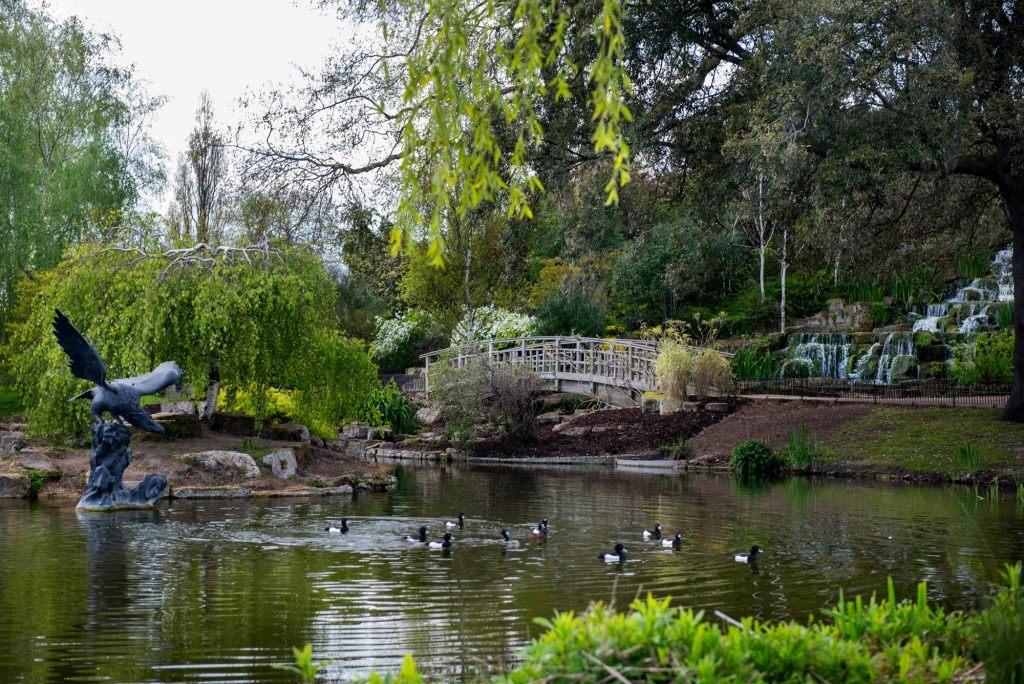



Regents Park, sitting in the boroughs of Camden and Westminster, has a short history compared to that of the majority of London, opening in 1811. The 487 acre park started its life off as King Henry VIII’s hunting grounds, but through the work of John Nash was developed into an area of leisure for those of higher social classes (Britannica). Around the time of its development into a park, there was a massive rise in leisurely activities such as: shopping, going out to restaurants, and going to parks. The park is defined by two rings, an inner and outer ring, lined with mansions that are now mostly used for educational and governmental purposes, Queen Mary’s Garden, an outside theater, a lake, a zoo, and even a conservatory (London Garden Trust).
Established in the early 1930’s, Queen Mary’s Garden is home to some traditional gardens from all across the globe and beautiful waterworks. This includes a Rose, Mediterranean, and Japanese Garden, waterfalls, a lake, and even a fountain. The Rose garden is extremely impressive, boasting a mind-blowing 12,000 roses with 85 different varieties. If you plan on seeing this beautiful display for yourself, it is best to do so during early June (Royal Parks).
Finished in 1828, the London Zoo is found within Regents Park and is still running till this day. Founded by Sir Stamford Raffles, the very founder of Singapore, created the ‘Zoological Society of London’ within Regents park in hopes to establish the world’s first scientific Zoo. When the Zoo first opened, weirdly all of the animals were kept indoors but due to a lack of air flow kept passing away, prompting the creation of the outdoor Zoo. This Zoo attracted many of London’s higher class citizens during the 1800’s due to the variety of foreign animals including Hippopotamus’, Elephants, Camels, Gorillas, and even Giant Pandas (London Garden Trust).
In The Romance of a Shop, Regents Park is a very important location to the story as it holds Lord Watergate’s place of residence,
"I wonder," put in Lucy, "if this poor lady can be the wife of the Lord Watergate?"
"I rather fancy so; I know he lives in Regent's Park, and the address for to-morrow is Sussex Place (Levy, Chapter 5)."
Lord Watergate is one of the wealthiest and most well-connected characters within The Romance of a Shop, displayed by his proximity to this upscale park. Settings are vital to a story and can accomplish so many things, including adding background to a character without explicitly stating it like in this case. Regent’s Park establishes and emphasizes Lord Wateragate’s social status as the park was very exclusive at the time, really only meant for those of higher social classes. However, despite this proper and pristine image created by the story, the park is quickly juxtaposed by its cleanliness. As Lucy and Gertrude are walking through the park, they observe it’s filth, “Regent's Park wore its most unattractive garb; a dead monotony of July verdure assailed the eye; a verdure, moreover, impregnated and coated with the dust and soot of the city (Levy, Chapter 14).”
At the time of this novel, the Industrial Revolution was occurring which heavily polluted populated areas such as London with soot, smoke, and dirt. The park was a symbol of wealth and beauty, but because of the conditions in London it looked anything but beautiful. In fact, when Lucy and Gertrude saw the park it made them feel, “listless and dispirited (Levy, Chapter 14).” This juxtaposition of wealth and cleanliness could be seen as the extreme wealth gap in London. So few people were rich while most of its citizens were barely making it by with the shockingly low wages. This juxtaposition could also represent how the wealth created by the Industrial Revolution was done through exploitation of workers; it was dirty work. The beautiful park being covered in soot and smoke, sends a reminder that the wealth created to use the park was done so through exploitation of workers. This description of Regents Park could also reflect how Lucy and Gertrude felt about Lord Watergate at the time. Their distaste for him could be represented by the filth that is covering the park. While Regents Park is not a large part of The Romance of a Shop, it adds to the story by contextualizing Lord Watergate as well as creating thoughts surrounding the juxtaposing of wealth and filth in London at the time.
----------------------------------------------------------------------------------------------------------------------------------------------------------------------------------------------------------------------------------------------------------------------
Works Cited
Levy, Amy. “The Romance of a Shop.” Cove Studio, studio.covecollective.org/anthologies/engl-2320-spring-2024/documents/the-romance-of-a-shop-81a8a4c9-6776-4e2f-aab3-857fd5f6171c. Accessed 21 Mar. 2024.
“John Nash.” Encyclopædia Britannica, Encyclopædia Britannica, inc., 1 Jan. 2024, www.britannica.com/biography/John-Nash-British-architect. Accessed 19 Feb. 2024.
A Brief History of Regent’s Park, www.londongardenstrust.org/features/regents.htm. Accessed 19 Feb. 2024.
“Queen Mary’s Gardens.” The Royal Parks, www.royalparks.org.uk/visit/parks/regents-park-primrose-hill/queen-mary…. Accessed 19 Feb. 2024.
Westminstertory. “Regent’s Park.” City of Westminster, www.westminsterconservatives.com/regents-park?page=1. Accessed 27 Mar. 2024. (Image)
DHlondonblog. “Everything You Need to Know about Running in Regent’s Park.” London Blog, 4 Oct. 2019, www.danubiushotels.com/en/london-blog/running-in-regents-park. (Image)
“The Regent’s Park.” The Regent’s Park | British History Online, www.british-history.ac.uk/old-new-london/vol5/pp262-286. Accessed 27 Mar. 2024. (Image)