
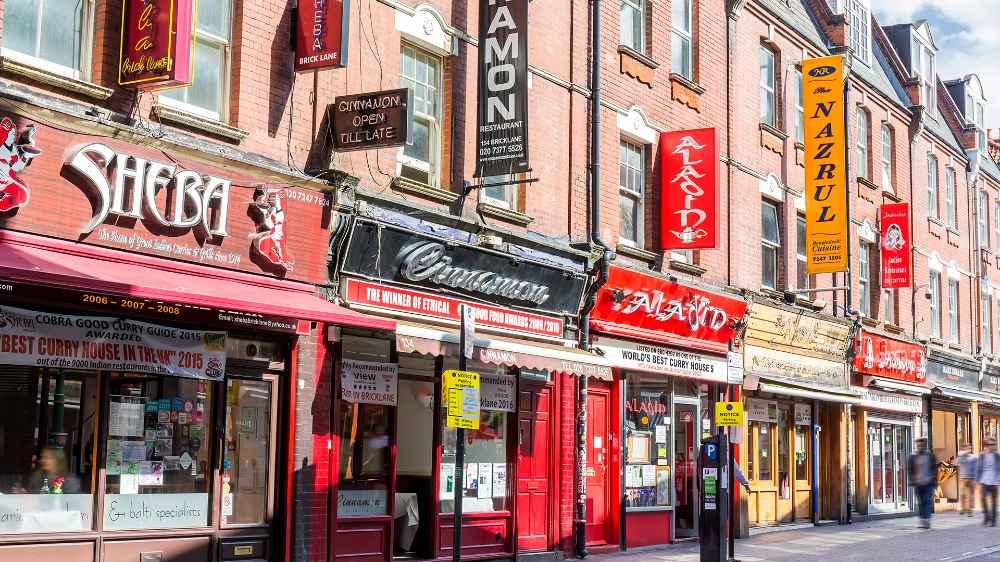
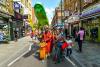
Brick Lane serves as the main focal point to Monica Ali’s novel, making the location the title of her work. She describes the time she’s past visited, when the restaurants “smelled of fresh boiled rice” and “old fried fat” where waiters stood outside the doors with menus and smiles (Ali). Brick Lane is today home to multiple food markets and restaurants, and is the heart of London’s Bangladeshi community. Before it was a tourist destination for all things food and culture, Brick Lane was a place of arrival and settlement for migrants due to the proximity to London’s docks and the City of London. Bengali Immigrants originally came from the Sylhet district of Bangladesh, by way of the East India Company and later imperial trading routes (Beyond Banglatown). The lane at the time was filled with cheap housing and availability of low paying jobs. Brick Lane increasingly became a center for Bengalis during the Second World War and following India’s independence and partition. After 1970, immigration to Britain was mainly driven by political instability in Bangladesh and harsher immigration laws in Britain (Beyond Banglatown). Bengalis found themselves starting new businesses in the Brick Lane area, like famous curry restaurants, bringing in new visitors every year (Tower Hamlets).
Ali describes Brick Lane with vibrant imagery as she has familiarity and connection to the Bengali food and people. In the 1990s there were plans to name areas of Brick Lane “Banglatown” and prompted redesigning of the street. This included conversion of shops into a “restaurant zone” which led to the boom of curry restaurants, growing up to 46 in 2003 (Beyond Banglatown). This development as a cultural hotspot and home for Ali makes her return to the spot a source of comfort in her identity in Brick Lane. In chapter three, however, the current state of Brick Lane denotes a time after the busiest hours, where Nanzeen enters a world out of comfort, describing the trash in the street as “entire kingdoms of rubbish piled high as fortresses” (Ali). Brick Lane during the time she views it seems to be almost disorienting and dirty, opposed to the comforting and vibrant scene it had before. Ali visualizes Brick Lane in this way to demonstrate’s Nanzeen’s internal conflict with herself and her identity in this situation.
After 9/11, Ali shows how Brick Lane’s community is affected due to the Bengal Tiger’s riot in Chapter 21. The Bengal Tigers are meant to unite Muslims in the Tower Hamlets community, but appear to be creating discord. Shown by the restaurant owners standing by, Ali mentioned “nerves flickered across important faces'' (Ali). It is also interesting how in this paragraph Ali compares Brick Lane to an artery, similar to a heart. Brick Lane to her is like a heart connecting her to home and the Bengali community. However, Ali says the “blood” that makes this artery flow and stay alive has been drained. Signifying “All the mixed-blood vitality of the street had been drained. Something coursed down the artery, like a bubble in the bloodstream” (Ali). The reference of mixed-blood vitality is interesting because while Brick Lane is a center for Bengali people, Brick Lane has welcomed people from French, Jewish, and Muslim cultures for generations. This “mixed-blood vitality” that is drained at the time of the riot and disturbance, shows the confusion in Brick Lane and worry of Nanzeen not finding her daughter. Brick Lane today is famed for its colorful street art and markets, housing a variety of different cultures and cuisines. (Yoong) It is still constantly changing due to gentrification and after COVID-19 there has been a decline in curry restaurants due to shifts in infrastructure and turnovers (Beyond Banglatown). While the future of Brick-Lane is uncertain for now, history has testified that the lane is no stranger to change.
Work Cited
Beyond Banglatown. Beyond Bangla Town. (n.d.). https://beyondbanglatown.org.uk/
“Explore Bangladeshi Culture in London’s Brick Lane.” Lonely Planet, 25 Apr. 2023, www.lonelyplanet.com/articles/brick-lane-london-walking-tour.
Fintoni, Laurent. “Day 18: London, Early 2000s.” Medium, 21 days, 21 memories, 11 Dec. 2014, medium.com/21-days-21-memories/day-18-london-early-2000s-a16b01bfea08
Kemp-Habib, Alice. “The Battle for Brick Lane’s Curry Houses Goes to the Heart of British-Bangladeshi Identity.” British GQ, 22 Apr. 2021, www.gq-magazine.co.uk/politics/article/brick-lane-curry-houses-banglade….
The Cultural Trail. The Tower Hamlets. (n.d.). https://www.towerhamlets.gov.uk/lgnl/leisure_and_culture/local_attractions/cultural_trail/cultural_trail.aspx#:~:text=Brick%20Lane%20was%20in%20existence,here%20by%20early%20Flemish%20settlers.
Yoong, S. (2023, December 1). The colourful history of Brick Lane in East London. The Culture Map. https://www.theculturemap.com/brick-lane-east-london-history/