
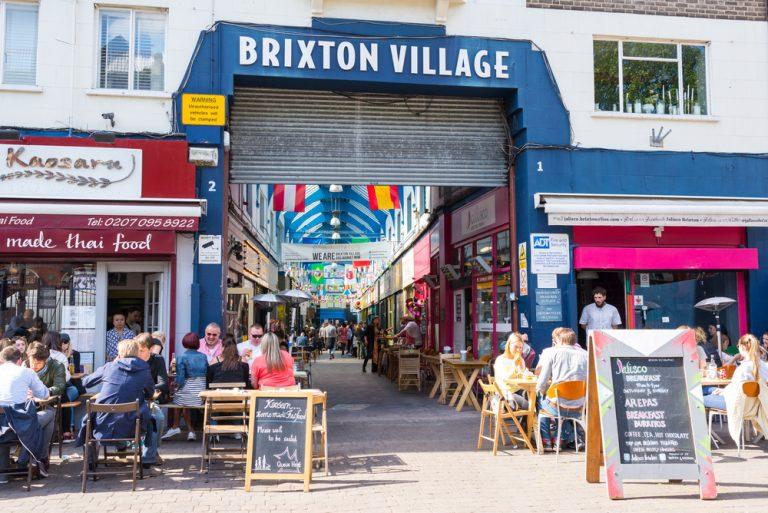

Brixton Market, a South London market and a rapidly growing hub for shopping among the affluent middle class, was created in the 1870s as a result of expanding suburbs (“History of the Brixton Markets”). The market was the first to have a department store and electricity-powered lights (Rufo). Brixton Market now consists of multiple diverse shops and streets that are connected to make an influential shopping experience. The most famous and well-known parts of the market are Electric Avenue, Pope’s Road, Brixton Station Road, Brixton Village, Market Row, and Reliance Arcade (“History of the Brixton Market”). There were many shopping options to choose from, some of which were entertainment areas to stimulate the mind and soul to create a richer shopping experience. Because of the rapid growth of jobs, tourists, and population within the Brixton Market area, the middle class eventually moved away from the area to make room for the working class (“History of the Brixton Markets").
The movement of individuals from the West Indies into South London started in the 1940s and created a diverse selection of products and services (“History of Brixton Market”). Travelers coming into the market brought new products and ideas, which diversified the area with the individual’s cultures and histories. Individuals, whether consumers or other traders, would travel to experience the diverse cultures of the shop owners by consuming specialized goods and services. Eventually, the working class created a majority, if not all, of the population within the Brixton Market. The growth positively impacted the area in the beginning.
During the 1960s, the market met a flatline due to the creation of nearby supermarkets that employed a majority of the travelers from the West Indies (Rufo). Tension arose within the Brixton Market because of the competition created by the supermarkets. The market’s main draw was the diverse selection of shops, but the implementation of supermarkets selling close to the same products caused a decline in shoppers and traders. Unfortunately, this caused the area to become poverty-stricken and eventually gain a reputation to be an overly active criminal location (“History of the Brixton Market”).
Anger from the increasing new developments forming, unemployment, crime, unfair and brutal law enforcement, and low-income housing caused stress to build between law enforcement and protestors (Rufo). James Berry highlights such injustice within class orders of society in South London through “In-a Brixtan Markit." Throughout the poem, the narrator describes a negative experience with law enforcement. The narrator originated from the West Indies and goes to the Brixton Market to shop. Once there, a shopping bag is undeservedly searched through because of the narrator’s origins and the tension and brutality of the police toward the diverse working class.
Fortunately, Brixton Market went through many years of regeneration and transformation to become what it is today. The market officially changed its name to Brixton Village and gave owners their shops for three months rent-free (Rufo). Many see this as a positive that brought light back into the market, but others disagree that too much has happened for the market to revert to its glory days.
Works Cited
Becky. Picture of “Brixton Village and Market Row.” Team Nomad Travel Blog, 2 Dec. 2016, https://teamnomad.co.uk/things-to-do-in-brixton/.
Berry, James. “In-a Brixton Market.” 1995. The Poetry Archive, The Poetry Archive, Inhttps://poetryarchive.org/poem/brixtan-markit/-a Brixtan Markit - Poetry Archive. Accessed 17 Feb. 2024.
Harris, Terry. Picture of “United Kingdom South London Brixton Electric Avenue Market.” Alamy Stock Photo, 21 Sept. 2010, https://www.alamy.com/stock-photo-united-kingdom-south-london-brixton-electric-avenue-market-31597062.html
“History of the Brixton Markets.” South London Club, South London Club, 28 June 2017, www.southlondonclub.co.uk/blog/2017/6/26/history-of-the-brixton-markets.
Mellish, Sam. Picture of “Electric Avenue on the 27th November 2020 in Brixton in the United Kingdom.” Alamy Stock Photo, 27 Nov. 2020, https://www.alamy.com/electric-avenue-on-the-27th-november-2020-in-brixton-in-the-united-kingdom-sam-mellish-image387318972.html
Rufo, Yasmin. “Brixton Village: How the ‘Oxford Street of South London’ Evolved.” BBC News, BBC, 30 Oct. 2023, www.bbc.com/news/uk-england-london-67161026.