
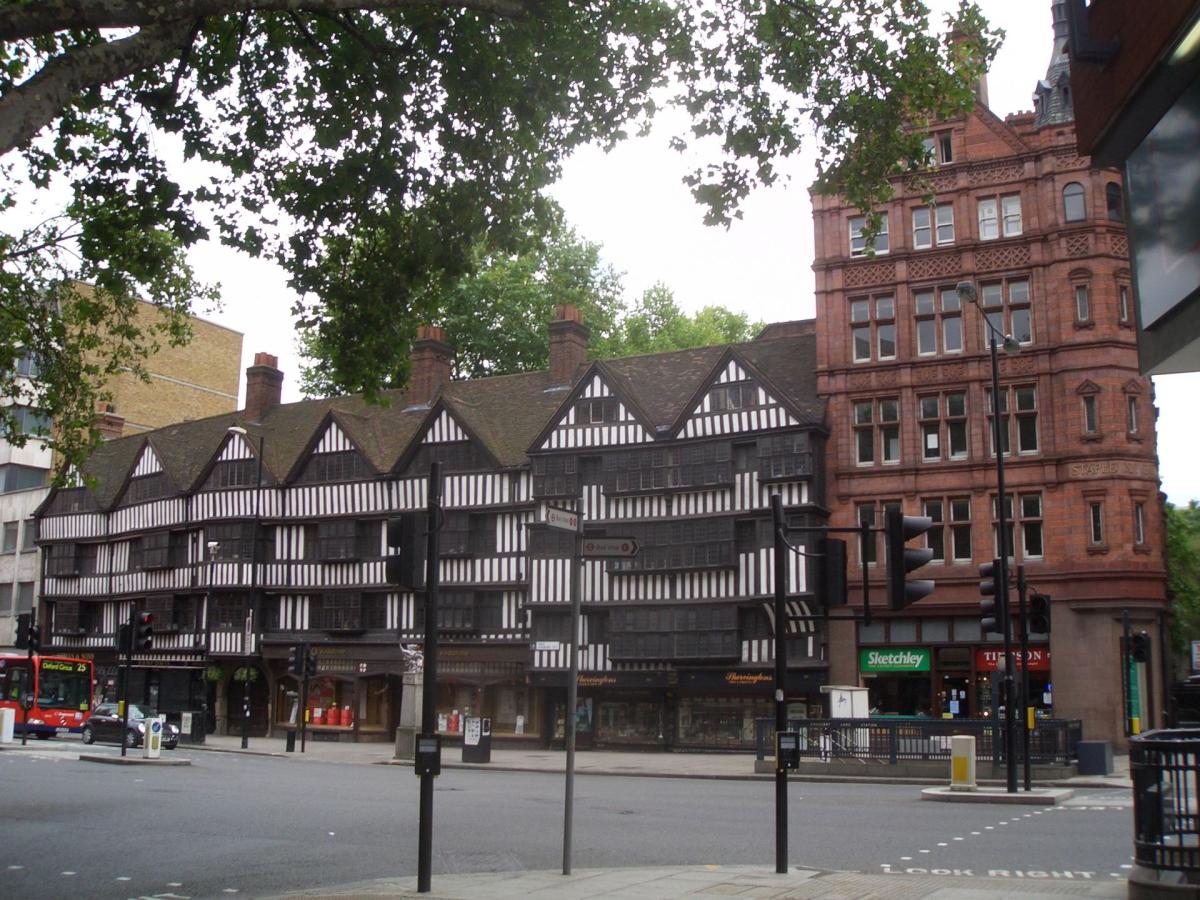
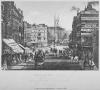
The next stop on our tour is going to be Holborn Hill, which is a street located in Holborn, London. This street has developed into a major tourist attraction over the last several centuries, but its beginning originated in 1417 ( Thornbury). During this time, Henry V decided he wanted to make improvements to Holborn and decided to fund the pavement of a road, which in later years would be known as Holborn Hill (Thornbury). From this point, many improvements continued to be made to the city of Holborn and to Holborn Hill specifically. Many shops, bars, inns, and houses were added to the street, which made Holborn Hill a popular shopping attraction for both upper-class locals and tourists. At the time, the upper class was drawn to this location because the Inn of Courts is located nearby, which put many lawyers and people of status in the proximity of the hill (Thornbury).
Holborn Hill and its upper-class inhabitants are mentioned in Charles Dickens's poem, “Bleak House”, which was published in 1852. In his poem, Dickens ridicules the upper class located on Holborn Hill when he says, “ …it would not be wonderful to meet a Megalosarus, forty feet long or so, waddling like an elephantine lizard up Holborn Hill” (Dickens). In this quote, Dickens is implying that the people who are on Holborn Hill, which are typically people of the upper class, are reptiles. He is specifically insulting the middle upper-class when he specifies that the city goers are “waddling” up the hill. In the 1800s, when wealthy peopled traveled to Holborn Hill, they would typically acquire a cart that they could ride up and down the hill, whereas upper middle-class occupants would have to walk (Thornbury). Dickens was aware of his target audience, and most likely chose to include the “waddle” comment to target the upper middle class.
Holborn Hill has changed since Dickens wrote about it in 1852. Holborn Hill has become a more urban area that houses families, rather than a popular shopping attraction (“Holborn Hill”). Holborn Hill now consists of around 200 houses, 3 pubs, and museums (“Holborn Hill”). The popularity of Holborn Hill has decreased over time due to overcrowding. Holborn Hill was a very narrow street, to begin with, and the addition of houses made the street feel even more claustrophobic (“Victorian London”). While these houses might have driven away shoppers, it does draw in many tourists who are interested in the unique architecture of the houses and pubs (“Victorian London”).
Works Cited
Dickens, Charles. Bleak House. New York, Dodd, Mead, 1951,
“Holborn Hill.” Academic Dictionaries and Encyclopedias, https://en-academic.com/dic.nsf/enwiki/3821696.
“Holborn.” Wikipedia, Wikimedia Foundation, 4 Sept. 2022, https://en.wikipedia.org/wiki/Holborn#/media/File:Staple_Inn,_London,_U….

London Metropolitan Archives - City of London/Heritage Images/SCIENCE PHOTO LIBRARY. “Holborn Hill and Skinner Street, City of London, 1864 - Stock Image - C042/7602.” Science Photo Library, https://www.sciencephoto.com/media/988810/view/holborn-hill-and-skinner….
Mary. “The Heist on Holborn Hill.” London Overlooked, 6 Mar. 2022, https://london-overlooked.com/greenham/.
Thornbury, Walter. “Holborn: To Chancery Lane” Old and New London: Volume 2. London: Cassell, Petter & Galpin, 1878. 526-542. British History Online. Web. 20 September 2022. http://www.british-history.ac.uk/old-new-london/vol2/pp526-542
“Victorian London - Districts - Streets - Holborn.” Dictionary of Victorian London, https://www.victorianlondon.org/districts/holborn.htm.