
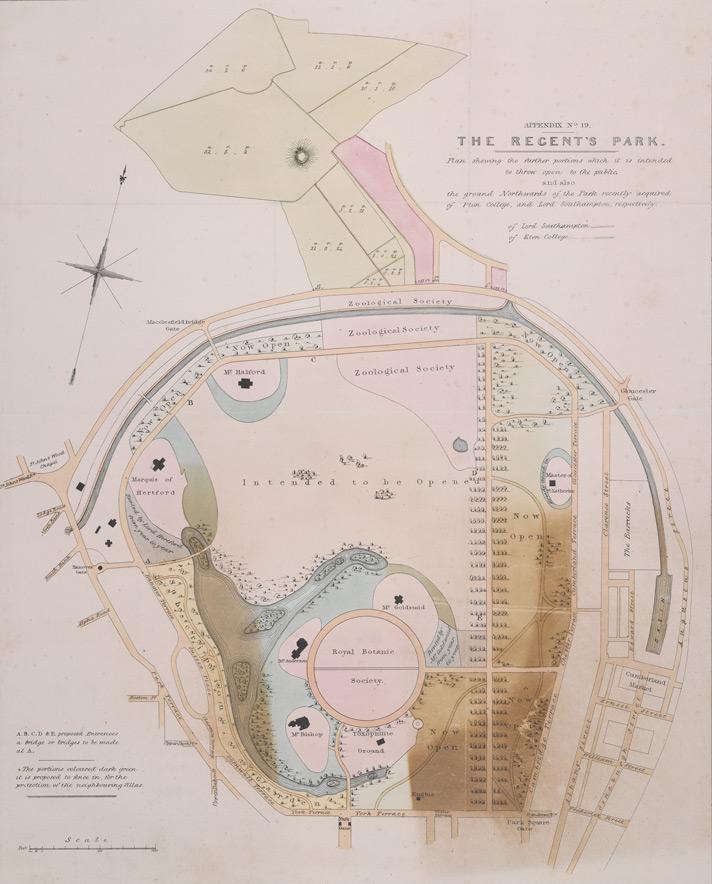

Regent’s Park is one of the Royal Parks of London, landscaped and redeveloped by the architect John Nash in the mid-19th century to be an area of leisure for the Royal Family and other aristocrats. Historically, the park’s 487 acres of land were known as Marylebone Park and belonged to the Crown Estate. The new Regent’s Park, first conceptualized in 1813, would be part of an ambitious urban development plan focused on “open space, free air, and the scenery of Nature'' in order to attract London’s wealthiest and serve as a green space to break up the increasing urbanization of London (Longstaffe-Gowan 88). It is considered one of the first examples of a garden suburb due to the development of palatial buildings as private dwellings within and around the Inner and Outer circles of the park, comprising villas, terraced housing, and mansions (Britannica). Public access was a point of contention surrounding the new park, likely due to the presence of the private dwellings around the park and a desire to preserve the park’s exclusionary factor; however, the previous Marylebone Park’s history as a public open space and the estate having always been viewed as a public amenity led to the expectation of public access to the park. By 1841, the entirety of the park was available to the public.
Regent’s Park is mentioned five times in Amy Levy’s The Romance of a Shop, a novel that examines how the late 19th-century feminist ideal of the “New Woman” informs the opportunities and difficulties experienced by the Lorimer sisters after they open a photography business to support themselves; from its descriptions, the reader gets the sense that it is synonymous with high-class leisure; a staple location within upper-class society. Several characters frequent the park, such as the Lorimer sisters, Mr. Darrell, and Lord Watergate. Watergate even lives in one of the aforementioned houses in the park. In the following quote from Chapter X, “Often, before business hours, Gertrude might be seen walking round Regent's Park at a swinging pace, exorcising her demons...”, it’s clear to the reader that the park exists as a green space within the city that people can escape to. In a contradictory instance from Chapter XIV, Lucy and Gertrude’s attempted leisurely stroll about the park is marred by “a dead monotony of July verdure assailed the eye; a verdure, moreover, impregnated and coated with the dust and soot of the city.” Although the park can not wholly escape or erase the often suffocating and pollutive urban influence of London, it still grants a degree of solace and refuge by the very nature of its existence.
Today, most of the residential dwellings in Regent’s Park are used as government offices and educational buildings. The park proper is mostly open parkland with conventional public park usages, London Zoo and Regent’s university sit on its periphery.
Works Cited
Basire, James. “The Regent’s Park.” British Library Online Collection, 1841, www.bl.uk/onlinegallery/onlineex/crace/t/007000000000014u00033000.html. Accessed 21 September 2022.
Britannica, The Editors of Encyclopaedia. "Regent’s Park". Encyclopedia Britannica, 17 May 2018, https://www.britannica.com/place/Regents-Park. Accessed 21 September 2022.
British 19th Century, British. Invitation? with Aerial View of Regent's Park. 1824. Artstor, library.artstor.org/asset/ANGAIG_10313956911. Accessed 1 October 2022.
Holt, Andrew. "Aerial photography view north-east of Regents Park. Camden. London W1 NW1 UK." Getty Images, www.gettyimages.com/detail/photo/aerial-photography-view-north-east-of-regents-park-royalty-free-image/639773022. Accessed 21 September 2022.
Longstaffe-Gowan, Todd. “Reinstating John Nash’s Picturesque Vision at Regent’s Park, London. ” Garden History, vol. 43, 2015, pp. 87–96. JSTOR, https://www.jstor.org/stable/26589595. Accessed 21 Sep. 2022.
Summerson, John. “The Beginnings of Regents Park.” Architectural History, vol. 20, 1977, pp. 56–99. JSTOR, https://doi.org/10.2307/1568351. Accessed 21 Sep. 2022.