
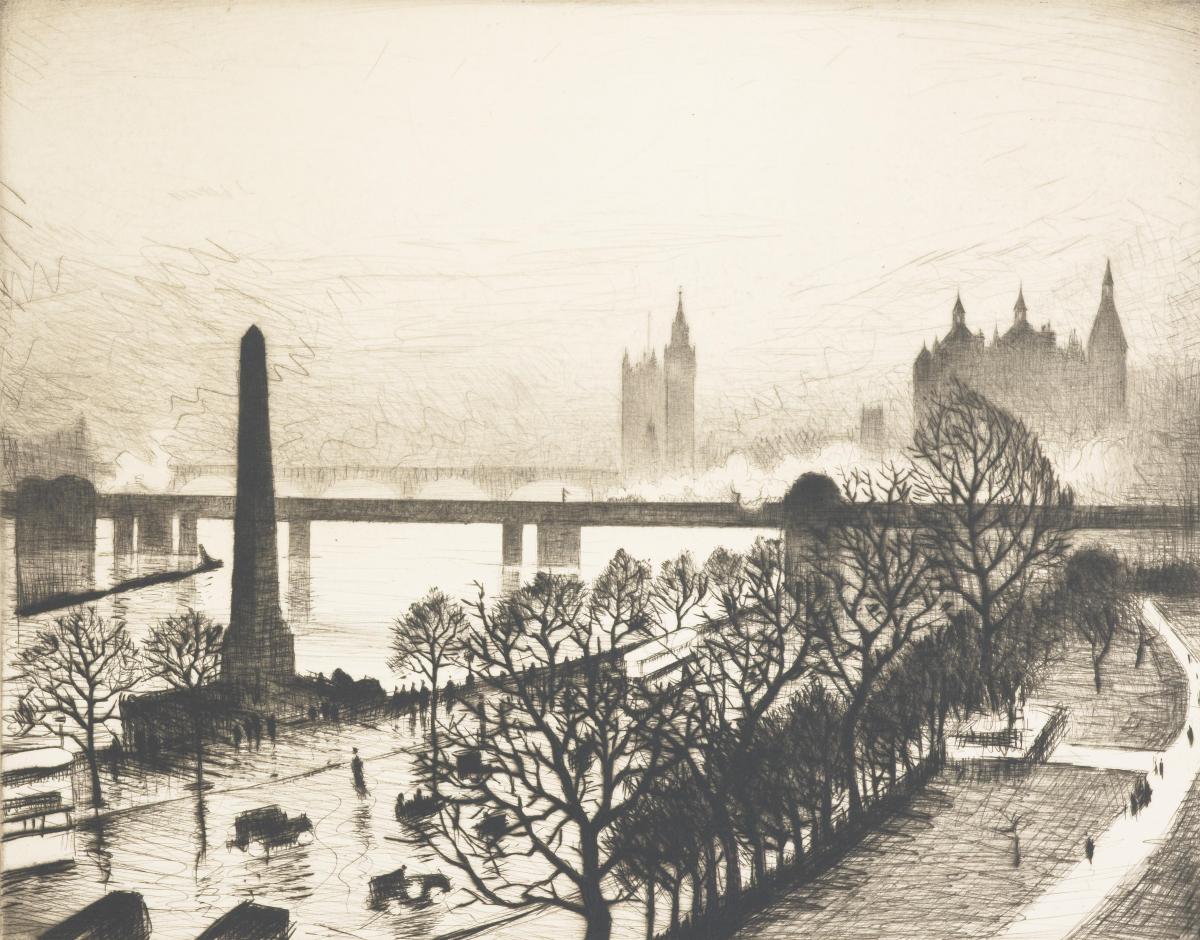
Westminster is particularly known for its status as a political hub in London; it is home both to Buckingham palace and the Houses of Parliament. Historically and presently, it has been a major tourist attraction and symbol of English nationalism. Buckingham Palace is, famously, the residence of English royalty and is one of Westminster’s most popular cultural landmarks (“Buckingham Palace”). The Houses of Parliament are the House of Commons and the House of Lords, which are the supreme legislative bodies in the United Kingdom (“Houses of Parliament”). As such, the political beliefs of Mrs. Dalloway in Virginia Woolf’s “Mrs. Dalloway in Bond Street” become evident as she walks down the streets of Westminster.
Towards the beginning of the text, the famous political landmarks prompt fond and sentimental thoughts of the monarchy from the main character as she walks through Westminster. When Mrs. Dalloway sees Buckingham Palace on her walk, she is reminded of the monarchy’s “character” and the Queen’s respectability (Woolf). She also thinks of how her husband Dick met the Queen (Woolf). Knowing this fact of Dalloway’s proximity to English royalty informs readers about the perspective from which she sees the world, specifically Westminster. While some people may resent the Crown for various reasons, Mrs. Dalloway has nothing but fond feelings. Just passing by the building evokes almost romantic language describing the monarchy. Woolf’s choice to make Westminster the setting for this piece serves as an intentional display of aristocratic views of English politics at the time.
Parliament is only mentioned once in the text, when Mrs. Dalloway internally questions, “How then could women sit in Parliament?” when discussing with Hugh the health of his wife, Milly (Woolf). Though the Houses of Parliament aren’t mentioned directly in the text, they are relevant because the political events in the text (World War 1 and colonialism in India) were largely influenced by Parliament, which creates legislation. At the time of the text’s publishing, the United Kingdom was dealing with the aftermath of World War 1 and the Irish War of Independence (Johnson). The wars required economic recovery; as a wealthy woman, the effect that this had on Dalloway would be drastically different than those of average income. The context of these wars provide an economic lens through which readers can see Dalloway’s unabashed wealth in her own thoughts. When Mrs. Dalloway thinks “it was character she thought; something inborn in the race; what Indians respected,” she is referencing the English colonial rule in India, which lasted from 1858 to 1947 (Woolf; Wolpert). While Dalloway assumes that Indians, in general, have respect for the Crown, when in reality many Indian people craved independence at this time (Wolpert). Dalloway’s opinion of English colonialism in India is further indicative of her status as a wealthy English woman who is in relatively close contact with the monarchy and aristocracy.
By using Westminster as a setting, Woolf makes her piece, in part, inherently political. Westminster’s political landmarks act as physical reminders of Mrs. Dalloway’s opinions, enriching the audience with her background as a character and providing context for her behavior throughout the text.
Works Cited
Britannica, The Editors of Encyclopaedia. "Buckingham Palace". Encyclopedia Britannica, 10 Jan. 2020, https://www.britannica.com/topic/Buckingham-Palace. Accessed 1 October 2022.
---. "City of Westminster". Encyclopedia Britannica, 15 Feb. 2018, https://www.britannica.com/place/City-of-Westminster. Accessed 1 October 2022.
---. "Houses of Parliament". Encyclopedia Britannica, 17 Mar. 2017, https://www.britannica.com/topic/Houses-of-Parliament-buildings-London-…. Accessed 1 October 2022.
Christopher Nevinson. Westminster from a Savoy Window. drypoint, 1925 -1926. <a href="https://www.tepapa.govt.nz">Museum of New Zealand - Te Papa Tongarewa</a>; Collection: Art; Gift of Sir John Ilott, 1957, JSTOR, https://jstor.org/stable/community.27018842. Accessed 17 Sep. 2022.
Harry Moult. The Entrance to the Cloisters, Westminster Abbey. From the Album: Photograph Album - London. black and white photograph, carbon print, 1920s. <a href="https://www.tepapa.govt.nz">Museum of New Zealand - Te Papa Tongarewa</a>; Collection: Photography, JSTOR, https://jstor.org/stable/community.27135573. Accessed 17 Sep. 2022.
Johnson, Ben. “Kings and Queens of England & Britain.” Historic UK, https://www.historic-uk.com/HistoryUK/KingsQueensofBritain/.
Panorama of London, Looking W over Lambeth and Westminster From. 29/10/1980. Cambridge University Collection of Aerial Photography, JSTOR, https://jstor.org/stable/community.29583608. Accessed 17 Sep. 2022.
Woolf, Virginia. “Mrs. Dalloway in Bond Street.” The Dial, vol. 75, 1923.
Wolpert, Stanley A.. "British raj." Encyclopedia Britannica, 8 Sep. 2020, https://www.britannica.com/event/British-raj. Accessed 1 October 2022.