
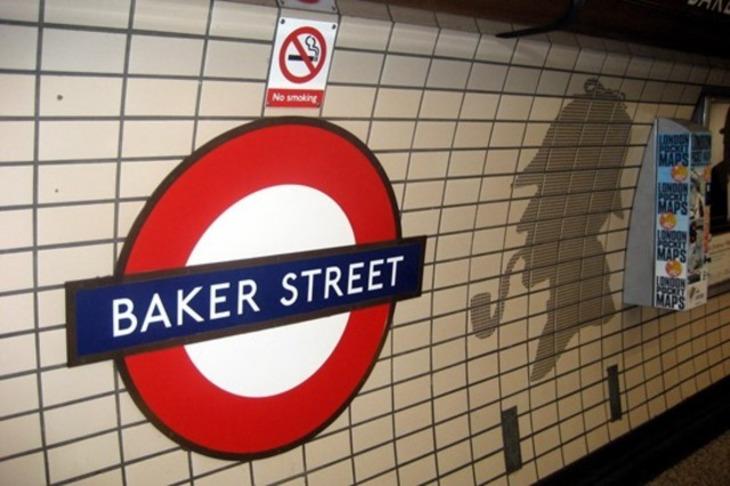
Originally, Baker Street in the City of Westminster in London was a high class residential zone, but in modern days, Baker Street has become a commercial area. This change is most notably contributed to the fact that Baker Street is considered a thoroughfare because of its importance as a primary path of travel for people coming and going. This high level of foot traffic made Baker Street the perfect location for a revolutionary new idea. In 1863, Baker Street was the birthplace of the ‘Met,’ a new form of transportation which allowed passengers to cut through London underground in the Metro system. Baker Street literarily is also known for housing Sherlock Holmes who lived in the fictional 221B Baker Street address (London Office Space, London Transport Museum).
In Romance of a Shop Baker Street becomes the residence for the sisters after their father’s death and new designated social status. While Baker Street was a high class residential zone, it represented a sort of downgrade for the sisters as they had lived in Campden Hill. This downgrade can be seen through descriptions of the two locales. Whereas Campden Hill is a proper estate that was "enclosed by a walled-in garden of several acres of extent," the locale of Baker Street cannot offer such a large property (Levy, Ch. I). This is even exemplified when the sisters look for a new residence and find their future residence "unfurnished, above a chemist's shop" (Levy, Ch. IV). The thoroughfare nature of Baker Street was seen throughout the novel as the sisters slowly become acquainted with the city people around them and leaning into a different class of people. Whereas before these sisters were not under any aspirations for working besides Gertrude’s writings, the sisters now find themselves high class yet needing to work. The setting of Baker Street is significant of that transition from leisure to labor. When Mrs. Devonshire in the novel states that, ‘“there are a great many photographers in Baker Street already,’” this is a nod at the commercial ventures that are pursued by the people of Baker Street and the already thick competition that the sisters must get through in their new surroundings to make it after their father’s death (Levy, Ch. IV).
Baker Street can be used as a locale for juxtaposition for their old residence in Campden Hill as well. While the sisters did live a life of higher social and economic status, they also lived a life of distance on Campden Hill. While they had a familiar friend, the Devonshires, they were far removed from the rest of the world and were not ingrained in the bustle of life as they are in Baker Street. Baker Street is a place where the street is often mentioned to lead to “Baker Street Station” directly creating a line of connection for them to many other locations (Levy, Ch. VII). Merely having a neighbor that ran a pharmacy shop next to them created a closer connection to bustle than the sisters had in Campden Hill.
Works Cited
Bishopsgate Institute. "Baker Street Station (c1890)." n.d. February 2024. <https://www.flickr.com/photos/bishopsgate/4840348379/>.
Brown, Elliott. "The Sherlock Holmes Museum - 221b Baker Street, London." 25 November 2011. <https://flickr.com/photos/ell-r-brown/6448195601>.
Gobetz, Wally. "London - UK - Marylebone: Baker Street tube station." 11 November 2006. <https://www.flickr.com/photos/wallyg/298693314/>.
Levy, Amy. The Romance of a Shop. Boston: The Algonquin Press, 1889. Cove Studio . <https://studio.covecollective.org/anthologies/engl-2320-spring-2024/doc…;.
London Office Space. Guide to Baker Street: History, Architecture, Business and Tourism. 22 October 2012. February 2024. <https://www.londonofficespace.com/buzz/baker-street-guide/>.
London Transport Museum. Baker Street: The World's First Underground. n.d. Webpage. February 2024. <https://www.ltmuseum.co.uk/whats-on/hidden-london/baker-street>.