
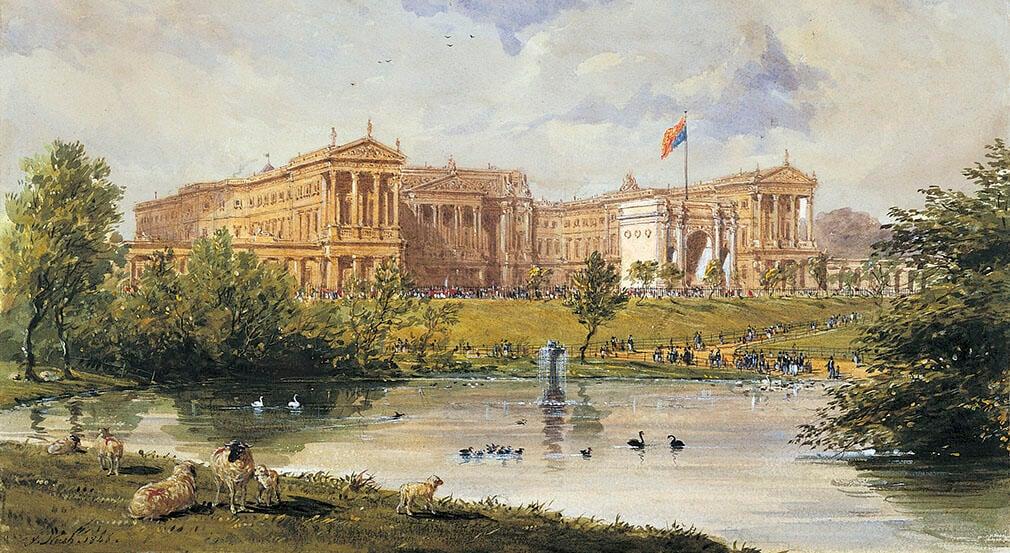
In modern times, Buckingham Palace serves as the primary residence for the royal family of the United Kingdom. As Chanu, Nanzeen’s husband in Brick Lane, notes in Chapter 14, this has been the case since 1837 as the reign of Queen Victoria began (Royal Museums Greenwich). However, it has been in the possession of the family since 1761 when King George III purchased it “...for his wife Queen Charlotte to use it as a comfortable family home…” (Royal.Uk). Since then, the building has undergone multiple renovations and expansions, perhaps most notably during the Regency period by architect John Nash (Encyclopedia Brittanica). According to the Royal website, the palace currently boasts 775 total rooms with “19 State rooms, 52 Royal and guest bedrooms, 188 staff bedrooms, 92 offices and 78 bathrooms.” The largest room is a ballroom, which Chanu’s guidebook says to be “one hundred and twenty- two feet long, sixty feet wide, and forty-five feet high,” and, at its construction, the biggest room in London (Brick Lane).
In addition to functioning as a residence and center of government, Buckingham Palace is a popular tourist destination, attracting over 19 million visitors from 2022–2023 (Statista). When Nanzeen and her family take their day-trip holiday to the palace, she finds the wide red front avenue to be “fit for a queen” but is only impressed by the building itself in terms of its size and the gold-tipped fence railings (Brick Lane). While not rife with the minarets and domes Nanzeen would have preferred, the palace is undeniably monumental. One of the facade’s most striking features is its world-famous balcony. On special occasions, such as weddings or military fly-bys, the family will use it to make appearances, often in elaborate ceremonial wear (Royal.Uk). The first Royal to do so was Queen Victoria during the opening of the Great Exhibition in 1851, “a triumphant celebration of the most extraordinary achievements of the Victorian age, from industry, culture, and engineering – gathered from all four corners of the world”(Royal Parks). Through the years, the tradition has become more prominent, and the balcony itself is more of a spectacle.
After departing the Palace area, Nanzeen, Chanu, and their daughters Shahana and Bibi head down the street to St. James’s Park for a picnic (Brick Lane). The park is bordered by both Buckingham Palace and St. James’s Palace along with the Houses of Parliament. Named for a women’s leprosy hospital that once stood on the site, the park began as a hunting ground under Henry VIII. Under James I, the park was refined and a menagerie (which had many exotic animals) was added. Charles II redesigned the park in the French style during his reign, inspired by his time in exile (Royal Parks). The last major update occurred in the Regency period, as the future King George IV and previously mentioned architect John Nash added “...a touch of romance and naturalness to the formality of St. James’s” (Royal Parks). Nash’s redesign included the lake where Shahana and Bibi go for a walk, which was once a simple canal. Today, a diverse variance of tourists and locals alike use the park for the same purposes described in Brick Lane: relaxation, exercise, and simply enjoying a peaceful bit of greenspace within the chaos of London.
Works Cited:
Ali, Monica. Brick Lane. HarperCollinsPublishers, 2004.
Blokhin, Kristina. “London Eye Cityscape View Building with St James Park Green Lake Pond on Summer Day and Water Fountain in UK Stock Photo.” Alamy, www.alamy.com/london-eye-cityscape-view-building-with-st-james-park-gre…. Accessed 28 Mar. 2024.
“Buckingham Palace.” Encyclopædia Britannica, Encyclopædia Britannica, inc., 26 Feb. 2024, www.britannica.com/topic/Buckingham-Palace.
"Buckingham Palace from Above." https://www.thesun.co.uk/news/9479437/buckingham-palace-intruder-queen/.
Nash, Joseph. Buckingham Palace, 1846. https://www.flickr.com/photos/britishmonarchy/9605267239.
“The Life of Queen Victoria and Her Family.” Royal Museums Greenwich, www.rmg.co.uk/stories/topics/life-queen-victoria-her-family#:~:text=Que…. Accessed 1 Mar. 2024.
“Royal Tourism: Admissions to Royal Estate UK 2023.” Statista, 7 Sept. 2023, www.statista.com/statistics/373102/uk-royal-tourism-admission-numbers/.