
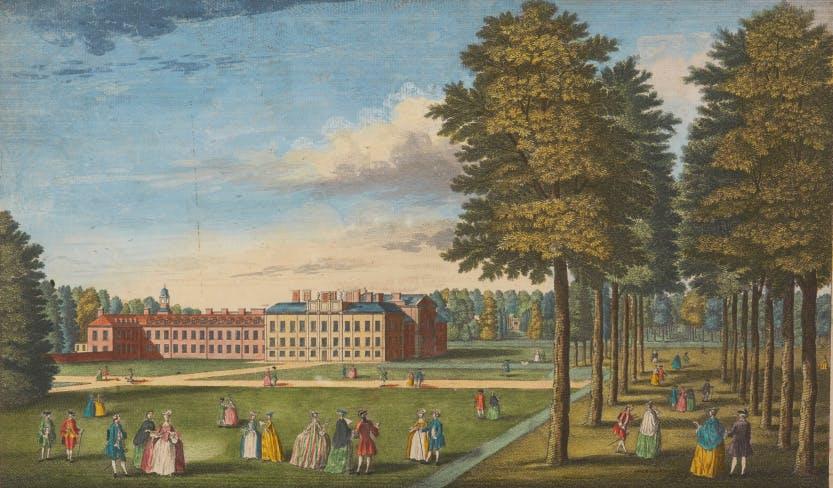
Historic England's "Kensington Gardens" entry lists that Hyde Park was opened in the 16th century and served as a private hunting park for Henry VII. When Kensington Palace was built in the 18th century, the western part of Hyde Park was sectioned off to create private gardens for the palace, and Kensington Gardens were created ("Kensington Gardens"). The gardens became public in the 19th century("Kensington Gardens"). According to Historic Royal Palaces' article "The Story of Kensington Palace," Queen Victoria spent her childhood in Kensington Palace and was close to the Gardens during that time. The number of statues and monuments in the park surged during the Victorian period (1837-1901) ("Story of Kensington Gardens"). The park was also strongly associated with children during this time, leading to the installation of a statue of Peter Pan in 1912 and a playground in 1909 ("Kensington Gardens").
Kensington Gardens appears in Virginia Woolf's "Mrs. Dalloway in Bond Street." "Mrs. Dalloway in Bond Street" is a short story that was published in 1923 in The Dial, a literary magazine ("Before It Was Mrs. Dalloway"). The story follows the character Clarissa Dalloway as she walks around Bond Street and adjacent areas using a stream-of-consciousness narration. Woolf uses the story to examine a changing British culture and society in the aftermath of World War I. Kensington Gardens is only mentioned once in the story, and in a reference to the past: "She had passed through the Admiralty Arch and saw at the end of the empty road with its thin trees Victoria's white mound, Victoria's billowing motherliness, amplitude, and homeliness, always ridiculous, yet how sublime, thought Mrs. Dalloway, remembering Kensington Gardens and the old lady in horn spectacles and being told by Nanny to stop dead still and bow to the Queen" (Woolf).
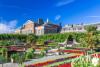
Woolf depicts Kensington Gardens as a memory from the character's childhood and associates the gardens with royalty. These themes align with the then-recent history of Kensington Garden. Just thinking of Queen Victoria brought the association with Kensington Gardens to Mrs. Dalloway's thoughts, so clearly, it represents the monarchy's power in the Victorian Era. This association is further cemented by examining the monuments in Kensington, which are products of systems of the past, like the monarchy and aristocracy, that are shown to be fading in power and relevance in "Mrs. Dalloway in Bond Street." Kensington Gardens can still be seen as a symbol of the past today; In 2012, a restoration project created new gardens inspired by the designs of the 18th century ("Story of Kensington Palace").
Woolf's use of Kensington Gardens in her short story draws from the history and culture of the location to make it a symbol of a past era. And still, nearly 100 years later, the location aligns with Woolf's representation of it.
Works Cited
Campbell, Sophie. "Everything You Need to Know About Visiting Kensington Palace." The Telegraph, 22 September 2017, https://www.telegraph.co.uk/travel/destinations/europe/united-kingdom/articles/kensington-palace-london-visitor-guide-tickets-prices/
"Kensington Gardens." Historic England, 01 October 1987, https://historicengland.org.uk/listing/the-list/list-entry/1000340?section=official-list-entry
Mann, Meredith. "Before It Was Mrs. Dalloway... Novels That Came From Short Stories." New York Public Library, 12 May 2016, https://www.nypl.org/blog/2016/05/12/before-mrs-dalloway
"The Story of Kensington Palace." Historic Royal Palaces, https://www.hrp.org.uk/kensington-palace/history-and-stories/the-story-of-kensington-palace/
Walker, Dave. "Kensington Gardens – A Secret Life of Postcards Special." RBKC The Library Time Machine, 06 February 2014, https://rbkclocalstudies.wordpress.com/2014/02/06/kensington-gardens-a-secret-life-of-postcards-special/.