
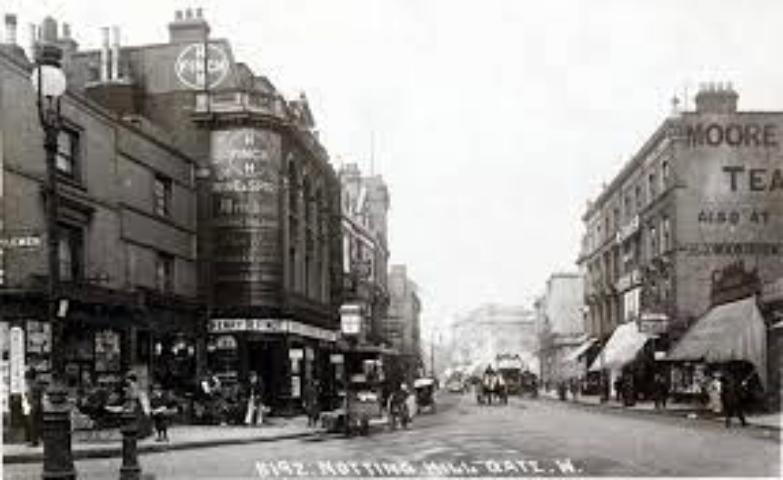


Notting Hill is a charming West London neighborhood just a short walk northwest of Kensington Palace. Hyde Park and Regent Park are two picturesque locations also worth visiting during your stay, which are near Notting Hill and can be reached by subway or even on foot from Notting Hill if you enjoy long, scenic walks. The hill that Notting Hill is named after sits under Ladbroke Grove near Kensington Gardens - another iconic and highly recommended tourist destination (“The History of Notting Hill”). West London as a whole hosts a large offering of museums and shopping with Kensington Palace at its heart.
The history of Notting Hill goes back as far as Viking times, when it was established as Knottynghull. In the 1700s, the town was used for brickmaking and pig farming, as the soil was rich with brick-perfect clay (“The History of Notting Hill”). In the 18th century, as a pig farming district, the ratio of pigs to people was three to one. Stylish!
In the early 1800s, James Ladbroke (a familiar name, as Ladbroke Grove rests atop the actual hill of Notting Hill) set about to develop Notting Hill into the fashionable suburban neighborhood it is today (“The History of Notting Hill”). During this time period, the novel The Romance of a Shop takes place. Amy Levy references Notting Hill, “As for the bride, she was subdued and tearful, as an orthodox bride should be; and invited all her sisters in turn to come and stay with her at Notting Hill directly the honeymoon in Switzerland should be over” (Levy Ch. 26), and “Fanny had returned from Switzerland a day or two before, and was now in the full tide of bridal complacency. As mistress of a snug and hideous little house at Notting Hill, and wedded wife of a large and affectionate man, she was beginning to feel that she had a place in the world at last” (Levy Ch. 27). Notting Hill in the 1800’s was a place for more wealthy citizens to live in fashion and luxury, and it is a significant destination in The Romance of a Shop because it indicates Fanny’s shift from 1800’s middle-class hardships, to wealth and affluence in a fashionable area with an upper-class husband.
Unfortunately, much of Notting Hill was damaged or destroyed during the Blitz, and the neighborhood transitioned into an area notorious as a slum when many of the townhomes were repurposed as HMOs (Homes of Multiple Occupancy) (“The History of Notting Hill”). Later in the 20th century, Afro-Caribbean immigration into the area became more prominent, but race riots ravaged the district following the increase in immigration and the rise of 20th century racism. The race riots prompted the Notting Hill Carnival as a celebration of Afro-Caribbean culture and quickly rose to world-wide fame as the largest carnival in Europe (“The History of Notting Hill”). In the late 20th century, the area began to return to its fashionable reputation and became a popular destination for celebrities, models, and influencers.
The Notting Hill Carnival is one of the most important cultural factors of the area, celebrating the Afro-Caribbean presence and culture of the area following the race riots of the early 20th century. It’s held on August 27th and 28th and yearly attracts thousands of visitors. The celebrity presence in Notting Hill is also very well known—celebrities who have lived in the neighborhood include Kiera Knightley, Harry Styles, Lindsay Lohan, Jennifer Lawrence, and Hugh Grant (“Celebrities that Have Lived or Live in Notting Hill”). The name Notting Hill may be known to many hopeless romantics from the rom-com film that takes the town’s name, starring Hugh Grant and Julia Roberts. Notting Hill is well known for its pastel-colored houses and is a popular Instagram photo site for visitors—so for those of you who are social-media savvy, now is your opportunity!
The History of Notting Hill. My Notting Hill. (2017, May 27). https://www.mynottinghill.co.uk/the-history-of-notting-hill/
Celebrities that have lived or live in Notting Hill. Homesite. (2021, July 30). https://homesite.co.uk/celebrities-that-have-lived-or-live-in-notting-h…;
Levy, Amy. Romance of a Shop. Boston, Cupples and Hurd/ The Algonquin Press, 1889.