
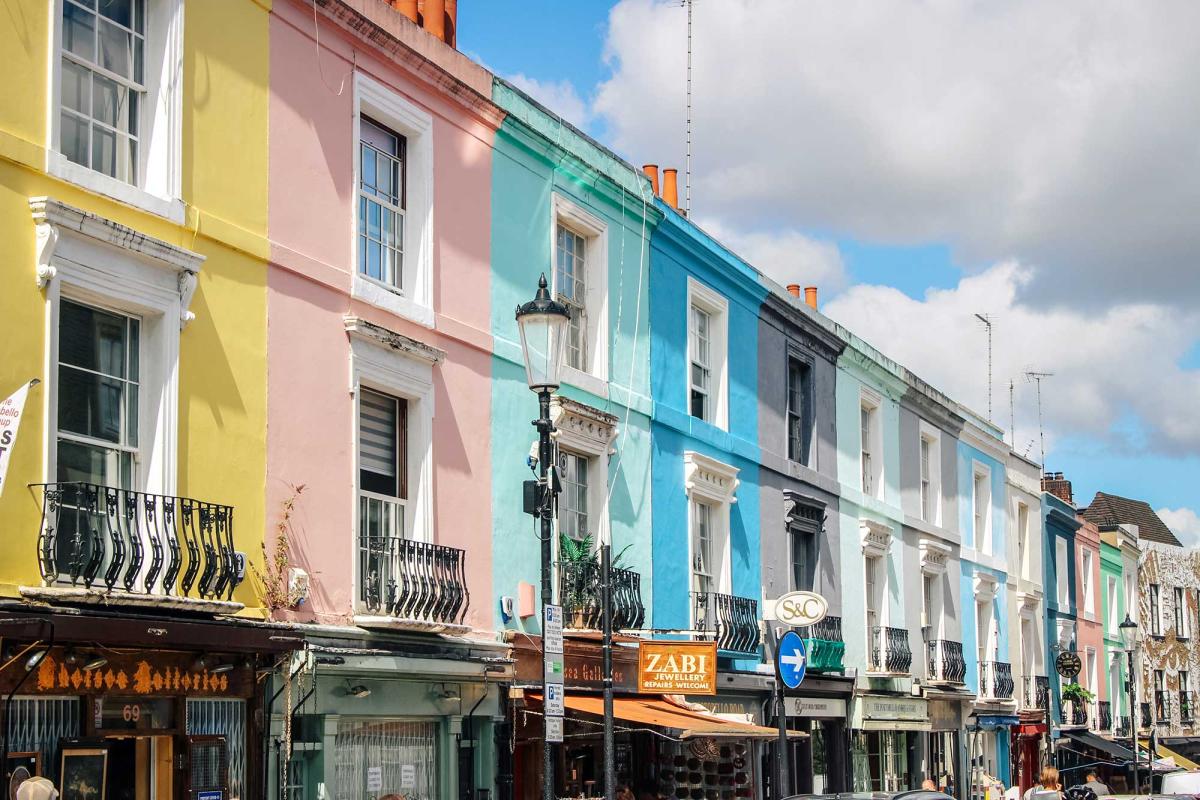



Notting Hill began as a carefully planned suburb, with the first wealthy homeowner, James Well Ladbrooke, breaking ground in the early 19th century. For a while, it was known as a very wealthy location for upper-middle class families to reside. However, due to the blitzes that had occurred during the first world war, a number of the houses were destroyed and then rebuilt as more communal homes. This ended up lowering the costs for the neighborhood, and its reputation quickly flipped to being one of the worst places to live in England. The change in Notting Hill resulted in decreasing the rental costs for houses all over the country. In the late 20th century, Notting Hill regained popularity, and upper-middle class residents once again flocked to the houses. Today it has reclaimed its title as one of the most expensive places to live in London (The History of Notting Hill).
Modern day Notting Hill is often known as the most “picturesque place in London”. Today, it is most known for the small, brightly colored, aesthetically pleasing houses that are dotted along the streets. It has also been featured in several movies, with the most notable one being the romantic comedy “Notting Hill” starring Julia Roberts and Hugh Grant. Along with the romantic neighborhood, there are several pleasant markets to frequent, including the Portobello market, which contains a large number of independently owned cafe’s, shops, and bakeries (Notting Hill Area Guide).
Notting Hill makes an appearance multiple times in “Romance of a Shop”. This is mostly because it is the location where Franny and her husband, Edward Marsh, settle down after they get married. The event is detailed in the quote, ‘As for [Franny], she was subdued and tearful, as an orthodox bride should be; and invited all her sisters in turn to come and stay with her at Notting Hill directly the honeymoon in Switzerland should be over. Edward Marsh suffered the usual insignificance of bridegrooms; but did all that was demanded of him with exactness” (Levy, Chapter XVI).
Her experience is further expounded upon in the next chapter, “Fanny had returned from Switzerland a day or two before, and was now in the full tide of bridal complacency. As mistress of a snug and hideous little house at Notting Hill, and wedded wife of a large and affectionate man, she was beginning to feel that she had a place in the world at last” (Levy, Chapter XVII).
Finally, Franny’s story arc comes to a conclusion in the epilogue, in which Franny is described as “continuing to flourish at Notting Hill, the absence of children being the one drop in her cup and that of her husband. "But, perhaps," as Lucy privately remarks, ‘ it is as well; for I don't think the Marshes would have understood how to bring up a child’” (Levy, Epilogue).
Works Cited
“End of London Toll-Gates ” ebay, 1864, images.app.goo.gl/WpaFzMfhGoUUgd3Y7.
Levy, Amy. Romance of a Shop. Boston, Cupples and Hurd/ The Algonquin Press, 1889.
"Notting Hill." 2023, CKtravels.com, images.app.goo.gl/1mbaxdgm9cmb6TPR6
“Notting Hill Area Guide.” Visit London, London and Partners, Supported by Mayor of London,
2024, https://www.visitlondon.com/things-to-do/london-areas/notting-hill
Perugini, William. "Strolling down Portobello Rd." 2019, The insider's guide to London's
Notting Hill, Lonely Planet, images.app.goo.gl/QA56rmgDq4A8dWos5.
“The History of Notting Hill.” My Notting Hill, Powered by WordPress, 2024,
https://www.mynottinghill.co.uk/the-history-of-notting-hill/#:~:text=In%20the%20early
%2019t %20century,areas%20 or%20%E2%80%9c Pleasure%20 grounds%E2%80%9D.