

Historically speaking, the East End of London has been home to impoverished individuals and armed conflicts for decades. Out of this East End, this stop includes both Cable Street and St. George Estate, as they are inextricably linked together.
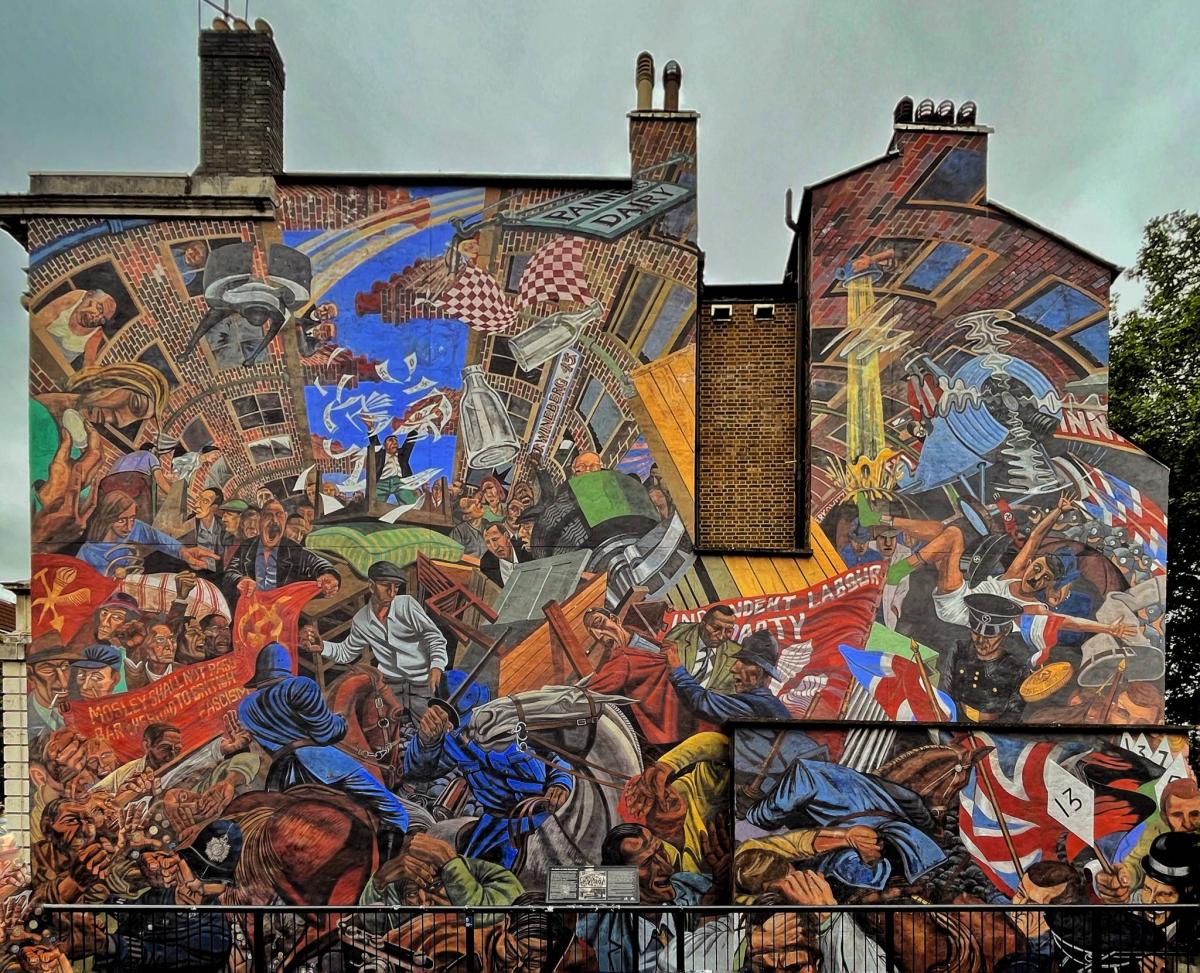
In the 1930s, Sir Oswald Mosley’s (former Member of Parliament of the United Kingdom) British Union of Fascists attempted to divide Christians and Jews in the East End. He organized a march of 3,000 of his followers in October 1936, which was luckily blocked by protesters’ barricades at the junction of Cable Street and Leman Street. The main barricade was in St. George in the East area of Wapping (St George-In-The-East 2).
There is an arguably intentional parallel between this so-called “Battle of Cable Street” and Nanzeen trying to get through policemen and their blockades when attempting to find her daughter in chapter 21. There were various impactful racial/xenophobic/national/religious ties to both “battles” but one is far more modern than the other. They may be decades apart, but the hurtful (not to mention limiting) undertones unfortunately remain the same. It’s “othering” behavior. The main difference is who’s doing the blockading. The power dynamics switched from the protestors to the police. The police’s efforts in 1936 were futile, as protestors threw trash, rotten vegetables, contents of chamber pots, and fought them by hand (Chesherj 2). Unlike these protestors, Nanzeen did not try to fight back in 2001. She admittedly did get up in his face, but certainly did not go as far as physically engaging with him. This characterizes not only her but the change in times and consequently behavior.
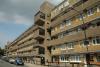
After a couple decades went by, the architectural writer Ian Nairn said in 1966, “‘of all the things done to London in this century, the soft-spoken this-is-good-for-you castration of the East End is the saddest ... Embedded in [Cable St] are the hopeless fragments of two once splendid squares…Those who could care about the buildings don’t care about the people, those who care about the people regard the decrepit buildings rather as John Knox regarded women: unforgivable blindness’” (St George’s Estate 1). Clearly, this mindset has also remained, or at least it still prominently shone through in chapter 21. The speaker mentioned the poorly kept state of affairs on the East End, such as the George Estate being described as if it and its inhabitants had been taken captive. A pub near Cable Street was boarded up, weeds were everywhere, and a bathtub was filled with traffic cones. With those descriptions alone it was clearly still run down and without funding in 2001. Regardless of this, it was still a place she could see herself in. Nazneen recognized the “traumatized stillness” in the face of a refugee child while traveling through the area. She likely shared traumas or at the very least a similar upbringing. The place was filled with families trying to make ends meet, which was like her own financial situation.
Curiously, roughly since August 2015 Cable Street has become known for its Jack the Ripper Museum. The East End is still a run-down place stricken with people just trying to make ends meet.
Works Cited
Chesherj. “The Epic Battle of Cable Street Mural.” Living London History, 7 June 2023, livinglondonhistory.com/the-epic-battle-of-cable-street-mural/.
“St George’s Estate.” Www.stgitehistory.org.uk, www.stgitehistory.org.uk/media/stgeorgesestate.html.
“St George-In-The-East.” Hidden London, hidden-london.com/gazetteer/st-george-in-the-east/.
https://streetartcities.com/cities/london/markers/a079ce45-81bd-4b4b-a1…
https://www.timesofisrael.com/the-true-history-behind-londons-much-laud…