
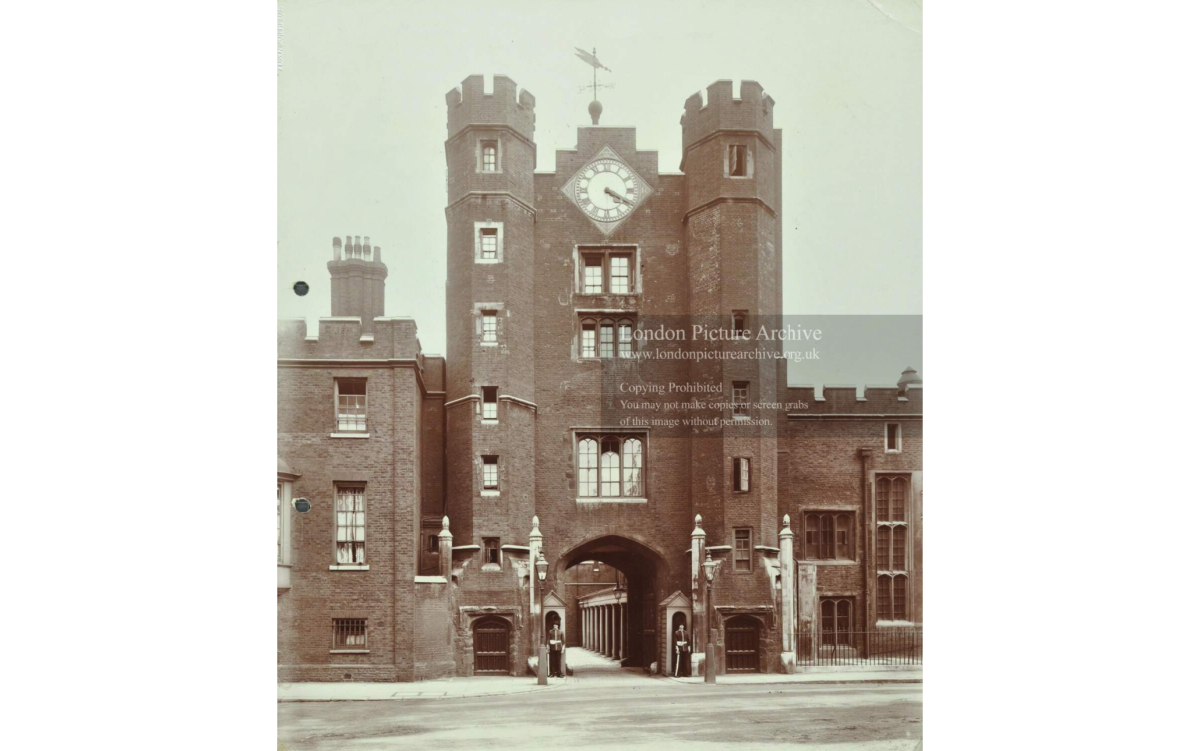
St. James Palace is a royal palace located in London, England. It was initially a hospital run by the Augustinian order of monks and later transformed into a leper hospital for women. It was built by Henry VIII between 1531 and 1536 and became home to many members of the Royal family. Elizabeth I was a resident at St. James Palace during the threat presented by the Spanish Armada and set out from St. James to address her troops located at Tilbury. Charles II, James II, Mary of York, Anne of York, and James Francis Edward Stuart were all born and baptized at St. James Palace (Oram). After the destruction of the Palace of Whitehall in 1698 by fire, most monarchs until William IV lived at St. James part-time. In 1809, much of St. James Palace was destroyed by fire, but mostly restored by 1813. William IV was the last sovereign to use St. James as residence. After his death, court functions and royal weddings were still held at the location. After decades of being used for mostly formal occasions, Queen Victoria officially moved there in 1837 (“St James Palace, London”).
In Virginia Woolf’s short story “Mrs. Dalloway in Bond Street,” the narrator mentions St. James Palace by stating, “There was St James palace; like a child's game with bricks; and now—she had passed Bond Street—she was by Hatchard's book shop.” As the narrator describes Mrs. Dalloway’s manic walk through London, they specifically compare it to a “child’s game,” particularly mocking the drama within the royal family and how it has been seen at St. James Palace. At the time “Mrs. Dalloway in Bond Street” was published, which was in the 1920s, not much was happening at the palace. Most of the royal family did not take up residency here anymore, though some still periodically lived there. Woolf’s remark about St. James palace, however, could be referring to the drama of this location in the past.
In May of 1810, the Duke of Cumberland was attacked in his sleep in his apartment inside of St. James Palace, and one of his valets, Joseph Sellis, was later found dead in his room with his throat cut. Sellis had apparently used the Duke’s sword to commit the attack, but accidentally used the flat of the blade rather than the edge. After the Duke called for help, Sellis escaped to his room. According ot the jury’s eventual verdict, Sellis commited suicide rather than face the consequences of his actions towards the duke (Knowles). This scandal raised a considerable amount of attention within the people and the royal family. Woolf comparing the palace to a “child’s game” may be because of the scandals that the palace endured, or it could simply be a mockery towards the royal family itself, referring to the game of thrones within the palace, and pointing out how the palace is “made of bricks'' because it was built mostly of brick.
Works Cited
Goodey, Emma. “The Chapel Royal.” The Royal Family, 3 July 2018, https://www.royal.uk/chapelroyal.
Knowles, Rachel. “The Scandalous Death of the Duke of Cumberland's Valet.” Regency History, 30 May 2013, https://www.regencyhistory.net/2013/05/the-scandalous-death-of-duke-of…;
Oram, Kirsty. “Royal Residences: St James's Palace.” The Royal Family, 24 Aug. 2022, https://www.royal.uk/royal-residences-st-jamess-palace.
“St James Palace, London: History & Visiting Information.” Britain Express, https://www.britainexpress.com/attractions.htm?attraction=4270.
“St James's Palace, St James's Palace, Westminster LB: Clock Tower.” London Picture Archive, https://www.londonpicturearchive.org.uk/view-item? key=WnsiUCI6eyJrZXl3b3JkcyI6IlN0LiBKYW1lcyBwYWxhY2UiLCJrZXl3b3Jkc01vZGUiOjF9LCJGIjoiZXlKemJ5STZNWDAifQ&pg=207&WINID=1663602467444#NDP0WUbVI5QAAAGDVm8eGA/147204.
“Visit Us.” Colour Court. St James's Palace 1930 | Royal Museums Greenwich, https://www.rmg.co.uk/collections/objects/rmgc-object-105598.