
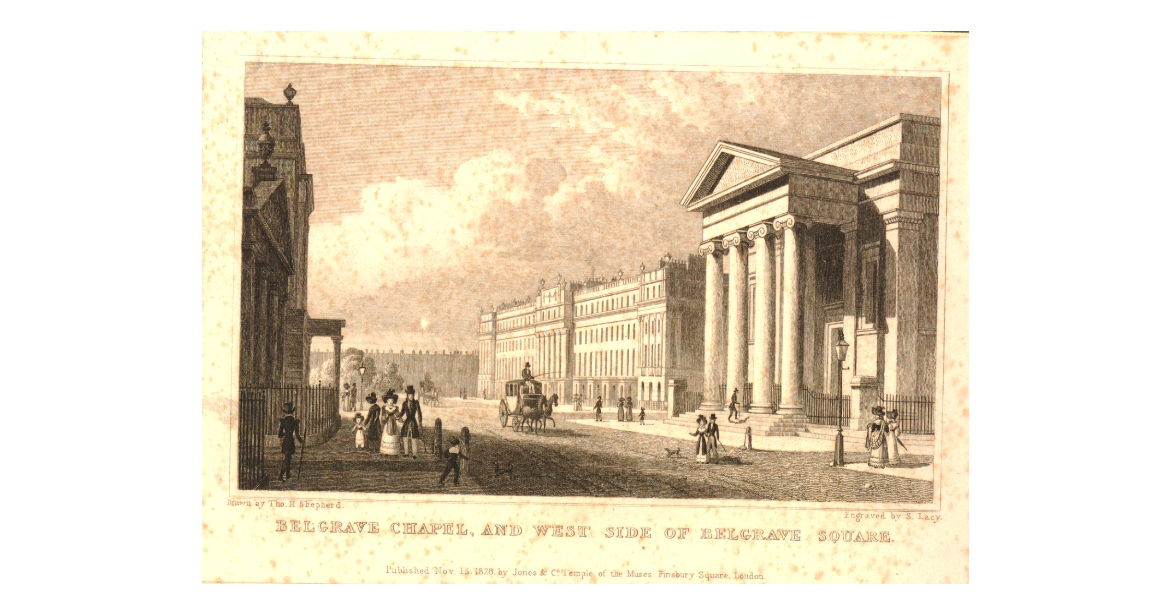
Image 1 is a 19th century illustration of Belgrave Chapel and the Western edge of Belgrave Square. This piece was created by an artist known as C. Lacy, and it is currently held at The British Museum in London.
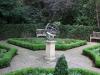
Image 2 is a photograph of a small part of Belgrave Square taken this century by Sarah Jackson.
Belgrave Square is in the Belgravia neighborhood of Westminster, London. The land was originally a natural marshland owned by the Grosvenor family, who later became the Dukes of Westminster. In the 19th century, the Grosvenor family sold the marshland to contractors, and Belgrave Square was constructed (“Belgrave Square”). The square was designed by George Basevi, and between 1820 and 1835, was constructed by Thomas Cubitt. The first garden was planted in 1826 (“Inventory Site Record”). Since then, Belgrave Square has been the home of English nobility and the site of several foreign embassies. (“Belgravia”).
“West London,” written in 1867 by Matthew Arnold, opens with, “Crouched on the pavement, close to Belgrave Square” (Arnold, line 1). Belgrave Square and the surrounding Belgravia neighborhood had been a wealthy and fashionable area of West London at the time. Arnold places poor/working class characters, “A tramp” (line 2), “A babe” (line 3), “A Girl,” (line 4), and “Some labouring men” (line 5), in juxtaposition with a wealthy passerby (lines 6-8). Arnold had written this in a post-industrial revolution world where new classes of people were emerging, and where wealth gaps were widening. The text’s clashing of a “wealthy person walking by” with the aforementioned poor/working class characters serves as a representation of that disparity. What’s more is the fact that the poor/working class individuals of the poem were placed inside the neighborhood of Belgrave, an area known for nobility to live and work—a fact audiences of the time would have likely been familiar with. Arnold shows the rich Belgrave-dwellers confronting the poor/working class people of their community and their conditions. As such, the themes in the ending of the poem about “sharers of a common human fate” (lines 11) carry a different meaning. Arnold does not grant comfort to the poor and working class characters in his poem. Rather, he comments on the wealthy nobility of the square, who are going to share the same fate with the poor/working class individuals of London.
In the 21st century, the Belgravia neighborhood is home to several foreign embassies, including the Spanish embassy (“SPANISH EMBASSY”) and the Embassy of Romania (“EMBASSY OF ROMANIA to the United Kingdom of Great Britain and Northern Ireland”). The attitudes towards class and status have not changed much. Belgravia’s gardens contain sculptures of Prince Henry the Navigator, Simón Bolívar, José de San Martín, Christopher Columbus, George Basevi, Sir Robert Grosvenor, and an homage to Leonardo da Vinci (“Inventory Site Record”). Today, the gardens still hold a reverence to individuals who were noteworthy—either in English nobility, the arts, or colonialism—in its spaces.
Works Cited
Lacy, C. Belgrave Chapel and West Side of Belgrave Square. 1828. The British Museum, London. www.britishmuseum.org/collection/object/P_1880-1113-2428. Accessed 4 Oct. 2022.
Jackson, Sarah. “Belgrave Square.” LondonGardensTrust.org, 15 July 2005, https://londongardenstrust.org/conservation/inventory/site-record/?ID=WST004. Accessed 4 Oct. 2022.
“Belgrave Square.” LondonGardensTrust.org, https://www.londongardenstrust.org/guides/site.php?tour=Chelsea&stage=7.00. Accessed 4 Oct. 2022.
“Inventory Site Record.” LondonGardensTrust.org, https://londongardenstrust.org/conservation/inventory/site-record/?ID=WST004. Accessed 4 Oct. 2022.
The Editors of Encyclopaedia Britannica. “Belgravia.” Encyclopaedia Britannica, https://www.britannica.com/place/Belgravia. Accessed 4 Oct. 2022.
Arnold, Matthew. “West London.” 1867
“SPANISH EMBASSY.” HistoricEngland.org.uk, https://historicengland.org.uk/listing/the-list/list-entry/1218320. Accessed 4 Oct. 2022.
“EMBASSY OF ROMANIA to the United Kingdom of Great Britain and Northern Ireland.” londra.mae.ro, http://londra.mae.ro/en/node/388. Accessed 4 Oct. 2022.