
The first telegraph systems were established within the United States and Great Britain in the 1840’s and soon after there was a desire to spread this communication (Israel & Slotten). Cyrus W. Field was a young millionaire in New York who “organized the New York, Newfoundland, and London Electric Telegraph Company” in collaboration with Fred N. Gisborne who received “an exclusive 30-year right to construct telegraph lines in Newfoundland” (Babe). Field was able to establish the American Telegraph Company which controlled the “telegraph lines along the eastern seaboard”, but he “was unable to convince American investors to back the Atlantic cable” (Israel & Slotten). As a result of the lack of funds, Field went to London with Samuel F. B. Morse, who invented the first American telegraph. The pair formed the Atlantic Telegraph Company in 1856 and were able to gain funds and support from the British government for the Atlantic cable and began construction in 1857 (Israel & Slotten).
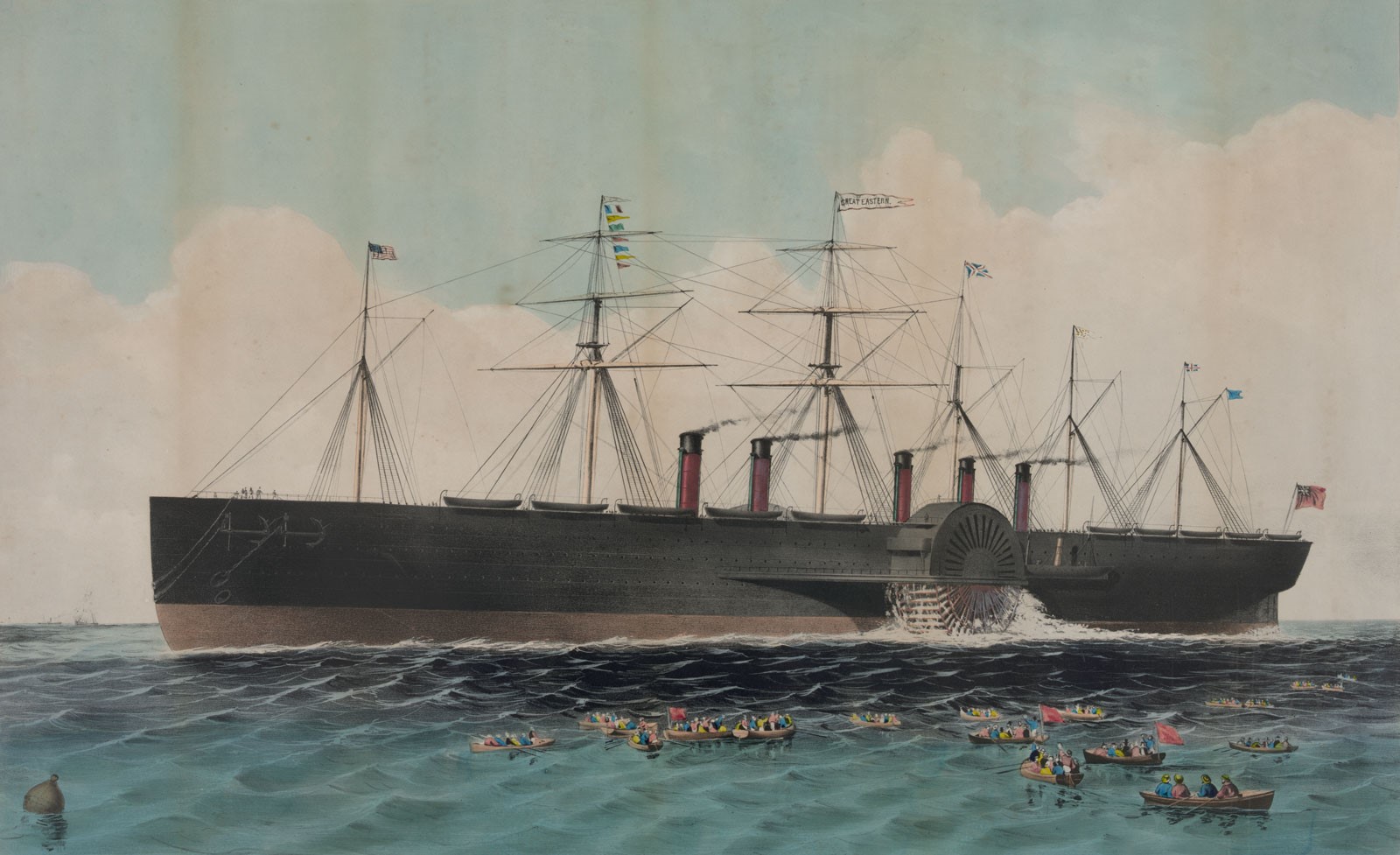
After a few failed attempts where the cable broke while being laid, Field succeeded in creating and laying a cable in August 1858 and “arranged for Queen Victoria to send the first transatlantic message” to President James Buchanan (Babe). However, after this celebratory exchange the cable snapped after only being in use for three weeks (Babe). Field was unable to gain financial support to reconstruct in America because of the Civil War, so he again returned to British investors (Israel & Slotten). 2700 miles of cable were needed to cross the Atlantic, and this cable was laid out by the large cargo ship, The Great Eastern and the British “war steamer Terrible [was] to accompany the expedition” (By Telegraph). The Transatlantic connection was finally restored in late July 1866, and the cable “remained in service for nearly a century” (Babe). The Transatlantic cable was revolutionary for the time and “opened up a new era in global communications” because “the Atlantic cable allowed for near-instantaneous communication” (Israel & Slotten). Not only did this cable change the way that news and communication travelled, but it also was “significant as a technology crucial in the development of the modern process of globalization” (Israel & Slotten).
Works Cited
Babe, Robert E. "transatlantic cable." The Oxford Companion to Canadian History.: Oxford University Press, 2004. Oxford Reference. Date Accessed 1 Nov. 2020 https://www-oxfordreference-com.proxy.library.kent.edu/view/10.1093/acref/9780195415599.001.0001/acref-9780195415599-e-1559
"By Telegraph." Boston Daily Advertiser, 7 June 1866. Nineteenth Century U.S. Newspapers, https://link-gale-com.proxy.library.kent.edu/apps/doc/GT3006420565/NCNP…. Accessed 1 Nov. 2020.
Israel, Paul, and Hugh Richard, Slotten. "Atlantic Cable." The Oxford Encyclopedia of the History of American Science, Medicine, and Technology: Oxford University Press, 2015. Oxford Reference. Date Accessed 1 Nov. 2020 <https://www-oxfordreference-com.proxy.library.kent.edu/view/10.1093/acr…;.