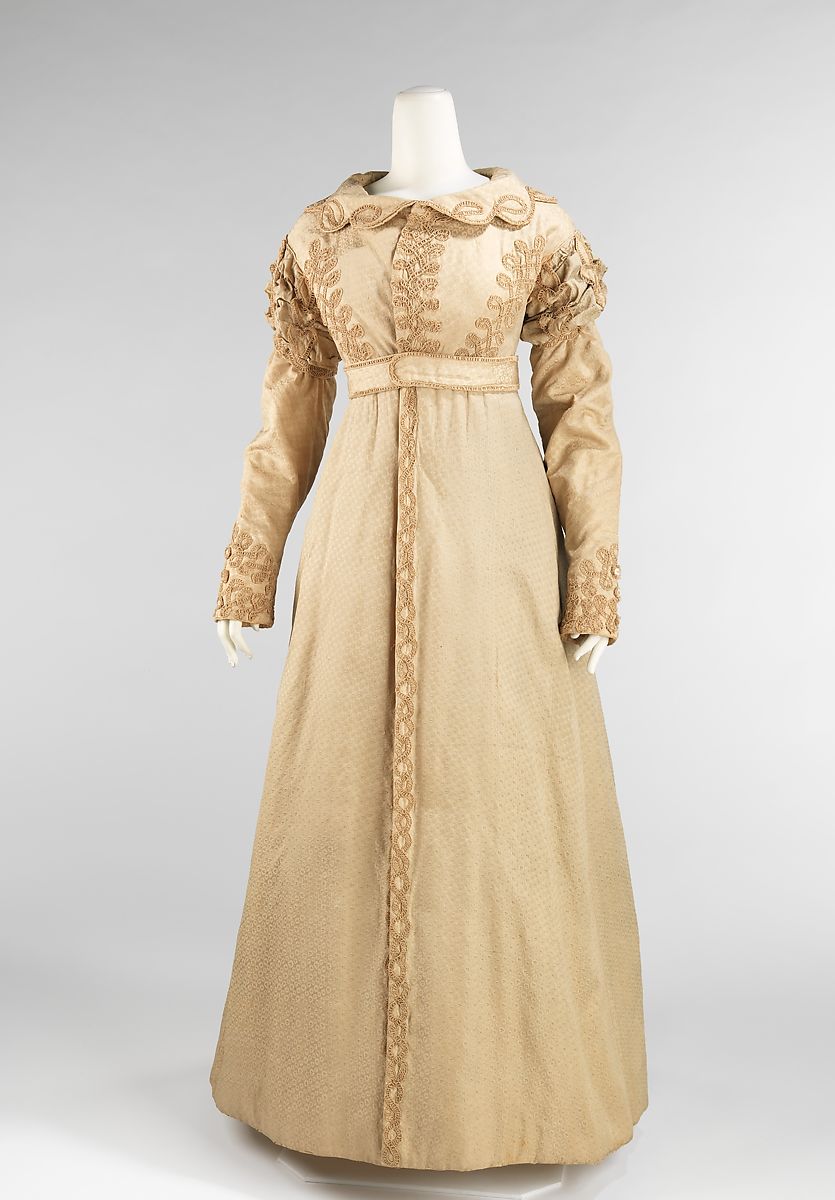
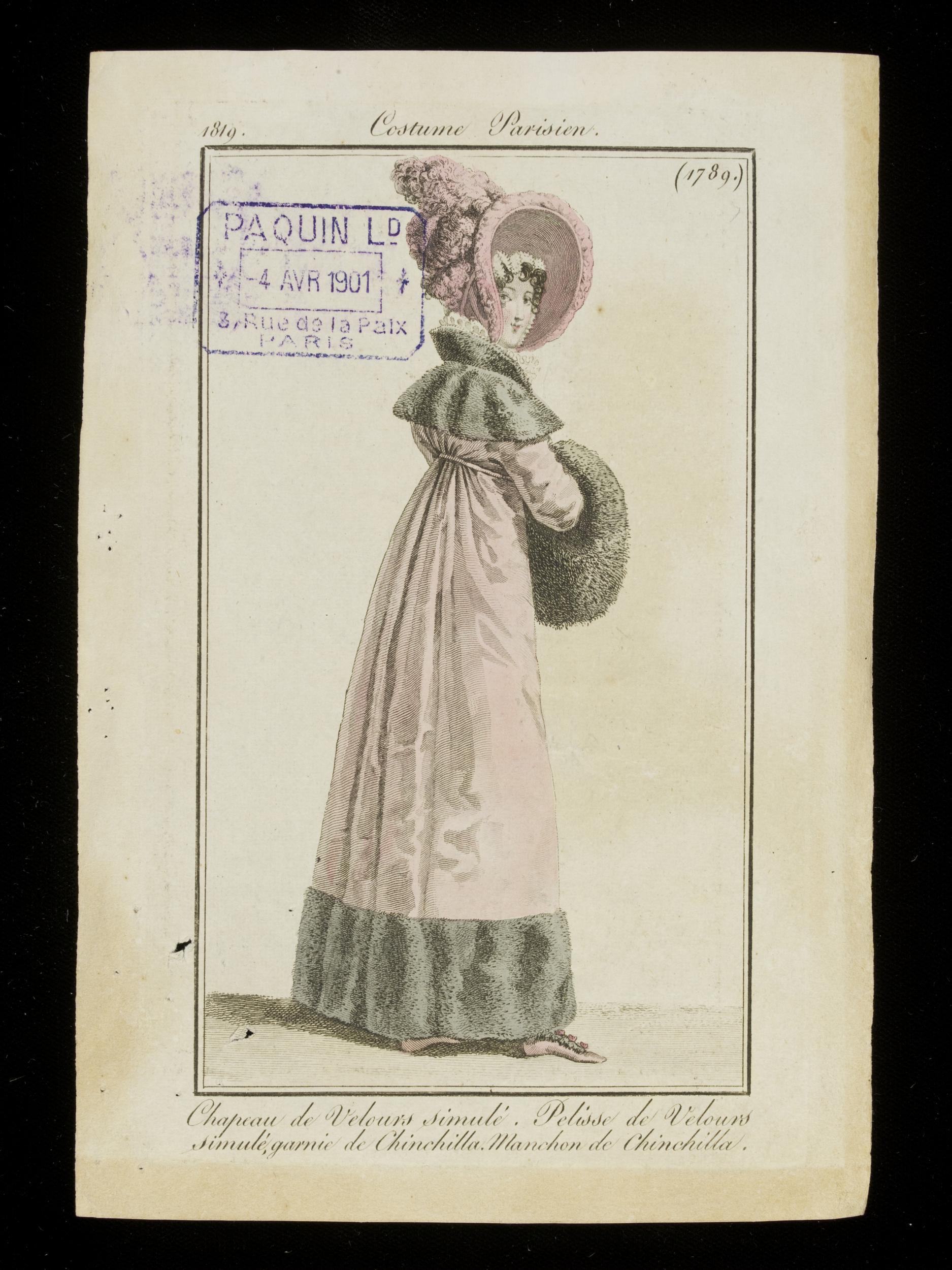
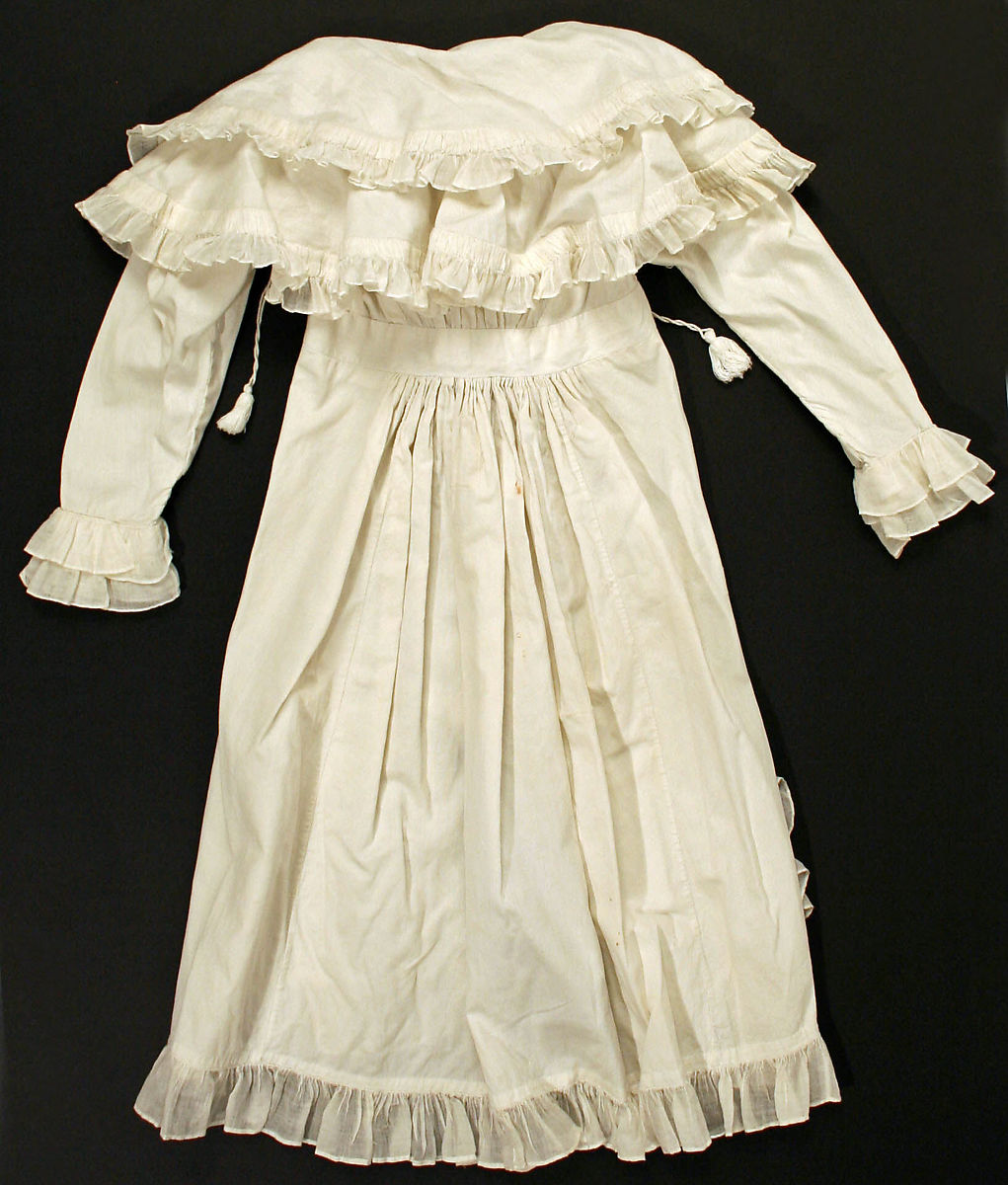
The pelisse is the archetypal women’s fashion garment of the early 19th century– a long overcoat with a high waist worn over a dress. Otherwise known in France as the redingote, the style began to take shape during the last quarter of the 18th century, and continued to be a central part of women’s fashion until the mid-19th century. It was first popular in children’s wear made from fine white cotton, and later grew popular in women’s fashion. Adapted from men’s military jackets, the pelisse typically adorned military-inspired decorative detail such as gold, braided trimmings. The garment originally followed the trend of ankle-length with a high-waisted line and sleeves, but evolved around the 1830s to be three-quarters in length with wider skirts, a waist-long cape, and open sleeves. Because pelisses needed to be fitted over the woman’s dress, it was considered standard practice for the pelisse to be tailored to the woman.
Typically, the overgarment was worn by well-dressed, fashionable women. Wealthier women wore certain pelisses according to the season and weather–it could be made of cotton, silk, or wool and often included a fur-trimming for winter months. More expensive pelisses included the warmer fur-trimming, and had higher quality design and decorative aspects, including lace, velvet, hem-with-fur, cuffs, swansdown, fringe, or silk-plush. Plain pelisses were cheaper and worn by members of middle class society.
Annotated Bibliography:
Source 1: “Astonishing Reductions in Pelisses at St. Patrick's Square.” Edinburgh Evening News, 15 Feb. 1896, https://www.britishnewspaperarchive.co.uk/viewer/bl/0000452/18960215/14…
This is an advertisement for a pelisse in a British newspaper. It is shown to be on sale at 5s 11d, or fur-trimmed for 10s 6d with a bonnet and hat to match. This further emphasizes the high cost for fashion, but there were alternatives (sales) that made this garment more accessible to the middle class. It is important to note here that it is double the price for a fur-lined pelisse, making a warm winter pelisse harder to obtain in the winter months.
Source 2: Heldman, James. “How Wealthy Is Mr. Darcy -- Really? Pounds and Dollars in the World of Pride and Prejudice.” Jane Austen Society of North America, 1990, pp. 38–49., https://doi.org/https://jasna.org/persuasions/printed/number12/heldman….
Though it is not explicitly stated how much a pelisse would cost, we can equate the cost of “having a wool cloak made” to the cost of a pelisse at the time, because the material and design would be very similar to that of a cloak. Though it is not exact, we can use the conversion chart found in this article to see that having a wool cloak made was 10 shillings, which was equal to about $25 in 1989. Adjusting for inflation, that would be worth about $56.75 today.
Source 3: Libes, Kenna. “Pelisse.” Https://Fashionhistory.fitnyc.edu/Pelisse/, Fashion History Timeline, 1 June 2020, https://fashionhistory.fitnyc.edu/pelisse/.
In this article, Kenna Libbs catalogs the history of the pelisse in the fashion industry. She describes in detail the fit of the garment, how they changed shape in order to fit the dresses they covered. She goes on to explain how pelisses ranged from decorative, fashionable silk to practical fur-trimmed wool in order to keep warm in winter.
Source 4: “Pelisse, Ca. 1815.” Metmuseum.org, https://www.metmuseum.org/art/collection/search/159181.
This article describes the pelisse’s evolution in the fashion industry, from the 1770s to 1815 . In France, it is known as the redingote and was previously a three quarter coat with a hood of fabric or a fur-lined trim. In later years, depending on the season, the pelisse was made with cotton, silk, or wool, and showcased a wide variety of detail including cuffs, hem with fur, swansdown, lace, velvet, fringe, or silk plush.
Source 5: “Pelisse, Ca. 1820.” Metmuseum.org, https://www.metmuseum.org/art/collection/search/159181.
The museum catalogs the pelisse, which was popularized in the early 19th century, around 1815-1820. It is described here as a very fashionable luxury that was fitted and tailored to cover the gowns underneath, Inspired by Greco-Roman military influence, the neoclassic style began as children’s wear made with fine white cotton, and progressed into women’s high fashion in the form of a fitted overcoat worn over a dress.