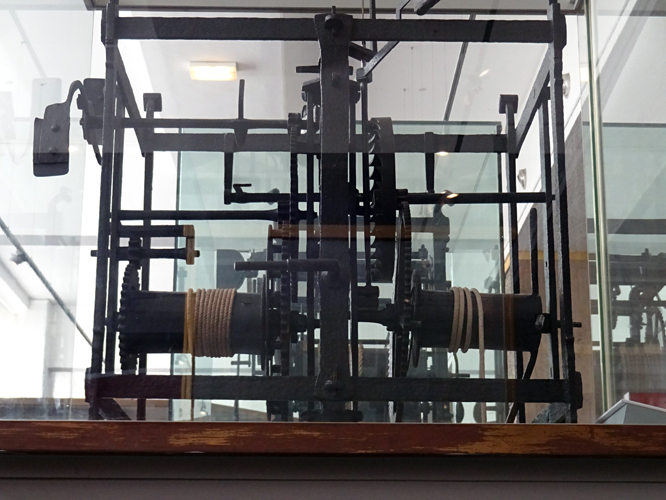
Timekeeping played a key role in the hustle and bustle of urban Victorian culture. Formerly, clocks were symbols of vast wealth, available only to the church, the royal family, and some wealthy aristocrats. In the seventeenth and eighteenth centuries, the development of the long-case clock transformed clocks from a public project (owned by the church) into a domestic product. By the beginning of the nineteenth century, new manufacturing processes and technologies made clocks accessible to the middle class and some working-class families. Clocks remained as public projects and tools, but they gained a new domestic identity.
Clockmaking was seen as a quintessentially English craft, despite the majority of clockmakers coming from French, German, and Swiss families. Anxiety exploded over maintaining the "purity" of clockmaking and the cheapening of market products, mirroring Victorian fears of colonialism and industrialization. The synchronization of clocks across England persisted as a major problem. New technologies aimed to make clocks more accurate and more precise. With industrial life determined by the strike of the hour, clockmaking developed a double identity as a craft of efficiency. Wire ropes, steel, and other new materials were incorporated into major public clocks to demonstrate the prowess of Victorian science and technology.
Annotated Bibliography
Sear, Joanne, and Ken Sneath. The Origins of the Consumer Revolution in England: From Brass Pots to Clocks. Routledge Taylor & Francis Group, 2020.
This book includes a section overviewing the role and history of clocks in England. The article begins with a discussion of monastic or public clocks, noting the rarity of domestic clocks before the seventeenth century. From there, the article moves into a brief description of the mechanics of lantern clocks and pendulum clocks. The article describes how the production of domestic clocks and watches exploded in the late-seventeenth century, but clocks remained a luxury good. The article continues with a more in-depth historical overview of clockmaking in the 18th century, explaining how Britain dominated clock manufacturing after the Edict of Nantes in France caused Protestant French clockmakers to flee the country. The article focuses on shifts in the prices of clocks in the eighteenth century. By the end of the century, clocks had become slightly more affordable, but increasing rent and food prices rendered them unattainable for many. One clock could cost as much as a year’s rent for a family. Some parishes established “clock clubs” in which members paid a small sum to draw lots and purchase a clock. By the end of the eighteenth century, clocks appeared in contemporary paintings of more modest families and probate inventories indicated that roughly half of households owned a clock.
This article provides information on the value of clocks and the clock’s role in the market before the nineteenth century. While the focus is primarily pre-Victorian, the article carefully tracks the increasing accessibility of clocks through the centuries. The article examines the arc of the clock from a symbol of extreme wealth to a manufactured good attainable for a laboring-class family. In addition, the article contains nitty-gritty details about clock prices and inventories, giving me information about how a clock might factor into a Victorian household or budget. The article also describes the research process— most of the information for this article comes from probate inventories, wills, or Old Bailey court records. I can mimic this information-gathering strategy in my own paper.
"Cheshire Quarter Sessions." Chester Chronicle, 7 Jan. 1848, p. 4. British Library Newspapers, link-gale-com.proxy.uchicago.edu/apps/doc/JE3233348930/BNCN?u=chic_rbw&sid=bookmark-BNCN&xid=b9ab916d. Accessed 9 Feb. 2022.
This 1848 newspaper article describes plans for a National Clock with the latest Victorian technologies. The reporter dives into a description of the clock’s grandeur, noting the accuracy of the four dials, the size of the clock face, and the eight-day wind-up requirement. To reassure the reader, the reporter states that “every resource of modern art and science will be made use of to render it a perfect standard.” The reporter transitions from analyzing the clock to describing the clock’s bureaucratic process. First, the clock must meet “the approval of Mr. Airy, the astronomer-royal, who has been consulted throughout by the government.” Mr. Airy lists his preferred clock materials, including cast-iron, hard bell metal, steel spindles, and wire rope, so that the clock may be easily cleaned. The reporter details the predicted accuracy of the clock through its “galvanic communication” with the Royal the Observatory at Greenwich. The reporter moves into a description of the three candidates proposed for making the clock. The reporter and the candidates debate over whether the clock should have ornamentation. One of the candidates argues that ornamentation is superfluous since it does not improve the clock's efficiency. The reporter seems to agree. The other two candidates argue that ornamentation will cement the clock as the pride of the nation a make a grand impression on foreigners.
This article touches on relationships between Victorian culture and timekeeping, industrialization, nationalism, and class structures. Clockmaking was seen as the highest of Victorian crafts. As a result, all of the candidate clockmakers were genteel men with connections to the royal family. We can see the impacts of industrialization in the reporter's obsession with the accuracy of the clock and the use of modern technology to ensure speed. He devotes an entire paragraph to the benefits of newly-developed wire rope, again communicating the rapid development of new technologies. The conflict over the use of ornamentation mirrors the discussion in Hard Times about efficiency— ornamentation is unnecessary for a clock. However, ornamentation becomes valuable if the clock is a national symbol. As a newspaper article collecting information from parliamentary papers, the structure of the piece demonstrates the importance of newspapers as the primary media source for Victorian society. With a few sentences, the reporter and his chosen references become the authority on clockmaking.
"MY GRANDFATHER's CLOCK." Bristol Mercury, 21 Jan. 1854. British Library Newspapers, link-gale-com.proxy.uchicago.edu/apps/doc/Y3206685527/BNCN?u=chic_rbw&sid=bookmark-BNCN&xid=1bb29866. Accessed 10 Feb. 2022.
This 1854 newspaper article describes the narrator’s “dream” about grandfather clocks. The author begins with a thinly-veiled complaint about “modern clocks” and the loss of old-fashioned values. Modern clocks jitter and jerk, rattling off the minutes. Old-fashioned clocks “stand so primly in the corners of rooms, slowly and discreetly ticking away the hours, as if it were a sober, solemn business, this disposing of time.” From this criticism, the narrator launches into a childhood memory. The narrator sits waiting for a story from his grandfather, but falls asleep. In his dream, a grandfather clock comes alive, along with dozens of other old-fashioned oak and mahogany clocks. These clocks “bustled about, and chatted, and gossiped in a truly wonderful manner for such ancient people.” The party is interrupted by “a jaunty rabble of modern clocks with […] short bodies and long legs, looking like a troupe of modern ballet dancers.” Scandalized, the old-fashioned clocks retreat as the modern clocks hustle and bustle. The narrator wakes up and reveals the political punchline- his grandfather was a Tory.
Besides the detailed descriptions of various types of long-case clocks, this story directly compares the new “Victorian” vision of time and industry with the aristocracy of previous generations. I find the narrative device of framing a satire as a dream within a memory fascinating— why does that distance need to exist? The clocks dance “Scottish reels” and blush at mentions of heels, dating the nostalgia to the Regency period. As social mobility (slowly) increases, the “gap in time” between the posh, old-fashioned clocks and the newfangled busybodies becomes literal. This article also explores industrialization and nostalgia for the “country life.” The new clocks constantly move to the next goal, focused on efficiency above all else. The old-fashioned clocks gossip and flirt and make “witty and facetious” comments. In general, this short story uses clocks as a vehicle to express Victorian anxieties, providing valuable evidence for my project.
"Industries: Clock and watch-making." A History of the County of Middlesex: Volume 2, General; Ashford, East Bedfont With Hatton, Feltham, Hampton With Hampton Wick, Hanworth, Laleham, Littleton. Ed. William Page. London: Victoria County History, 1911. 158-165. British History Online. Web. 12 February 2022. http://www.british-history.ac.uk/vch/middx/vol2/pp158-165.
This 1911 summary overviews the history of clock-making in England from the early 1600s to the late 1800s. The article begins by listing a few of the highest-status roles in clockmaking, from Clockmender of Westminster Abbey, to Clockmaker to the King, to head of the Clockmakers’ Company. From there, the article launches into a listing pattern, describing famous clockmakers, their inventions, their greatest works, their positions, their descendants and wills, and any collections containing their clocks. Many of the more illustrious clocks can still be found in the Victoria and Albert Museum, the British Museum, and Winchester Palace. The article also explores the ties between clockmaking and the neighborhoods of Holborn and Clerkenwell. Exiled Huguenot clockmakers settled in these neighborhoods and other communities of clockmakers sprang up around them. Clockmaking often passed through families, with bloodlines such as the Perigals or the Frodshams dominating the industry for decades at a time. In the 1800s, as standardized manufacturing exploded, forged watches engraved with the names of English clockmakers swarmed the markets. Clocks and watches became more and more accessible. Clock synchronization persisted as a major problem, but innovations in magnetism and motors presented new solutions. The author finishes the article with a brief description of the cheapening of the watchmaking industry and the need for maintaining English watchmaking standards.
This extensive article provides valuable context on the history of clockmaking in England from a late-Victorian perspective. The article traces clockmaking through family lines, noting innovations and centers of clockmaking. With these locations in hand, I can research factory conditions and examine how clockmaking transitioned from handcrafting to manufacturing. In addition, the article describes the close ties between clockmaking, the royal family, and the Royal Observatory. Clockmaking was a cultural symbol, often representing the pride of a town or church. The anxiety over the preservation of the clockmaking industry from foreign competition mirrors Victorian fears over the stability of the Empire and the nationalist drive to preserve “Englishness.”
“Plate 3, ‘the Bottle. in Eight Plates’ - George Cruikshank's Cautionary Hogarthian Progress (1847).” Victorian Web, 2017, https://victorianweb.org/art/illustration/cruikshank/bottle3.html.
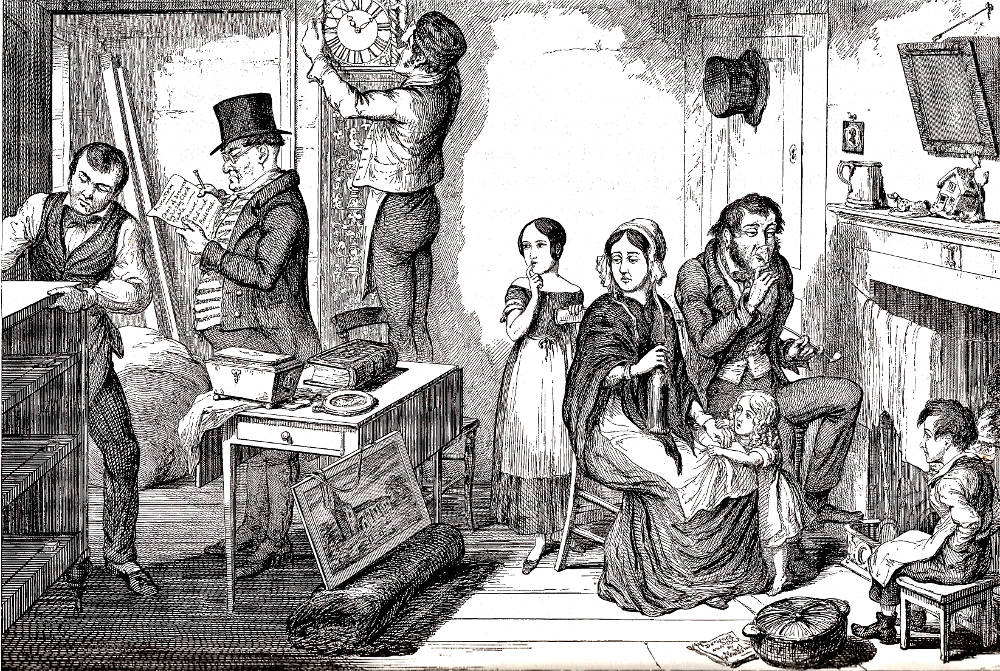
This 1847 image depicts an “execution” against a family home due to debts and unemployment. The fathers stares vacantly into a coal fire, hung with scraps, drunk. His ragged hat hangs from a hook on the wall, about to fall into the fire. Three children watch the bailiff and his men run down a checklist, cataloguing the family’s possessions. The mother holds the bottle for her husband in one hand and quiets her daughter with the other. One of the bailiff’s men fiddles with a tall grandfather clock in the corner, examining the face. The other man prepares to lift a bookshelf. A few scraps of bric-a-brac are scattered over the mantelpiece, too cheap to be worth collecting.
This moralizing image warns the reader against the dangers of gin and tobacco. However, despite the sense of desolation, the cottage contains decorations. The family has paintings, a few knickknacks, a bookshelf, a carpet. Previously, a grandfather clock would only have been available to the aristocracy or the obscenely wealthy. Now, a working-class family can afford to purchase one. The presence of these items indicates the increasing availability of goods through manufacturing and industrialization. This image gives me a better idea of the accessibility of grandfather clocks and other similar-value goods in the mid-nineteenth century.