
Vivie’s Commentary:
I’ve always wondered what mother had done for a living. That day after supper with all of mother’s friends that she had wanted me to meet, I decided to confront her. I had asked her about everything. From where our family is to why she chose her career as a prostitute… I needed answers. I have lived twenty-two years of my life knowing little to nothing about someone who referred to themselves as my mother. After nights of discussion with Frank Gardner, I have finally decided to either get answers or remove her from my life entirely. What shocked me was her story. Which was one that was so distinct from this modern time, and it had put her in such a position where she had no options at all. Yet, this woman has done her best to provide everything to me so that I will never have to be forced down the same path as her. I regret treating her so coldly all this time, and I am not saying that I forgive her, but I’m willing to give her a chance. Now that I have seen what she has done for me, I simply cannot imagine a life without her. My respect for her had increased so much with the understanding of the reasons behind her actions. I still have many questions in mind, but I do not want to bother mother any more about her past. For now, I will educate myself on her life through these articles I find scattered in the weekly newspapers.
Editorial Commentary:
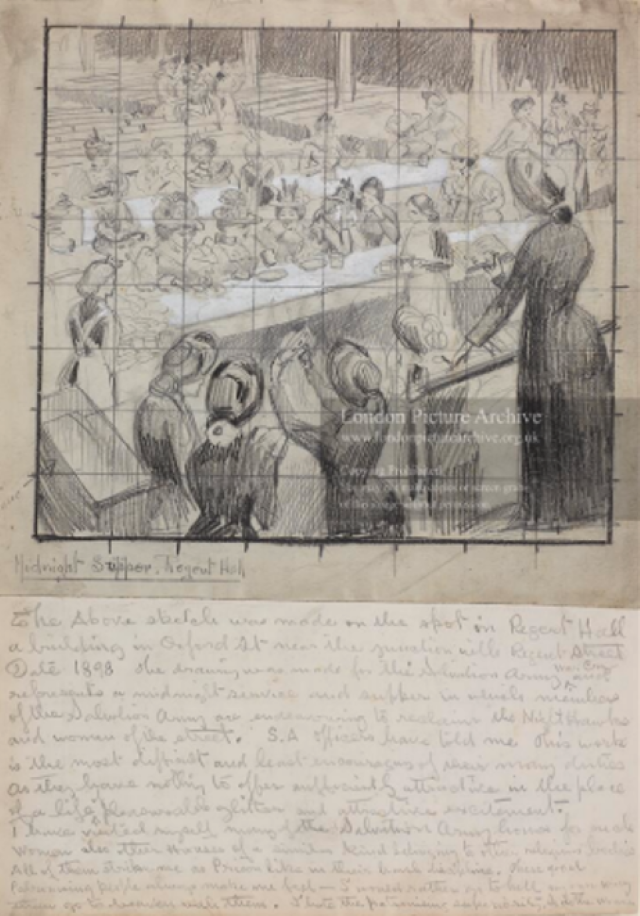
During the Victorian era, women from the lower class often had to resort to prostitution and hard labor to help sustain their family ("Roles of Women in the Victorian Era"). In Vivie’s commentary, she mentioned a lot about her mother working as a prostitute. It can be inferred that her mother came from a poor family, which resulted in her career. Based on Vivie’s previous commentaries regarding her education, her mother earned a lot of money and was capable enough to provide Vivie with higher education at the University of Cambridge. Her mother was likely successful in earning money and eventually taking herself out of that business. Prostitutes in the Victorian era was known as “fallen women,” which referred to women who were viewed by society as someone who stepped outside the standards set for women by society. These women were often frowned upon as people felt like they are disgraceful for expressing their sexuality outside of marriage. Vivie’s comment about knowing very little about her mother was probably because her mother did not want her career to be known, as that would cause disturbances to not only her life, but also Vivie’s life as she would be the daughter of a prostitute. Her mother might have also likely hidden her career from her daughter as she did not want her daughter to also frown upon her. During the 19th century, prostitution was very common. It accounted for 50,000 of the women residing in London. The definition of prostitute at the time was very broad. It could refer to someone who sells their body to earn money, someone who lives with a man who is not her husband, and women who had illegitimate children (Flanders). Based on Vivie’s commentary, Vivie does not seem to know anything about the rest of her family members besides her mother. This could mean that she grew up without a father. Based on this, Vivie’s mother could have fit into more than one of the above definitions of a prostitute. The item Vivie kept looks like a newspaper article that discussed prostitution at that time. It likely covered the issue of there being such a large population working in the industry. At the time of the Victorian era, sexually transmitted diseases such as syphilis were very common. Many doctors were voicing their concerns that the large population of prostitutes was the root problem behind the spreading of the diseases. In the 1860s, the Contagious Diseases Act was implemented, allowing “forced medical examination of any women who was suspected of being a sex worker.” If they were found to be infected, they would then be locked up in a hospital until cured (Hughes). Vivie was likely not only collecting this paper for the purpose of getting a better understanding of her mother like she said, but also to keep up to date on how her mother’s career was viewed in society. Society felt that sexual pleasure was something that should only be enjoyable to men and women should remain pure until marriage. Prostitution to them felt more like a choice instead of a situation that poor women were forced into, which is why they put all the blame on the women working as prostitutes and overlook the idea that men had to go seek prostitutes for the prostitution industry to be flourishing.
Works Cited
Flanders, Judith. “Prostitution.” Discovering Literature: Romantics & Victorians, British Library, 15 May 2014. Prostitution | The British Library (bl.uk). Accessed 12 Oct. 2023.
Hughes, Kathryn. “Gender roles in the 19th century.” Discovering Literature: Romantics & Victorians, British Library, 15 May 2014. Gender roles in the 19th century | The British Library (bl.uk). Accessed 12 Oct. 2023.
Randoll, Robert. “Oxford Street, Westminster.” London Picture Archive, London Metropolitan Archives, Main Print Collection, 1898. Oxford Street, Westminster - London Picture Archive. Accessed 9 Oct. 2023.
“Roles of Women in the Victorian Era.” Victorian Era, 2022. Victorian women and roles of women in the Victorian Era. (victorian-era.org). Accessed 13 Oct. 2023.