
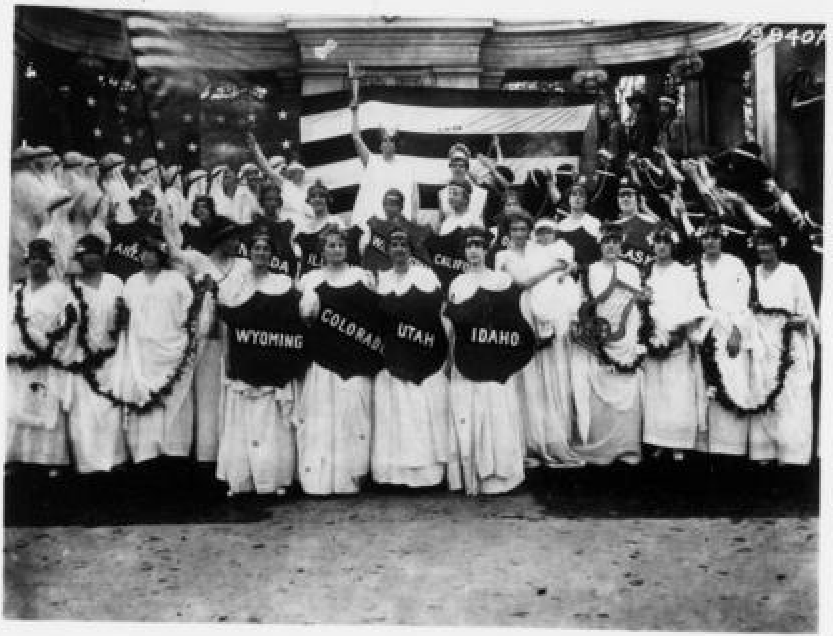
Vivie: Following my pursuit of knowledge at the University of Cambridge, I deemed it fitting to grant myself a respite. In all my days, I've rarely set foot within the confines of my family's home, and I dare say my dear mother would even take interest. Hence, I embarked on a journey to explore the magnificent lands of the United States of America. As a scholar, I felt prompted to make a visit to the Library of Congress, a holy grail of knowledge wherein I sought the history of the United States. Whilst perusing the volumes that lined the library's hallowed shelves, I happened upon a file bearing the label, "National American Woman Suffrage Association Records." It was within these files that I chanced upon an image depicting women assembling in unison, resolute in their fight to secure the privilege of suffrage. This discovery has left me disheartened, for it is grievous to witness that the plight of women in the United States mirrors the injustices endured in my homeland. Why am I denied the right to cast my ballot? My education far surpasses that of many a man who enjoys this sacred prerogative, and yet, it remains withheld from me. Is this affliction confined to two nations alone, or does it afflict the entirety of the globe? When shall the governing authorities acknowledge women as individuals and accord us the same regard as men? We find ourselves on the cusp of a new era, the emergence of the "New Woman," and in this struggle for suffrage, we must persist. I yearn for the opportunity to elect those who wield power. I am averse to the notion of a man, ignorant of the nuances of a woman's experience, choosing another man who shall do nothing for the women. It astonishes me that the United States, having waged a war for its independence from my own homeland, has not extended the fruits of liberty to all its citizens, as I had once assumed. Alas, the innate greed of men, their insatiable thirst for dominion, perpetuates a patriarchal order that prevails unchecked.
Commentary: Ensuing the review of Vivie’s commonplace book, it becomes conspicuously evident how much this picture resonates with her. While browsing the shelves of the Library of Congress, Vivie stumbles upon a file named the "National American Woman Suffrage Association Records". While flipping through the pages, she comes across an image of a protest led by women regarding their right to vote. She describes how depressed this image makes her as the same social issue is being fought for back in London, her hometown. Before 1918, no woman in London was granted the right to vote (UK Parliament, n.d.), meaning millions of women were suppressed under patriarchal rule of men. A women’s role in society during this time was simply to obey their fathers and husbands, stay at home to tend to children, and tidy up the house. Vivie drastically contrasts this “Old Woman” role pressured onto her by acquiring an education at the University of Cambridge and staying away from home her entire life, making her a “New Woman”. So, it would be expected for someone like her to be rebellious against the idea of women not having suffrage. During a segment of her writing, she asks rhetorical questions whether women around the world were being treated the same. To address Vivie’s questions, women around the world, as far as India, endured the similar or even worse experiences as men had married multiple women at once to keep around for their sexual pleasure (Kadam, 2016). Although women technically have far risen over these issue with the emergence of the “New Woman” movement, women still face challenges such unequal (less) pay compared to men, underrepresented in positions regarding authority, and experience prejudice in healthcare (IWPR, n.d.).
Works Cited
“About the Institute for Women’s Policy Research.” Institute for Women’s Policy Research, 10 March 2015, statusofwomendata.org/about/#:~:text=Women’s%20status%20in%20the%20United,political%20office%20across%20the%20nation.
Kadam, Surabhi. “Social Condition of Women during Eighteenth Century in India.” History Discussion, 10 June 2016, https://www.historydiscussion.net/history-of-india/social-condition-of-…
“National American Woman Suffrage Association Records: Subject File, 1851-1953; Equal rights amendment; 5 of 6.” Library of Congress, 1851, https://www.loc.gov/resource/mss34132.mss34132- 036_00322_00372/?sp=47&st=image&r=0.016,0.017,0.953,0.615,0. Accessed 12 October 2023.
“Women Get the Vote.” UK Parliament, https://www.parliament.uk/about/living-heritage/transformingsociety/ele…. Accessed 4 October 2023.