



Before there were text messages, before there were phone calls and emails, people communicated via letters. However, not everyone had the privilege to freely write to whomever they pleased. During the Regency era, there were social norms surrounding letters. It was unpopular, if not scandalous, for an unmarried man to write a letter to an unmarried woman and even more so if the couple was not known publicly to be engaged. Letters play an important role in many of Jane Austen’s Regency novels as they reveal character motives and desires and act as a way to spread information. One of the most famous letters to appear in Austen’s novels is Mr. Darcy’s letter to Pride and Prejudice’s heroine Elizabeth Bennet. Following Elizabeth Bennet’s rejection of Mr. Darcy’s first marriage proposal, Darcy breaks social codes by writing a letter to Elizabeth Bennet. In his letter, Darcy explains the motivations behind his actions that Elizabeth Bennet holds against him. Without the letter, Elizabeth Bennet, and the reader, would have been left clueless about Mr. Darcy’s truly respectable nature. Mr. Darcy's letter acts as the first time Mr. Darcy expresses his emotions and admits to his flaws. He lets Elizabeth see into his life that he has been keeping secret to maintain his mysterious appearance. Upon revealing the troubled past between Mr. Wickham and Darcy’s sister and admitting to his reason for separating Jane Bennet from Mr. Bingley, Elizabeth recognizes Mr. Darcy’s fierce loyalty to those he loves. She is able to view Mr. Darcy in a light she would never have if he hadn’t written the letter.This display case focuses on how letters act as a way to communicate when talking face-to-face feels unbearable and the importance of following words with actions. In addition to the process of replicating Mr. Darcy’s letter, the case includes photos of movie adaptations of the letter as well as a diagram depicting the movement of Mr. Darcy and Elizabeth in advancing to each other following the receipt of Darcy's letter.
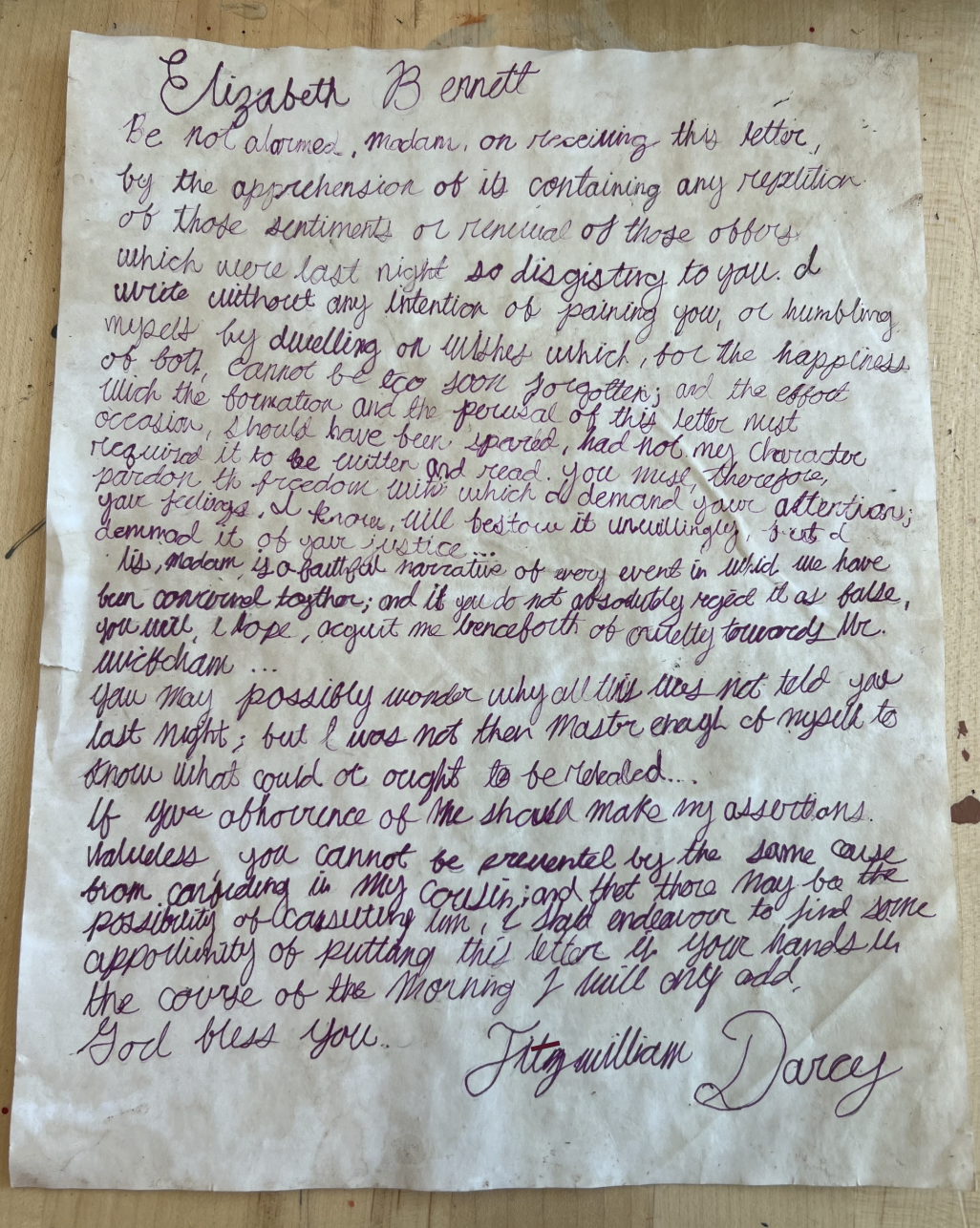
Recreation of Mr. Fitzwilliam Darcy's Letter to Miss Elizabeth Bennet in Pride and Prejudice (1813) by Madelynn Booth, October 2025. The letter is an abbreviated version of the one Mr. Darcy writes to Elizabeth Bennet in Volume II of Pride and Prejudice. This version of the letter consists of the opening paragraph, a portion of the ninth, as well as the beginning and ending portion of the tenth and final paragraph. The actual letter that Elizabeth receives is "an enivelope containing two sheets of letter paper, written quite through, in a very close hand" (Volume 2, Chapter 12). I chose to recreate the four sections of the original letter mentioned above because I felt they best encompassed Mr. Darcy's goal of the letter. The opening paragraph of Mr. Darcy's letter displays how he is still bitter about the rejection of the proposal but is trying to save his pride. This appears when he mentions how Elizabeth found his proposal "disgusting," which he refers to as "wishes [that] cannot be too soon forgotten." However, as the letter progresses, Mr. Darcy explains the reasons he has for his actions like his hatred for Mr. Wickham and why he separated Mr. Bingley from Jane Bennet. I did not include these paragraphs in my letter mostly because of their length, but also because I found the ending of the letter more important to Mr. Darcy's character arc. The ninth paragraph repeats Mr. Darcy's negative opinion of Mr. Wickham, which I viewed as Mr. Darcy's subtle and final attempt to dissuade Elizabeth from considering Mr. Wickham as a suitor. Lastly, the final paragraph of Mr. Darcy's letter proves how both Elizabeth and Darcy were too quick to pass judgement on to the other person but with forced reflection have changed.
Process of Creating the Letter from Mr. Darcy to Miss Elizabeth Bennet, October 2025, Photo by Dr. Golden, October 2025. The letter is written in cursive on tea-stanned paper provided by Dr. Golden. The ink is a dark purple, and I applied it to the paper with a dip pen. I started the process by trying out different colored inks on a scrap sheet of paper in the hopes to find a dark shade. I was hoping to use black ink but dark purple was the closest I was able to get. After picking the ink, I then practiced writing the start of the letter on one of the papers Dr. Golden had provided. The paper was colored to look like it had been stained with tea but was not the actual tea-stained paper that I saved for the final copy of the letter. After practicing my cursive and getting a sense of how big to write the words, I progressed to the tea-stained paper. Having blocked out on the scrap paper how much space each paragraph would take, I got to work on the introduction paragraph of the essay and slowly worked from there. I had to be careful to not smudge the ink as I wrote, and I found it difficult to get the perfect amount of ink on the pen to be able to write a full word without it blotting or running out of ink too soon.
Mr. Darcy Writing the Letter, 1995 film version of Pride and Prejudice. Colin Firth portraying Mr. Darcy writing the letter depicted a better representation of what the letter would have looked like than my effort. The words are close together to fit as much as he can on the two double side pages that are delivered to Elizbeth Bennet. Not only does the letter itself demonstrate Mr. Darcy's care for Elizabeth, but also the emotionally tortured state he appears to be in while writing the letter. He shows his desire for Elizabeth to understand him but also his fear of her rejecting him again and still choosing to believe Mr. Wickham over him.
Elizabeth Bennet Reading Mr. Darcy's Letter, 2005 movie adaptation of Pride and Prejudice. Elizabeth reads Mr. Darcy's letter and is completely shocked by the realization that she has misjudged Mr. Darcy. In this adaptation, Mr. Darcy personally delivers the letter to Elizabeth and starts to speak what is actually the opening paragraph of the letter. Mr. Darcy delivering the letter himself further shows how he is setting his pride aside to protect Elizabeth from Mr. Wickham. In the novel, Elizabeth reads the letter quickly at first, looking for an apology and with her prejudices against him at the front of her mind; however, as she keeps reading, her feelings become "acutely painful" (Chapter 36). For the rest of the day all Elizabeth could think of was "her letter" (Chapter 36). This identification of the letter as "her letter" and not just "the letter" or "Mr. Darcy's letter" demonstrates the already shifting opinion Elizabeth has for Mr. Darcy. The letter quickly becomes a cherished item for Elizabeth, a physical manifestation of Mr. Darcy admitting to his faults.
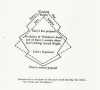
Dorothy Van Ghent Structural Plot Diagram from "On Pride and Prejudice" in The English Novel: Form and Function, 1953. Mr. Darcy's letter to Elizabeth acts as the pivotal moment in their relationship: It forces Mr. Darcy to think about how his actions look and impact others. It results in Elizabeth reconsidering her opinion of Mr. Darcy. In turn, it moves the pair closer together. This can be seen in Van Ghent's structural diagram of the Pride and Prejudice plot. After Elizabeth realizes Mr. Wickham's past and Darcy admits to his mistake of misunderstanding Jane's feelings towards Mr. Bingley, the pair are able to reconnect with a sense of understanding. Mr. Darcy doesn't stop after the letter. He then follows through with actions. He reunites Jane Bennet and Mr. Bingely, he pays for Mr. Wickham and Lydia's wedding, and he proposes for a second time. Mr. Darcy demonstrates that actions do speak louder than words; however, when they are put together, actions and words are the most powerful combination.
Mr. Darcy Walking Through the Fields Towards Elizabeth Bennet, 2005 Pride and Prejudice movie adaptation. While the movie adaptation's final proposal scene is different from what happens in the book, it shares the same theme of action being taken. In the book, Darcy and Elizabeth meet and talk in Longbourn. The proposal is more a conversation between the two expressing their regret for their previous treatment towards the other, and Mr. Darcy stating that his actions which follow his letter are for Elizabeth. The movie adaptation differs slightly but contains similar sentiments and dialogue. When Mr. Darcy walks through the field, it is another silent display of affection. Elizabeth has previously remarked on her fondness for walking. Darcy walking to her shows how he has paid attention to Elizabeth all of this time and is willing to meet her at her level rather than expecting her to change her ways. Regardless of which version you prefer, Mr. Darcy's second proposal demonstrates how words, when met with action and more words, finally unites the two in their love.