

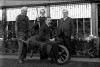
William Singleton, showcasing the strength of a prosthetic arm, designed and built by James Gillingham. Gillingham (1839-1924), a shoemaker and self-taught “surgical mechanist”, helped nearly 15,000 disabled people regain their independence throughout his career. His first design, shown here in this photo, was the result of a canon misfiring during a celebration in March 1863. The strength that this image boasts, resembles the case of Prince Dolores, who, with the help of royal surgeons and mechanics, “managed to walk so as to be quite independent.”
Works Cited
Craik, Mariah D. The Little Lame Prince and His Travelling Cloak. Cove Studio, studio.covecollective.org.
Gillingham, James. Artificial Limbs, Surgical Appliances, etc [Electronic Resource]: With Illustrations of Remarkable Cases. Internet Archive, Exeter : Printed by H. Besley, 1888, archive.org/details/b21290143/mode/2up.
Image Source
Zemka, Sue. “1822, 1845, 1869, and 1917: Artificial Hands”. BRANCH: Britain, Representation and Nineteenth-Century History, edited by Dino Franco Felluga, Oct. 2015, branchcollective.org/?ps_articles=sue-zemka-1822-1845-1869-1893-and-1917-artificial-hands.
Consulted
Chard Museum. “James Gillingham(1839-1924): New Limbs for Old”. https://www.chardmuseum.co.uk/james-gillingham.
Museums Victoria Collections. “Item St 40883: Prosthetic Arm – Wooden, J. Gillingham, Circa 1914 - 1916”. Nick Crotty, photographer, collections.museumsvictoria.com.au/items/403747.
Rowley, Mark. “James Gillingham Collection of Photographs”. Art and Medicine, www.artandmedicine.com/biblio/authors/Gillingham2.html.
Science and Society Picture Library. Searched Gillingham, 45 results appeared. www.scienceandsociety.co.uk.