

Sir Edwin Henry Landseer was a child prodigy who began training at the Royal Academy of Arts when he was only thirteen years old ("Landseer, Edwin Henry (Sir)" 1). Most known for his paintings, sculptures, and etchings of animals, he was Queen Victoria’s favorite painter. Landseer was so talented that when the former president of the Royal Academy, Sir Charles Eastlake, died, he was offered the presidency. He declined the offer ("Landseer, Edwin Henry (Sir)" 3).
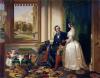
Though he was most famous for his scenes depicting animals and wildlife that conveyed a sense of sentiment and intelligence, he also created portraits and historical pieces. One such painting was titled “Windsor Castle in Modern Times.” He began the painting in 1840 and did not complete it until three years later in 1843. The medium was a traditional oil painting on canvas. The painting depicts Queen Victoria greeting her husband, Prince Albert, after a hunt—the results of which are strewn about the floor and on an ottoman as well—and she is holding or possibly presenting him with flowers. Their first-born, also named Victoria, who Queen Victoria referred to as Vicky in a letter regarding the painting, is depicted as a young child playing with one of the birds brought back from the hunt. They are in a simple but elegant drawing room, which Shawe-Taylor explains is the White Drawing Room at Windsor Castle, and it is decorated with the Morel and Seddon furniture that had been commissioned by George IV. Through the large window there is a clear view of the East Terrace, where Victoria’s mother, the Duchess of Kent, can be seen leisurely being pulled around in a bathchair—a light carriage designed for one person—with two attendants who appear to be either fanning her or blocking the sun. The names of the dogs are inscribed on the back of the painting along with the names of the individuals pictured. They are Eos, who was Albert’s favorite, Dinmont, Dandy, and Islay. Victoria was very happy with the painting, calling it “cheerful and pleasing,” and Landseer was paid 800 guineas for it (Shawe-Taylor). Such an amount would be worth approximately $66,716 U.S. dollars today.
The painting depicts quite an idyllic scene, with a happy young family and no sign of discontent or any other sort of unpleasantness. This is to be expected, as the royal family would want to be depicted in a flattering way, and also because the public, especially the middle class, viewed them as perfect and the ideal.
Both Queen Victoria and her daughter are wearing white dresses, with elegant lace detailing on the queen’s. White was an expensive color of clothing, as it was hard to create and equally as hard to keep clean. The fact that both the queen and her daughter are wearing it for what seems to be an ordinary day exhibits their wealth in an understated manner. The same can be said for the drawing room that they are in. It demonstrates wealth with the gold trimming on the wall, and the rich green curtain and matching furniture, but it does so in a way that isn’t gaudy, and makes it clear they are upper class without being showy or blatant.
Albert is wearing outdoor clothing with boots that are slightly muddy, and is surrounded by multiple different kinds of birds, indicating his prowess at shooting. This fits with traditional general roles, as men were supposed to be tough, capable providers. Game would not typically be spread out in the drawing room like this, and it is an obvious, intentional display of Albert’s skill. Victoria seems to be handing him a small bouquet of colorful flowers. This gesture is gentle and feminine, and when compared with Albert’s contribution of game, we can see that she is clearly depicted as more delicate and fragile, furthering the adherence to the women’s more submissive, subservient role to their husbands and men in general. The exception to this is the fact that Victoria is standing, and therefore taller than the seated Albert, which can be attributed to Victoria’s superior role as the ruling monarch.
Victoria, the Princess Royal, would’ve been about three at the time that the painting was finished. She can be seen gently playing with one of the birds Albert had caught. The specific type of bird she is holding is a Halcyon, and was a symbol of peace, which furthers the painting’s overall sense of tranquility and happiness (Shawe-Taylor).
Works Cited
"Landseer, Edwin Henry (Sir)." Benezit Dictionary of Artists. October 31, 2011. Oxford University Press. Date of access 20 Oct. 2020, https://www.oxfordartonline.com/benezit/view/10.1093/benz/9780199773787.001.0001/acref-9780199773787-e-00103924
Shawe-Taylor, Desmond. The Conversation Piece: Scenes of Fashionable Life. London: Royal Collection Publications, 2009.