
This timeline provides a sociohistorical context for Edward Hopper’s 1961 A Woman in the Sun.
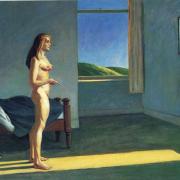
In relation to the sociopolitical movements of the 1960’s, A Woman in the Sun, shows the female freedom that women were just beginning to experience with the legalization of the pill for married women in 1960. This was just a taste of what was to come. The woman in the painting represents freedom. Freedom of expression. Freedom of work. Freedom from men. The FDA’s approval of the pill would only just be the beginning of the second wave of feminism as it would continue into the next decade with legalization of the pill for all women and the decision of Roe vs. Wade to make abortion federally legal. These movements were integral in women’s freedom, allowing them more bodily autonomy, which in turn allowed them to have more opportunities in the workplace and just in life. Women were no longer expected to just be homemakers, wives, and mothers, but they could have a regular job like the men, reflected in the shoes in the painting which would have been worn in an office setting.
For Edward Hopper, the sale of Nighthawks, would prompt a successful art career in which he was able to create more freeing paintings like A Woman in the Sun. This, in addition to the support he got from his wife, Jo, would be integral in the creation of success in the art world. Nighthawks was just the beginning. It was far less taboo than A Woman in the Sun, but it was indeed a great stepping stone to Hopper’s success.
Works Cited
Bailey, Martha J. “‘Momma’s Got the Pill’: How Anthony Comstock and Griswold v. Connecticut Shaped US Childbearing.” The American Economic Review, vol. 100, no. 1, 2010, pp. 98–129. JSTOR, http://www.jstor.org/stable/27804923. Accessed 20 Mar. 2023.
Cascone, Sarah. “How Jo Nivison Hopper Is Being Rediscovered as an Artistic Force in Her Own Right.” Artnet News, 24 Mar. 2022, https://news.artnet.com/art-world/jo-nivison-hopper-2086277. Accessed 2 April 2023.
Hopper, Edward. A Woman in the Sun. 1961. https://uploads1.wikiart.org/images/edward-hopper/woman-in-the-sun.jpg. Accessed Feb 16, 2022.

Hopper, Edward. “Edward Hopper: A Woman in the Sun.” Edward Hopper | A Woman in the Sun | Whitney Museum of American Art, 2023, https://whitney.org/collection/works/1337.
Lebovic, A. (2019), ‘How to be in Fashion and Stay an Individual’: American Vogue, the Origins of Second Wave Feminism and Mass Culture Criticism in 1950s America. Gender & History, 31: 178-194. https://doi.org/10.1111/1468-0424.12415
Wood, Gaby. “Edward Hopper's Wife and Muse.” The Guardian, Guardian News and Media, 25 Apr. 2004, https://www.theguardian.com/artanddesign/2004/apr/25/art1.
Timeline
Table of Events
| Date | Event | Created by |
|---|---|---|
| 1924 | Josephine Nivison HopperJosephine Nivision Hopper was Edward Hopper’s wife and the model for A Woman in the Sun. She was in her 70’s by the time Hopper painted the painting, but he made her look younger for the purpose of the painting.He had a vision of what this painting meant. Jo, as she was called, was integral in Hopper’s success. He was the only model he would use for his paintings. She was a successful artist for sixteen years when they were first married, and was able to help him sell his paintings, the first being in 1924. This happened at a show where Jo was showing her own paintings and insisted he show his paintings too. She would even somewhat give up her own painting career to run books for all the paintings Edward had sold. While she gave up her career for Edward, she never stopped painting. The two would even paint together, sometimes creating similar or identical scenes. Above is a painting titled Self Portrait done by Jo. Jo was the driving force for Hopper’s career. If not for Jo’s dedication to Edward, he would not have had the opportunity to sell as many paintings as he did, therefore, he would not have had the success he had. Hopper, Josephine Self Portrait. Date unkown. https://en.wikipedia.org/wiki/File:Josephine_Nivison_Hopper,_Self_Portrait.jpg. Accessed 2 April 2023. |
Allison Schroeder |
| 1942 | NighthawksEdward Hopper painted Nighthawks in 1942. It was inspired by a scene in Greenwich Village in Manhattan, New York. He spent around a month and a half working on the painting, once again using his wife Jo as a model and himself as a model for the male figures in the painting. It was sold within three months of its creation for three thousand dollars (almost fifty thousand today). The Art Institute of Chicago purchased it after it had been displayed at a gallery where he normally showed his work for sale. Previously to this painting, Hopper worked as a commercial painter and did not sell much of his work. It was his first major sale and is known today as one of the most iconic scenes in American art culture. Jo showed her great approval of the painting and its name, which was originally Night Hawks. This, along with many of hos other works, depicts a scene of loneliness. He never did this with intention, however, he seems to capture the loneliness of the human spirit quite often. This scene in particular has been parodied many times in popular culture and is perhaps one of the most recognizable art pieces of the twentieth century. Hopper, Edward. Nighthawks. 1942. https://en.wikipedia.org/wiki/File:Nighthawks_by_Edward_Hopper_1942.jpg. Accessed 2 April 2023. |
Allison Schroeder |
| 1960 to 1972 | The Pill and other feminist movementsThe Food and Drug Administration approved the first oral contraceptive widely known as “the pill” for the first time in 1960, after previously approving it for usage in menstrual disorders. Although it was approved in 1960, the pill was not legal for married women until 1965 and for unmarried women in 1972. This followed the baby boom which notably comprised a large amount of the population. After the approval of the pill, birth rates in the U.S. began to decrease drastically (Bailey). This gave women more control and autonomy over their bodies, as abortion was not federally legal yet. Bill Baird (pictured right) was arrested several times for distributing birth control to unmarried women, which prompted the court case Eisenstadt v. Baird which made birth control available to unmarried women. The woman depicted in the painting is in control. She is illuminated by the sun to be the focal point of the painting. While the painting is somewhat voyeuristic in nature, the woman has the control. She is standing there tall and proud of her actions. Hopper was far more conservative than his wife Josephine. Their relationship was tumultuous because she was more liberal and he was more conservative. She gave up her painting career for him. The loneliness she shows in the painting is likened to the experience of women who didn’t have the option of the pill before. This directly correlates with second wave feminism. In the 1950’s and 60’s the second wave of feminism was just starting and women were entering the previously male dominated workplace. Women were beginning to wear workplace attire, including heeled pumps. Women were beginning to develop a certain style that pertained to this workwear era. This woman in this painting has a pair of workplace heels under her bed. She is young, so it is likely that she would have been working this sort of office job. The bareness of the scene highlights these pumps and the woman separately. It asks: why would this woman have these heels?
“Bill Baird.” Radcliffe Institute for Advanced Study at Harvard University, https://www.radcliffe.harvard.edu/schlesinger-library/collections/bill-…. Accessed 2 April 2023. |
Allison Schroeder |

