
During the end of the 19th century and through the majority of the 20th century, Education was an ever-evolving space across the country. The examples in this set give a glimpse into a historical mirror as to how different Education was through the last 120+ years. There is a noticeable change through the decades in what methods, techniques, and settings were being studied and tested as different pedagogy techniques were being developed. As the title of this gallery suggests, Work-Play-Study schools appear sporadically across the country which pivoted the traditional focus of academia from that of textbook academics-only to that of hands-on skills, environmental/setting changes, and incorporating play time in addition to the daily class routine. Many ideas were tested, as were the children as a whole, when their outcomes were the purpose of the education instead of the education itself.
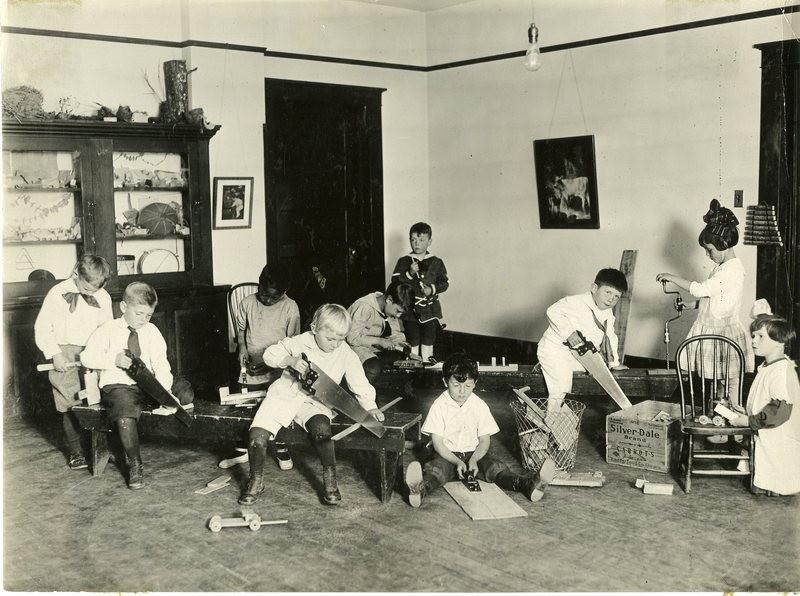
College Elementary School, Washington State Normal School, Kindergarten class, circa 1900. As the Work-Play-Study school concept grew in awareness, the rigid structure of academic education in one classroom all day began to depart in favor of gaining experience in several disciplines throughout a long day. This was due in part to the size of cities and their populations becoming larger. The new structure was able to fill the schools with more students (some report almost doubling capacity) by adding the utilization of (what we would call today) gymnasiums for physical activities, music lessons, and drama clubs; libraries for the study of external topics, and workshops to serve as skill-building for their students but also for the maintenance of its school as well as serve as project sources for other schools. All this new educational diversity was added to the typical academic part of the day. In this first picture, we can see a Kindergarten class assumingly using hand tools such as saws, hammers, planers, and drills all to craft additions to the pinewood derby-type cars (floor left of center and chair on right). Perhaps the importance of STEM and motor skill concepts we know today were in effect before their labels as this picture was taken after the Industrial Revolution when much of the knowledge, skills, and trades were refined and made more efficient.
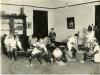
First-Aid Class at the Work-Play-Study School at Gary, IN., 1917. The second picture gives a glimpse into the history of the progression of Work-Play-Study schools as well as what was going on in the world at the time. In this picture, we can see a group of students practicing bandaging arms, ears, heads, and even fashioning arm slings. Unlike modern vocational-focused education available in some high schools today for the few that choose it, there was additional pressure for all students to learn real-life skills as a sense of "Americanism" increased during the first World War (1914-1918). Coming out of the war there was a focus on an "Educational Renaissance" where education systems were being restructured and rebuilt. Dauphin County was of no exception. Seminars and meetings were had discussing the importance of teaching hygiene and first aid in hopes to convince a diversion from the typical academic-only studies. Here again, we see a shift to the use of a "platoon" style where the students are formed into groups/grades that will use the different parts of the entire school as referenced in the first picture.
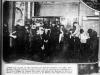
Pacific Oaks College Children's School, Children & Outdoor Construction, circa 1945. In the third picture, we see a group of students at work on some type of platform utilizing hammers and nails. Perhaps they were working on a modification for the student's raft structure already in the water pictured beyond and below the deck platform. Children worked outdoors with small penned animals, used tools, and played in the elements (water, sand, and mud). Again, we see education in skills for the children but also for the benefit of maintenance of the school as in the first picture. In addition to incorporating work and play into the traditional learning environment, some Work-Play-Study schools also found ways to integrate the use of the environment itself. Here in this picture, we see the use of water and a physical structure that the kids worked on and around. This school, and those like it, had parts of the academic learning in the adjacent gardens. Not only did the students learn how to compost and garden, but the garden itself served as a classroom to learn math, science, and writing outside. This school changed hands over the years as did the complexity of the school system. As the Work-Play-Study concept seemed to spread over the decades there was also expansion and exploitation of it. At one time, the parent owner, a college, used this pre-Kindertarten - 8th grade school not only to serve as a "test lab" for the outdoor concept but also used the kids themselves as a teaching element for their college student body for those continuing into college for child education-related fields (i.e. education, development, social work, psychology, etc.).
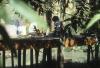
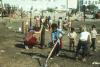
Washington Environmental Yard, From Lot to Land, circa 1972. The fourth and final picture is an early picture of the Washington Environmental Yard, or "WEY" as it became known. Although it sounds like a penitentiary, it was a school reformed into an environmental education program (aka lab - like the previous picture) in part, to study the outcomes of the children in this differentiated setting. The site of the school was roughly 1.5 acres (the size of about a football field) of nothing but asphalt even for the playground elements in the beginning. The location was soon completely converted into a more natural environment including a pond, gardens, and a platform for the children to engage with. Similar to the last picture is the concept of having the students interact with the elements, nature, and each other as opposed to only studying inside all day long. Here, we see the students taking part in that transformation by using shovels, pry bars, and digging post-holes for future structures. The operation and results of the WEY school were studied in depth and were shown to not only have both boys and girls intermix more due to playing in the natural scenery but also provided a safer setting for all the children compared to those with objects and toys to play with (and argue over). As the school was more focused on engagement with the surroundings, the structures, natural elements, and each other were the objects of attention. Interviewed staff noted because of this there was less violence and less need for reprimanding and stern discipline. The garden, sandbox, climbing platform, and swing set that were available at the school surely kept them captivated.