
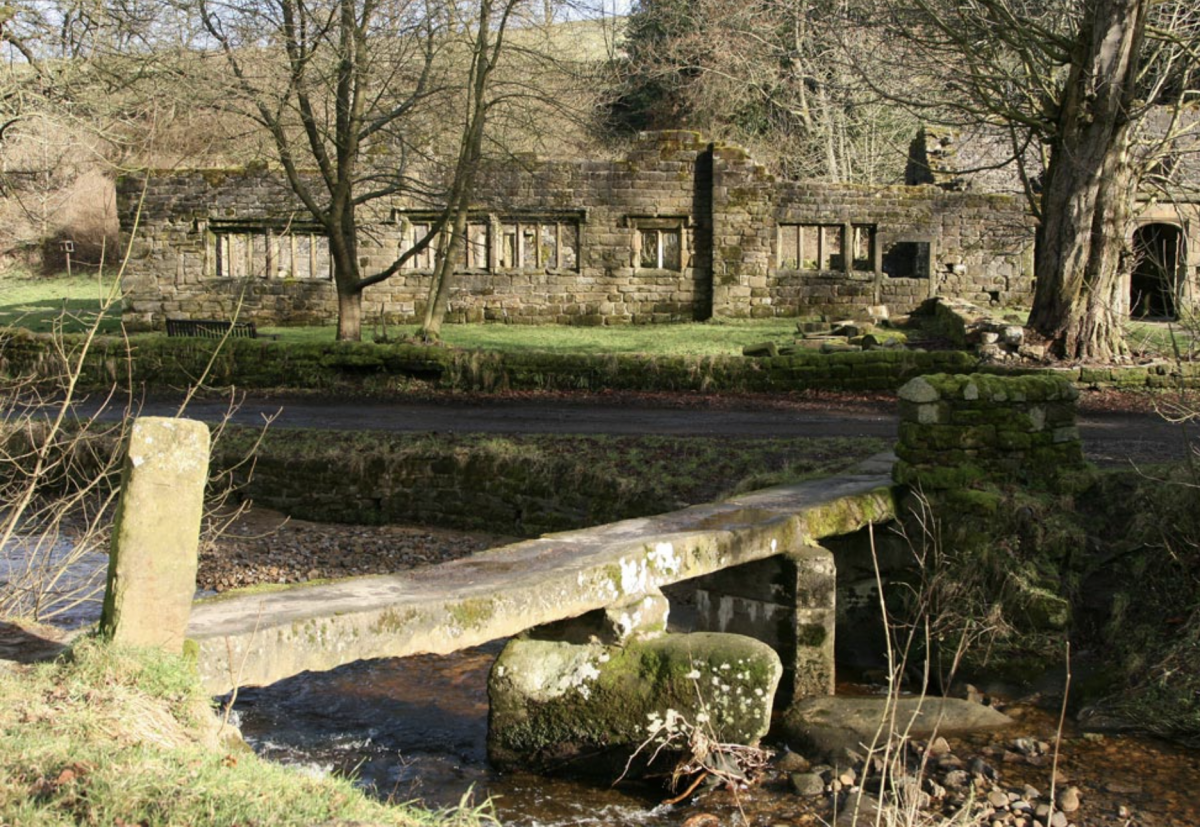
 In the final chapters of Jane Eyre, Jane arrives at a new, but not unfamiliar, location in her quest to reunite with Rochester. While this location was referred to prior to the ending, this annotation aims to elucidate the evolution of the place's significance with the newfound insight that the ending allows us. Previously In chapter 27, Rochester had only briefly mentioned this location— a second property known as Ferndean Manor— in a derogatory statement on the topic of his plans for his wife, Bertha Mason. Then, Rochester stated,
Though I possess an old house, Ferndean Manor, even more retired and hidden than this, where I could have lodged her safely enough, had not a scruple about the unhealthiness of the situation, in the heart of a wood, made my conscience recoil from the arrangement. Probably those damp walls would soon have eased me of her charge: but to each villain his own vice; and mine is not a tendency to indirect assassination, even of what I most hate (Brontë 269).
Later in chapter 36, we learn more precisely that this estate is "about thirty miles off" from Rochester's previous residence, Thornfield Hall (Brontë 382). This real-world location Wycoller Hall, identified on our map, is greatly speculated to be the place and inspiration for the story's Ferndean Manor. The Lancashire area where Wycoller Hall is located was often frequented by the Brontës, and its location roughly matches the distance from Thornfield stated in the book ("Ferndean manor & the Brontë Connection"). Starting in the 17th Century, Wycoller Hall was owned by the Cunliffe family —where a daughter, Elizabeth Cunliffe, married and lived with a man named Thomas Eyre (Avery).
Both Wycoller Hall's real-life and fictional landscapes encapsulate a moderate, and woodsy atmosphere. In Rochester's earlier statement, the estate's overgrown and secluded nature had extremely negative connotations —as it's suggested that it would be a torturous place to send Bertha to live out her life until an inevitable death. With his previous perceptions in mind, this indicates that Rochester's decision to take up residency in Ferndean now may suggest a self-deprecating view of his own personage or circumstances. Yet, this becomes the final resting location of both Jane and Rochester. A study published by Yoshiaki Shirai in The Journal of the Brontë Society, suggests that the significance of the location is changed by Jane's presence and the mid-late 19th century phenomenon: "pteridomania" (Shirai). This trend referred to an increased affinity for naturalism, particularly in the form of ferns which the interest in and collection of were correlated to intellectual habits (Iliana). Not only was naturalism and ferns it fashionable at the time of Charlotte writing Jane Eyre (suggesting that Ferndean in name and environment was positively received by society), but ferns also became a symbol of female's sexual desire (Iliana). With this suggestion in mind, the ending at Ferndean Hall connotates not only a happy ending for the characters but one that highlights what would be, at the time, a taboo sexual desire on Jane's part.
Work Cited
Avery, Alison. "Wycoller Hall (Ferndean Manor), Lancashire." Beautiful England Photos. https://www.beautifulenglandphotos.uk/wycoller-hall-ferndean-manor/. Accessed 27 January 2022.
"Ferndean Manor & the Brontë Connection." Lancashire Countryside Service. https://web.archive.org/web/20100714215918/http://www.lancashire.gov.uk/environment /countryside/pdf/Wycoller_sheet_3.pdf. Accessed 27 January 2022.
Iliana. "Pteridomania: The Victorian Obsession with Ferns." Cshouse, 10 June 2021. https://cshouse.org/pteridomania-the-victorian-obsession-with-ferns/. Accessed 27 January 2022.
Shirai, Yoshiaki. "Ferndean: Charlotte Brontë in the Age of Pteridomania." The Journal of the Brontë Society, vol. 28, no. 2. 18 July 2013, pp. 123-130. doi: https://doi.org/10.1179/bst.2003.28.2.123. Accessed 27 January 2022.