
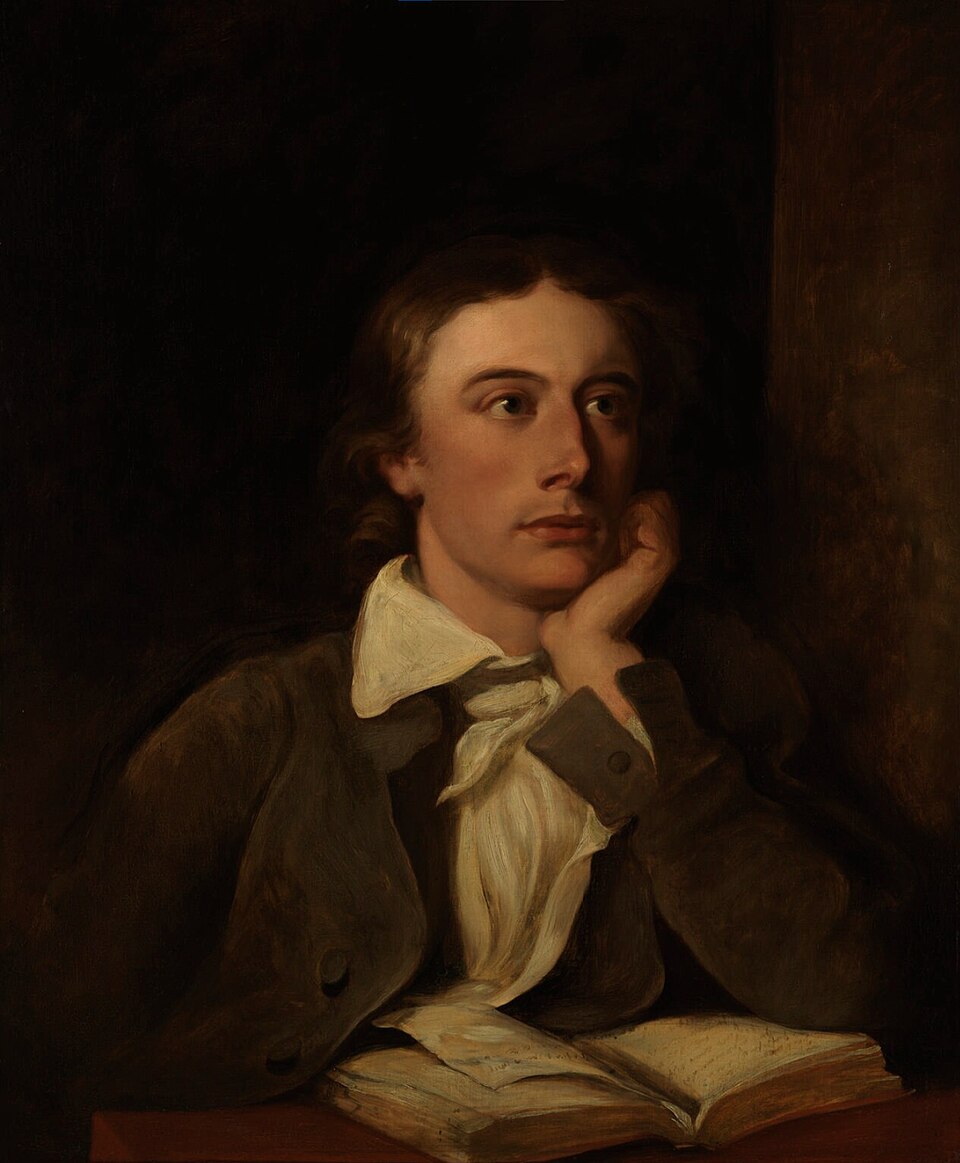
John Keats was born in London on October 31, 1795, and died in Rome on February 23, 1821, to tuberculosis.
He was of the second generation of Romantic poets, alongside Percy Shelley and Lord Byron. Although having published only 54 poems before dying at the age of 25, his passion for life and the imagination shone intensely. A tragically ephemeral poet himself, his ruminations on life's ironies contrasted with the beauty of art and imagination are seen clearly in the six great odes he wrote in 1819.
One of the most popular of all Romantic poems, "Ode on a Grecian Urn," belongs to this illustrious list. It is a delightfully complex ekphrasis poem about a speaker beholding the scenes on an urn about lovers, a pastoral procession, and an empty city. Here, Keats notes the wonderful irony of art in which idealistic scenes are trapped in time, much unlike the human observer. It is also where the infamous line "Beauty is truth, truth beauty" can be found, the meaning(s) of which is debated widely. Keats is also the originator of the famous term "Negative Capability," which posits the ability to exist independently, in a "negative" space, of traditional logic and reasoning. It was in a letter to his relative that he claimed great thinkers “capable of being in uncertainties, Mysteries, doubts, without any irritable reaching after fact and reason.”
Keats stands as a great literary "what if?" whose short life only emphasized the ephemeral themes of his work.
Guthrie, Camille. “John Keats: ‘Ode on a Grecian Urn.’” Poetry Foundation, 13 Sept. 2020, www.poetryfoundation.org/articles/145240/john-keats-ode-on-a-grecian-urn.
(Information) Poetry Foundation. “John Keats.” Poetry Foundation, 2009, www.poetryfoundation.org/poets/john-keats.
(Image) Wikipedia Contributors. “John Keats.” Wikipedia, Wikimedia Foundation, 23 Mar. 2019, en.wikipedia.org/wiki/John_Keats.