
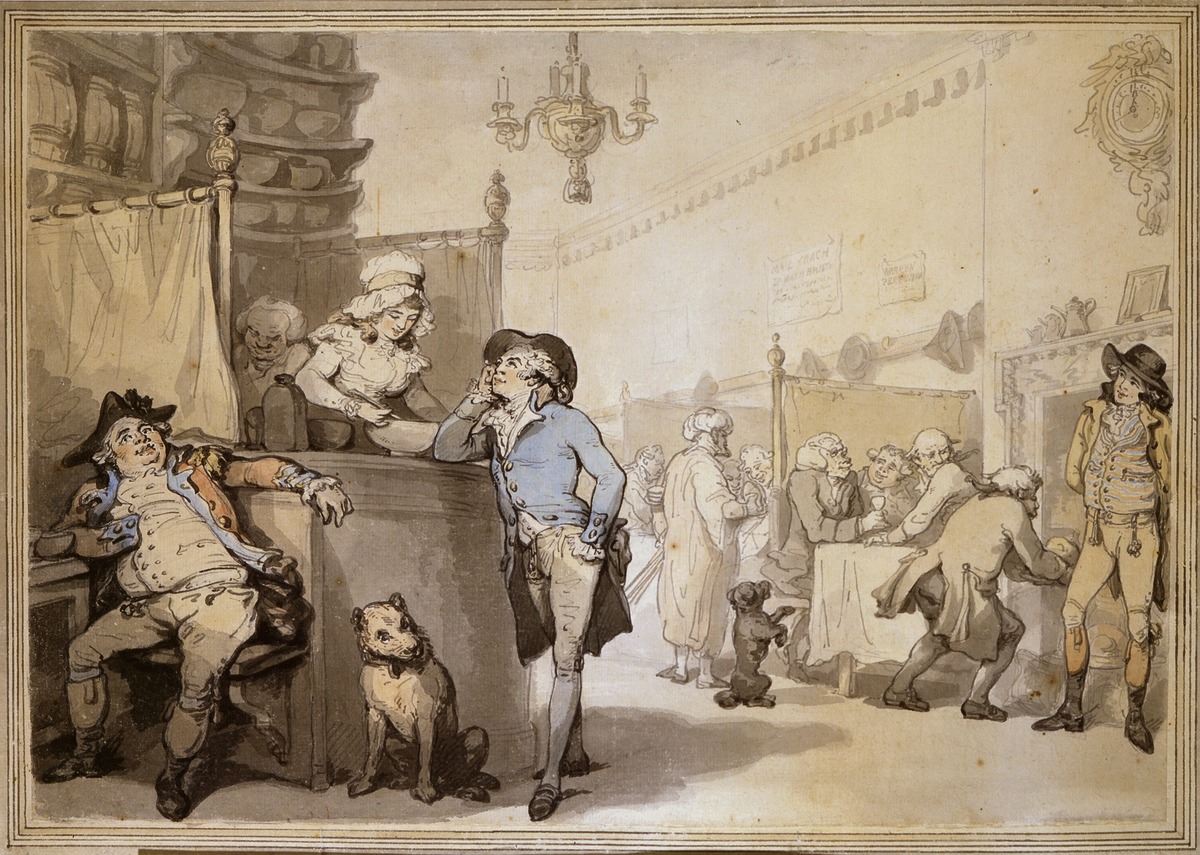
Thomas Rowlandson (1757-1827), The Coffee House (pencil, pen, and watercolor on paper, 1790; Aberdeen Art Gallery); Art UK.
In 1711, Joseph Addison (1672-1719) and Richard Steele (1671-1729) founded the daily periodical, The Spectator, to bring "Philosophy out of Closets and Libraries, Schools and Colleges, to dwell in Clubs and Assemblies, at Tea-Tables and in Coffee Houses" (Spectator, no. 10). The two writers came together from opposing political perspectives to craft a prose of disinterested, civil observation by its fictional characters "Mr. Spectator" and fellow members of the Spectator Club. Literary historians have treated the periodical's daily installments as a progenitor of the serialized, epistolary novel (Benedict 6-7).
The social context of The Spectator and other periodicals was the coffee house, which served coffee, chocolate drink, wine, brandy, and punch, and which became hubs for conversation, news, and deal-making among middle-glass gentlemen. The houses tended to host specific professions -- artists at Old Slaughter's, literati at Will's, dancers and opera singers at the Orange, and so on. During the Restoration, Charles II attempted to close them, suspecting "treasonable" conversations since people of all ranks were admitted, but his opposition was stymied by his own cronies who habituated the scene. After the Glorious Revolution, Addison idealized the coffee houses as upholding civility and learning more constantly than was likely. Nonetheless, when James Boswell -- the biographer of the essayist Samuel Johnson -- came to London from his native Scotland, he loved to frequent the coffee houses and imagine himself as "Mr. Spectator" himself (Brewer 35-40).
Benedict, Barbara M. "Joseph Addison." The Oxford Encyclopedia of British Literature, edited by David Scott Kastan, Oxford UP, 2006, vol. 1, 6-10.
Brewer, John. The Pleasures of the Imagination: English Culture in the Eighteenth Century, Farrar Straus Giroux, 1997.