
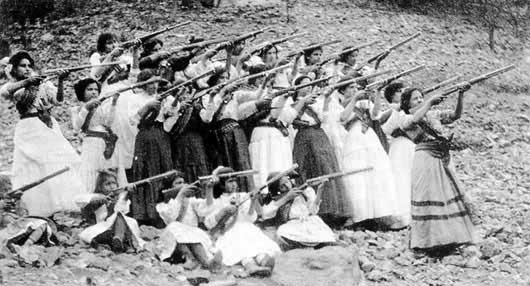
The Mexican Revolution was a war that ended the rule of dictator Porfirio Díaz and altered Mexico's politics and social systems. It began in 1910, when leaders such as Francisco I. Madero called for democratic reforms. Factions led by people such as Emiliano Zapata and Pancho Villa advocated for a redress of land and social inequalities.
The ten-year war was very violent and caused many economic issues as well as deaths. As a result, the Constitution of 1917 was established with the intention to protect the rights of workers and equalize the distribution of wealth.
This historical event has significance to A Solid Home in that Garros portrayal of its traumatic aftermath is depicted through her work. The play does not depict the revolution itself, but instead describes an aristocratic family living in the ruins of their once beautiful estate. This is a reference to the fall of Mexico's class structure that was brought about by the revolution.
The characters are stuck in the family crypt, and are unable to escape their psychological confinement after death. This reflects the way that not all people were liberated by the Mexican Revolution. The house represents privilege, as well as its downfall beyond repair. This symbolizes the same downfall suffered by Mexico post-revolution.