
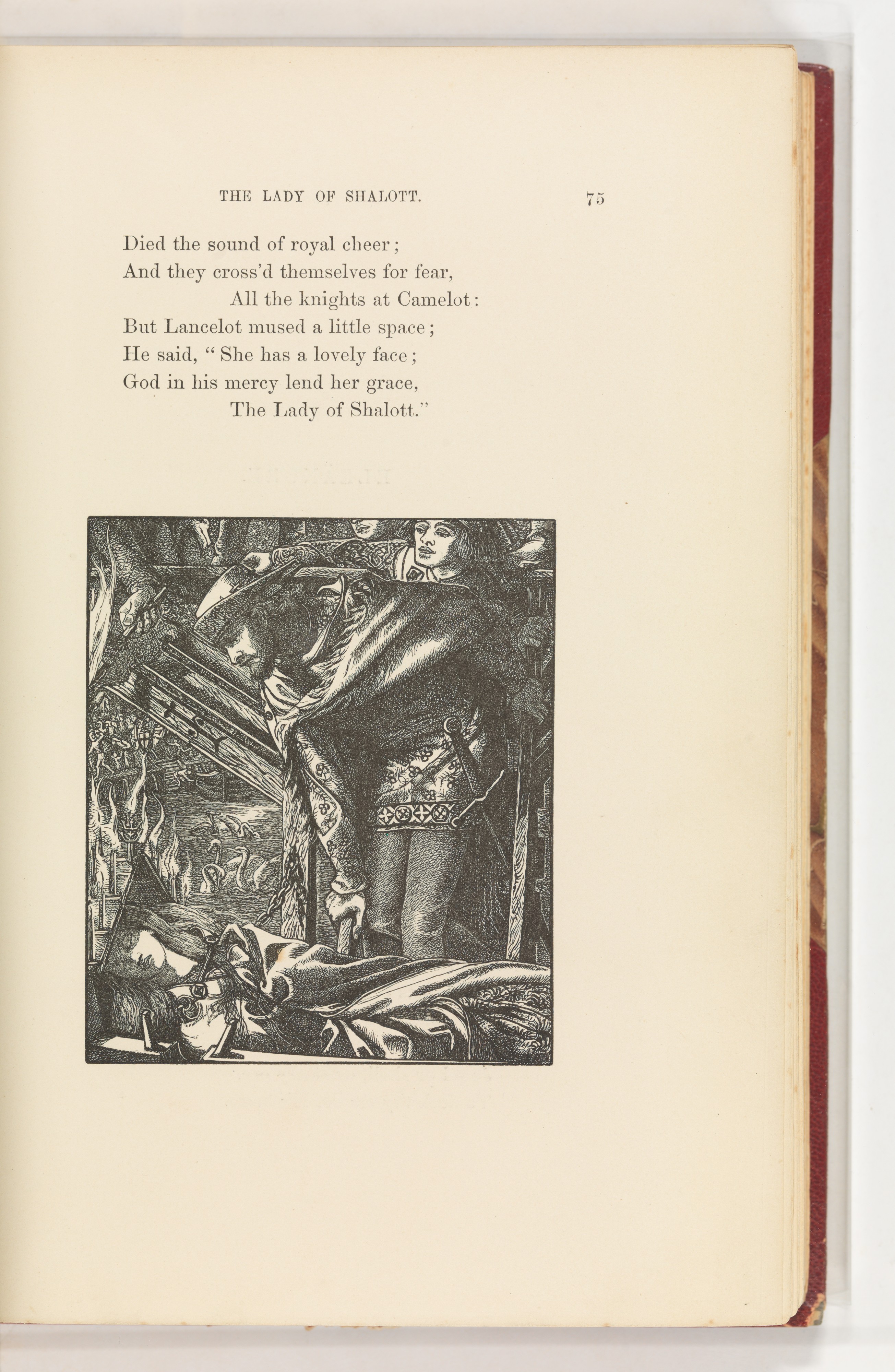
Tennyson's conflict with the Pre-Raphaelites stems from the Pre-Raphaelites insistence on taking Tennyson’s work and interpreting it in ways that didn’t represent his viewpoints at all. In Edward Moxon’s 1857 edition of Poems, it featured illustrations by major Pre-Raphaelite artists. John Everett Millais, William Holman Hunt, and Dante Gabriel Rossetti, all artists with distinct styles, were commissioned to create illustrations for Tennyson’s work following the text, but they had other plans. Tennyson expected all images to convey the meaning of his words and no more, but when it comes to strictly mirroring a text, failure is bound to happen among artists of different styles.
This pending failure of course happened, and Tennyson had some complaints. Still, Ruskin defended the Pre-Raphaelites creativity, writing that, ‘they are always another poem, subordinate but wholly different from the poet’s conception, and serve chiefly to show the reader how variously the same verses may affect various minds.’ It must be understood that the Pre-Raphaelites were fans of the Gothic, and, coincidentally, Tennyson’s “Lady of Shalott” was one of the most Gothic pieces that caught their attention. Tennyson’s writing was evocative and full of sensory details that were practically begging for the Pre-Raphaelites' attention. It wasn’t that the artists were against him; they just wanted to bring those visuals to life, while Tennyson wanted the viewers to use their imagination. While it is important to try to maintain the true meaning of texts and depict them as they were intended to be viewed, Illustrators have the right as artists to respond to the emotion of the text itself. “The Lady of Shalott” allowed the Pre-Raphaelites to convey an even more Gothic atmosphere and Wordsworthian intensity.
Nonetheless, the artist's individual style did cause problems in the publication process. After all, as George Somes Layard in the text says, "Millais realized, Hunt idealized, and Rossetti transcendentalized the subject.” This made it difficult to get anything done. Millais made the greatest contribution to the collection of poems for Tennyson, providing 18 images. His contribution as an illustrator was so grand that Author Trollope said that it was “the best I have seen in any novel in any language.” Rossetti, on the other hand, was a perfectionist, which greatly delayed publication and strained Moxon’s budget. In fact, Rossetti only contributed 5 out of the 7 promised drawings, refusing to “sacrifice the exuberant detail of his drawings to the exigencies of printmaking.” Ultimately, the book turned out to be a major financial failure due to mixed reviews and competition.