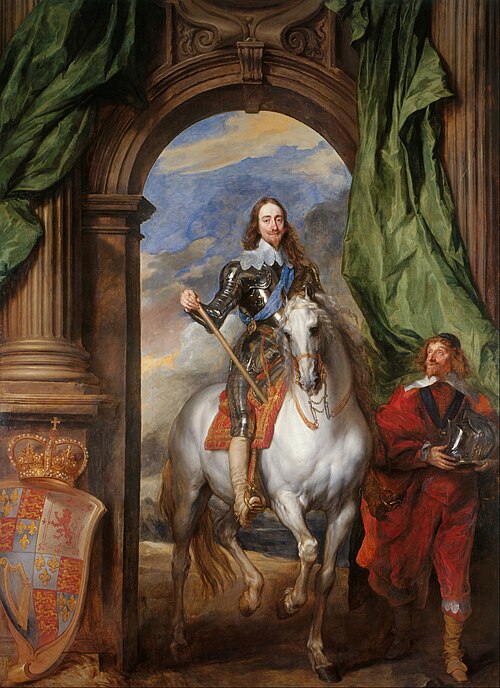
Anthony Van Dyck, Charles I (1600-1649) with M. de St Antoine (oil on canvas, 12.1 ft x 8.8 ft, 1633; Royal Collection, Windsor Castle); Wikimedia.
Van Dyck (1599-1641) was a Flemish artist, whom the Stuart monarch, Charles I, appointed painter to the English court in 1632. Along with another celebrated Flemish artist of the period, Peter Paul Rubens (1577-1640), Van Dyck typified the Continental artist on whom Charles relied rather than cultivating native English artists. Among the greatest art collectors of his age, Charles instinctively turned to France, Netherlands and Flanders, Spain, and Italy to define the taste of the court.
Van Dyck was especially known for the Grand Style portrait, in this example also an equestrian portrait. The huge canvas depicts Charles in military armor, astride a noble steed and riding through a triumphal arch. The architecture alludes to the triumphal arches of the ancient Roman Empire, which were erected for powerful generals and emperors returning from a great military victory. The symbolism enforces Charles's absolute power; and since he is accompanied only by his riding master, M. de St Antoine, instead of surrounded by cheering crowds, the symbolism also enforces his "Personal Rule" — referring to his decade of ruling without Parliament, an absolutist monarch justified by Divine Right. The picture was originally hung at the end of the Long Gallery in Hampton Court Palace, creating an illusion of the king entering the palace in a blaze of power (Roy Strong, Charles I on Horseback, Viking, 1972, 14, 20-25).