
William Hogarth (1697-1764) was an English satirist, cartoonist, and painter who was famous for his “Modern Moral Subjects,” which were series of paintings that formed a connected narrative and served as a satirical critique of English society. Hogarth reproduced the paintings as engravings for sale, and some series originated only as engravings.
In the early eighteenth century, a new satirical art form became popular in England: portrait caricatures. Previously, the form had been practiced in the seventeenth century by elite circles in the Roman art world. They were first popularized by Pier Leone Ghezzi (1674-1755) and typically this type of portraiture exaggerated prominent features of a person. Ghezzi’s caricatures were done humorously rather than maliciously, and permission was granted by the sitter for the work to be done. However, caricatures were based on phrenology, the pseudo-science that asserted the physiognomic fallacy that character can be read in features, since personality traits were located in the brain and consequently the shape of the skull. Caricatures exaggerated such physical features as representations of moral attributes such as greed or voraciousness. Later on, George Townshend (1742-1807) would use caricatures to satirize English military figures.
Hogarth strongly opposed Ghezzi’s work, likely because he believed it undermined the status of his own art. Rather than seeing his art as an exaggeration of history and English society, Hogarth saw his satires as works of observation. Subscription tickets for viewing his Marriage a la Mode series addresses the difference between Ghezzi’s caricatures and his paintings of “comic” history. His work, Characters and Caricatures, depicts the difference between “character” and “caricatures,” which is that “character” depends upon observation, whereas “caricatures” are created through serendipitous scribbling (essentially haphazard sketching guided by prominent features of the sitter). In the lower center of the crowd, Hogarth is believed to have inserted portraits of himself and Fielding grinning at one another.
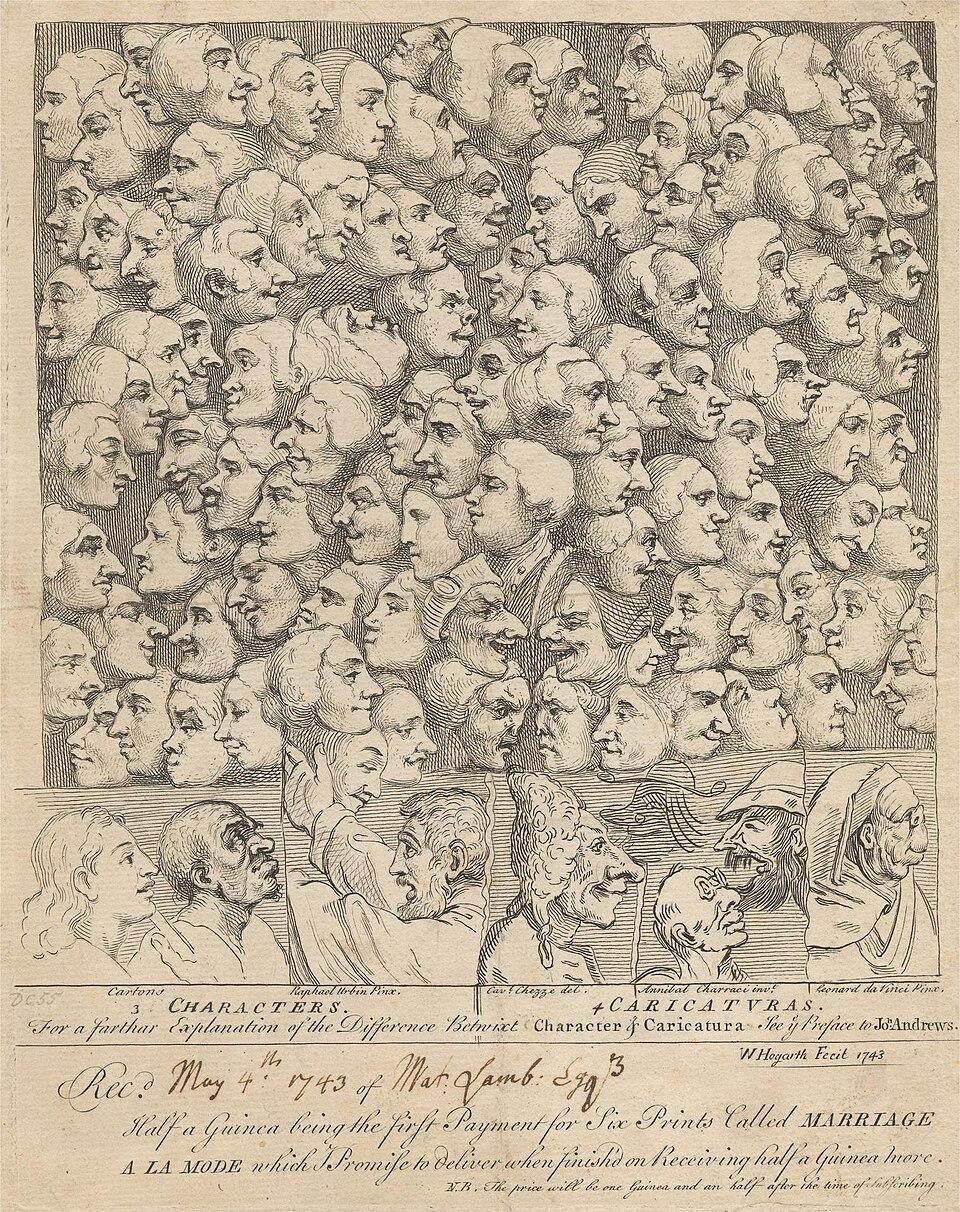
The image above of Characters and Caricatures depicts Hogarth’s view regarding the differences between the two terms. The “character” drawings present physical features (on people) that are less dramatized than the caricature counterparts. Hogarth viewed his work as an observation and reflection on English society whereas he viewed caricatures as a form of exaggeration.