
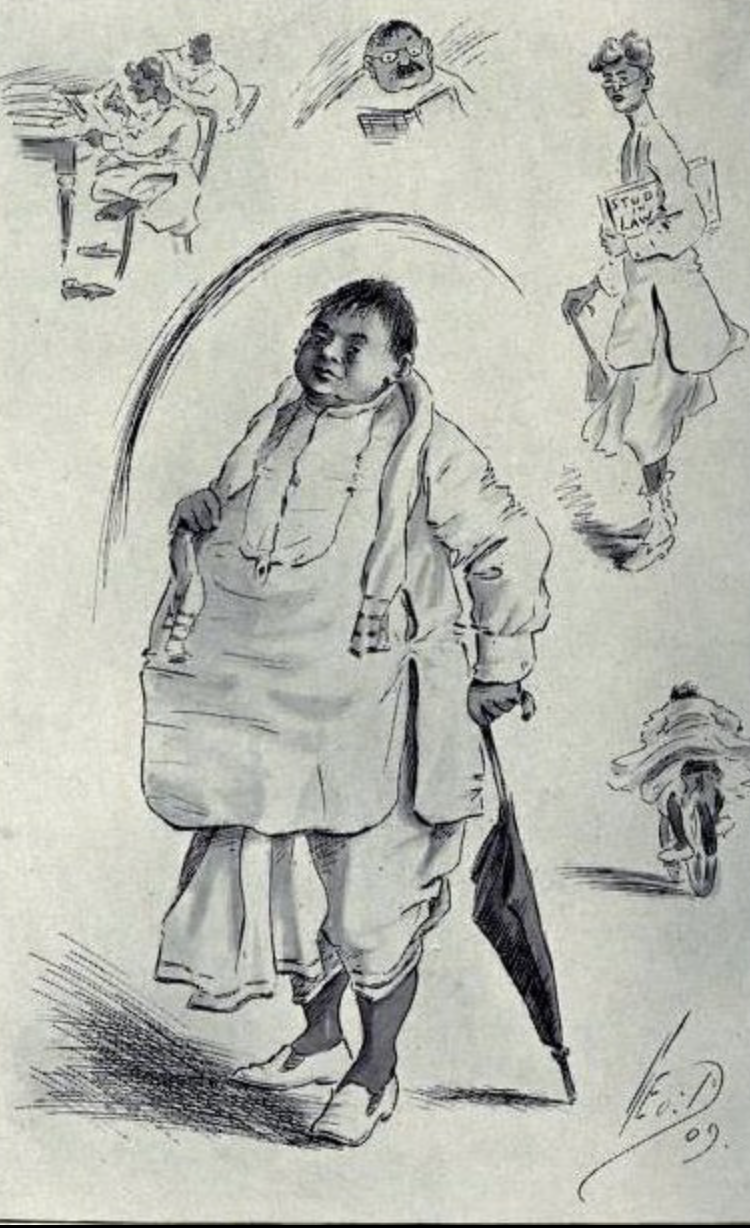
Babu is a title of endearment and respect typically used to refer to educated men in India. When the honorific “ji” is utilized as a suffix, respect is specifically shown toward an individual’s father in northern and eastern India. Babu can also be used as a suffix added to a person’s name. When India was under imperialist rule, this term served as a way for the British to refer to Indian clerks, as “babu” was understood to be the equivalent of “sir” or “mister.” A babu would have had privileges as workers of the British empire, and their British counterparts would have perceived them as having equal ties to both Britain and India. However, in some contexts, babu was also used in a disparaging way by British officials. Since the mid-1900s, babu refers to workers in the Indian Administrative Service and of the general government, particularly in the media.
Sen uses this title to refer to several people in her narrative, which is saturated with myriad individuals; this seemingly constant influx of characters often makes it hard to track Sen’s different relationships, but knowledge of the significance of “babu'' underscores the idea that certain characters have more status and comfort than Sen experiences. This is evidenced when Sen begs Uncle Purna to take her money to Panna Babu’s house (Sen 61). With knowledge of the title's implications, it becomes clear that Sen believes that Panna Babu would take care of her, thus making her insistent and disrespectful tone toward her uncle more anchored in reason. Moreover, Sen's character becomes fleshed out with an understanding of the term. Her uncle notes that she has "the Babus under [her] thumb and has made [him] lose [his] job" (Sen 66). Here, Sen's charismatic and social nature becomes underscored with her Uncle's use of the term "Babus." This contrasts other moments in which Sen appears to be vulnerable, weak, and struggling to merely survive.
"Babu." The Free Dictionary, 27 February 2021, https://www.thefreedictionary.com/babu.