



Display Explanation
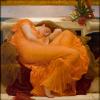
The room that this installation would be in would be circular, with earth-toned dark green paint on the walls. I want the room to be circular so that the paintings, that would be hung from the ceiling about a foot or so away from the wall, would be facing each other so that the installation looks cohesive rather than three individual paintings next to each other. I want the paintings to be hung from the ceiling rather than the wall because surrounding the paintings, I would put vines and cool-toned flowers with the painting within all of them. This is so the paintings look like they are in nature, to add to the natural setting of these paintings. For the flowers, I would have orange dahlia and begonia flowers by Flaming June to highlight the bright dress and bring out the "flaming" aspect of the painting. For Lamia, I would add pink orchids with baby's breath around the painting with a few blue agapanthas flowers within as well. I think this would bring out the pink, blues, and forest green of the painting. Lastly, for The Soul of the Rose, I would of course add baby pink roses to the installation, like the ones in the painting. However, I would also add dianthus flowers and angel amber kiss pansies. I think this would bring out the color scheme of the painting well. As for the lighting, I want there to be soft lighting that is bright enough to be able to see the paintings (obviously) but also not bright enough to the point where it ruins the nature and earthy aesthetic of the installation. I would want fairy lights throughout the installation with soft toned lights from the ceiling that would face each painting so that they appear like they are glowing. Lastly, I would add nature sounds such as birds chirping, light wind sounds, and waterfall sounds.
Installation Note
The painting Lamia shows a woman with long red hair dressed in a bright colored, flowy dress, and seems to be relaxed and delicate while sitting amongst nature. However, this painting also shows the sensuality of the female body by having one of her arms and breast out of her dress. Additionally, she is seen wrapped within a blue and gold cloth that appears similar looking to snakeskin. Throughout further research, I have found that Lamia, in some stories of Greek mythology, was the queen of Libya and was discovered to have had an affair with Zeus. In other stories, Lamia was a monster who "devoured children" and appeared as a half snake half human animal/demon. Although it is not confirmed, some critics have said that this is what Waterhouse was depicting with the blue and gold cloth, that it is actually snakeskin. This painting is actually Waterhouse's second version of Lamia and in the first painting, she is seen kneeling at the lab of a soldier and also has snakeskin shown on the lower half of her body. Apparently, Waterhouse got this idea from John Keat's poem "Lamia" which is about a groom, who on his wedding night, finds out that his bride is a half snake half human monster. It is unknown why Waterhouse, in this second version of Lamia, does not include the soldier. The Soul of the Rose, similarly to Lamia, also shows a woman with long red hair dressed in a long robe of some kind and smelling flowers. The artist makes the woman look effortless and elegant while still displaying the natural beauty of the female body. Her face portrays a look of longing and possible loss or missing someone, possibly a lost love. The Soul of the Rose is also a painting by Waterhouse, and it appears throughout his works that he uses women's place in society and their power in his paintings. He is from the Victorian Britain time period, where women had just started to be active in politics and had voting rights, but still were not equals to men. As I mentioned before, the woman in this painting has a look of longing on her face. It is said that Waterhouse painted this piece based on a poem from Alfred Lord Tennyson called "Come into the Garden, Maud" which is about a lover longing their soulmate and a line from it reads "My soul bleeds into the rose." Therefore, it is seen that this woman in the painting is sensing the grief of losing her lover. Based on her clothing and background, we can assume this woman is well-off financially and has some power, even if it is not fully represented in society at this point in time. Waterhouse also brings a sense of sensuality to this painting in the way the woman is positioned and is delicately smelling the flowers with her eyes closed. Waterhouse incorporates sexuality in this painting subtly and not with any obvious signs such as nudity, but rather naturally gentle by the way she is placed. Flaming June, shows a woman, similarly to Lamia in a bright, flowy dress, but because of the way it drapes around her body, it does not leave much to the imagination.It is unclear whether Leighton meant that June was the name of the sleeping woman, or if the painting takes place in the month of June, or if she, as a woman, is portraying the month of June. The woman has long red hair and is sleeping peacefully, and although she is not necessarily sleeping in a very natural position, the artist still makes her seem effortless. She also seems to be sleeping on a porch, with a background of nature behind her. Her flushed cheeks may represent her taking a nap after a long day in the hot sun in the tropical landscape that we see behind her. However, there is debate about whether this painting really does just show the peace of a woman sleeping during a summer evening, or if the painting means the connection between life and death. This is portrayed because of the plant, oleander, that is placed above the woman, which can be extremely toxic and deadly. For this reason, many believe that this painting represents the linking between sleep and death. Others have said that the woman, like the oleander, represents beauty and peace from afar, but when coming too close to either of them, can be deadly. Some have said that the woman in this painting is a "femme fatale" meaning a deadly woman who seduces men to catch them in deadly traps, rather than a peaceful, innocent woman sleeping after a long summer day. All three of these paintings have women with red hair and pale skin, what seemed to be a theme during this time period. I also feel like these paintings represent the natural beauty of women and the femininity and power that they naturally radiate. In all three of these paintings, the women are doing everyday things, yet still show the natural female body and the beauty it holds. There is an element of purity and innocence to these women in the paintings and the artists use nature and peace to highlight the natural beauty of the female body. However, there could also be a deeper meaning to these paintings that associate them with death and the subtle power, and possible fatality, that women have, although looking peaceful and innocent on the inside. This is where my title, Belladonna, comes from. In Italian, it means a beautiful lady, but in English it means a poisonous plant. This shows the two sides of the same thing - what I think these artists are trying to portray with their paintings.
Leighton, Frederic Lord. Flaming June. 1895. Museo de Arte de Ponce.
Accessed 5 Feb. 2022.
Waterhouse, John William. Lamia (version 2). 1909.
Accessed 5 Feb. 2022.
Waterhouse, John William. The Soul of the Rose. 1908.
https://www.john-william-waterhouse.com/soul-of-the-rose/ (Links to an external site.)
Accessed 5 Feb. 2022.