
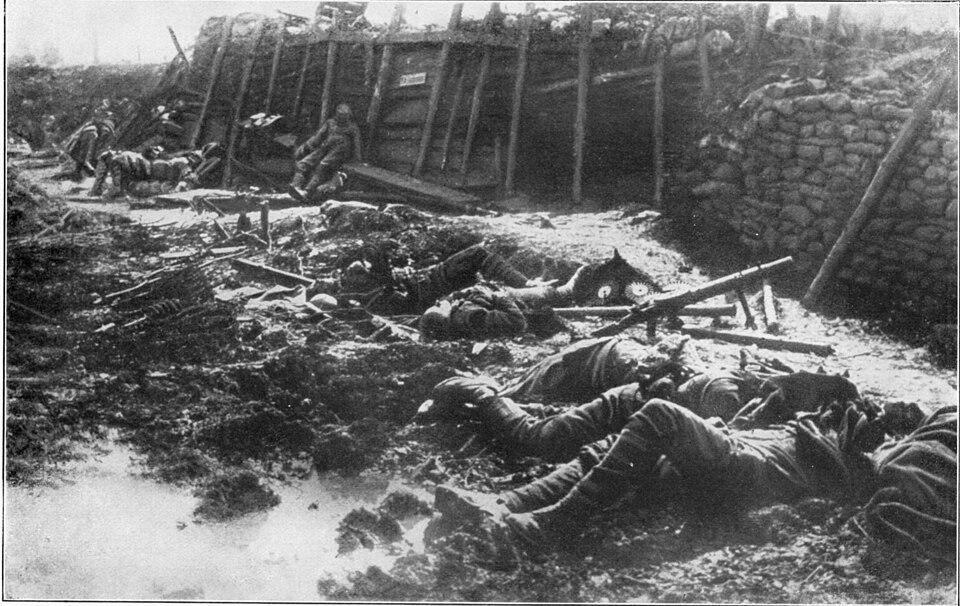
This photo represents identity and belonging because it shows how World War I stripped the soldiers of their individual identities and humanity through all the death and violence they witnessed. The soldiers in the photo are lying together, most likely dead, after a gas attack, which reflects how war was able to easily take them away from their lives, their homes, their families, their sense of belonging, and turn them into casualties of war.
The photo connects to Dulce et Decorum Est because it gives a visual representation of the deadly aftermath of poison gas that Wilfred Owen was describing in the poem. Wilfred Owen writes about a soldier dying painfully during a gas attack, and this image shows the aftermath of a gas attack. Both the poem and the photo reject the idea that war is honorable because both show the cost that war has on human lives.
British Emplacement after German Gas Attack (Probably Phosgene) by Hermann Rex is licensed under Public Domain.


Cartwright, Mark. “The Terrors of Poison Gas in WWI.” World History Encyclopedia, 19 Nov. 2025, https://www.worldhistory.org/article/2839/the-terrors-of-poison-gas-in-wwi/
Owen, Wilfred. “Dulce et Decorum Est.” Poetry Foundation, Poetry Foundation,
https://www.poetryfoundation.org/poems/46560/dulce-et-decorum-est