
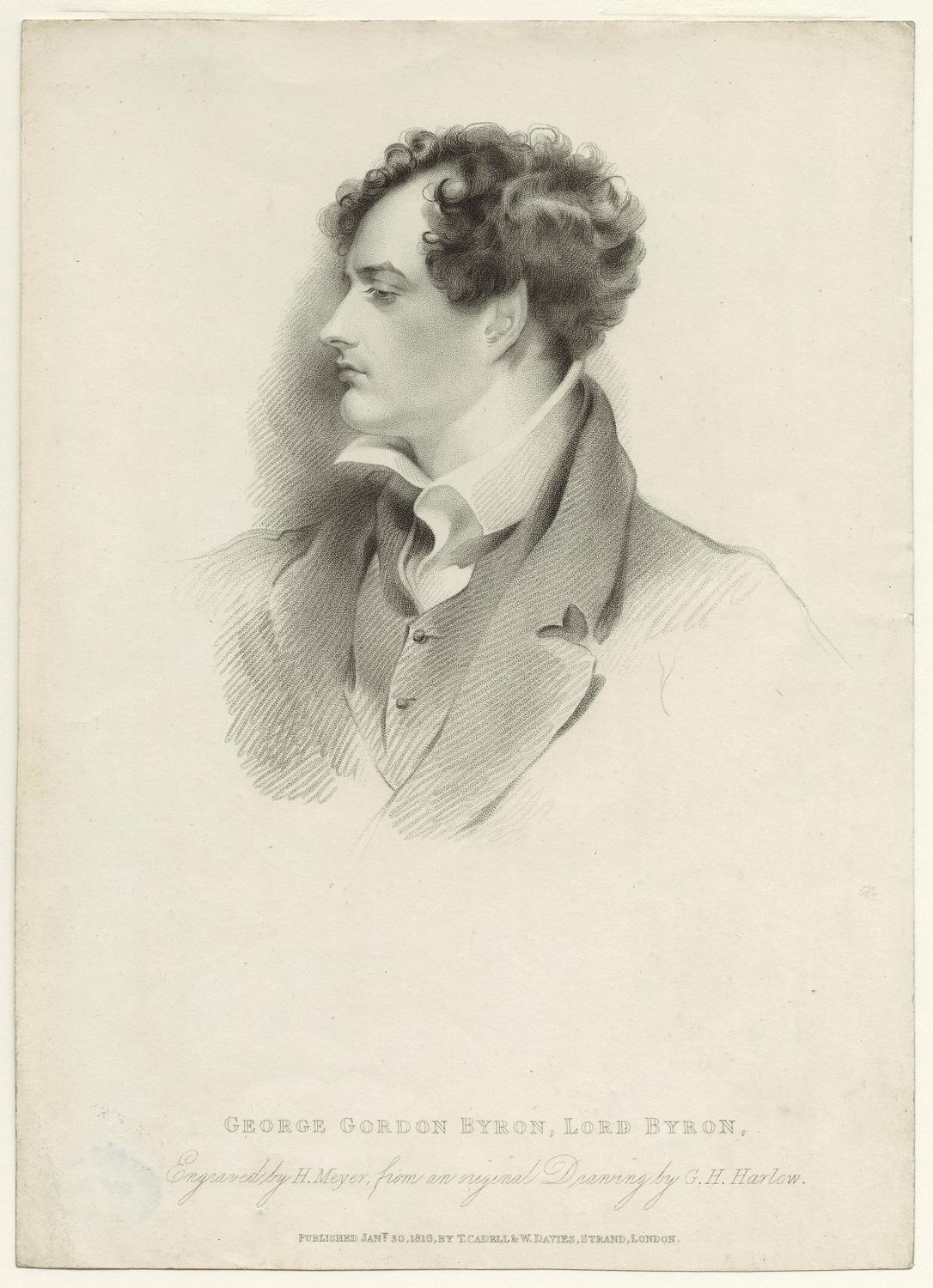

The Byronic hero is a character type named after Lord Byron, or George Gordon Byron, a prominent figure and poet in the Romantic Era. Born in 1788, Byron grew up with his aristocratic family in London. When his father died, he inherited the “Lord” title from a deceased uncle. It wasn’t until his adult years that Byron began publishing his work and notably, he was launched into the limelight with his semi-autobiographical poem called “Childe Harold’s Pilgrimage.” The titular character was believed to be an early example of a Byronic hero. As a long narrative poem that consisted of four parts, the poem followed the protagonist Harold from naive youth to weathered veteran after what many thought could be an examination of the author’s own travels and tales.
The first two cantos of “Childe Harold’s Pilgrimage” brought Byron into the public eye, he himself writing, “I awoke one morning and found myself famous.” This unexpected attention thrust Childe Harold into the forefront of the literary Romantic world, the protagonist becoming one of the first examples of a Byronic hero with qualities like arrogance, intelligence, moodiness, and a disregard for authority. Though similar to the Romantic hero, a Byronic hero exhibits a greater level of psychological depth and emotional complexity.
Along with the traits already listed, the Byronic hero was much like Byron: “mad, bad, and dangerous to know.” The Byronic hero has many dark qualities and is usually isolated from “normal” society: either by circumstance or self-imposed. The Byronic hero tends to have a deep secret or sin (Edward Fairfax Rochester from “Jane Eyre”) that reinforces their exile. Byron himself was a bit of an exile, who left England in 1816 and never returned. This was due to a legal separation from his wife and child, rumors of an affair with his half-sister, and his ever-increasing debt.
Byronic heroes firmly embody individualistic aspirations and self-sufficiency, while still being gloomy and discontent. Often, these characters seek retribution or revenge for some wrong (Heathcliff in “Wuthering Heights”) or are burdened with severe melancholy and anger. In spite of these attributes, Byronic heroes are often enticing and attractive to readers with their disregard for societal norms and customs. An accurate definition provided by “ The Norton Anthology of English Literature” describes the Byronic hero as “ an alien, mysterious and gloom spirit, superior in his passions and the torturing memory of an enormous, nameless guilt that drives him toward an inevitable doom. He is in his isolation absolutely self-reliant, pursuing his own ends according to his generated moral code against any opposition, human or supernatural.”
Lord Byron had a significant impact on Romantic and Gothic literature of all forms–and the influence of his work has grown even more influential throughout time. Prominent Byronic heroes began to emerge like Edmund Dantes of “The Count of Monte Cristo” and Claude Frollo from “The Hunchback of Notre Dame,” with more contemporary characters like Erik from “Phantom of the Opera” or Severus Snape from “Harry Potter.” Other classic literary archetypes emerged from the Byronic hero like the anti-hero, classic hero, the tragic hero, and more.
Sources:
Marin, Cristina Gabriela. “The Byronic Hero.” Language and Literature, European Landmarks of Identity = Langue Et littérature: Repères Identitaires En Contexte européen = Limba și Literatura, Repere Identitare în Context European: Selected Papers of the 9th International Conference of the Faculty of Letters, pitești, 8-10 June 2012, University of Pitești, Pitești, 2012.
Moore, Thomas (2006). "Letters and Journals of Lord Byron, 1830, volume 1". In Ratcliffe, Susan (ed.). The Concise Oxford Dictionary of Quotations. Oxford, England: Oxford University Press.