
Blois, one of the many chateaux of the Loire, is significant to Rebecca because it is surrounded by a dark history, yet the narrator focuses on its aesthetic beauty. In Rebecca, the narrator states that "there were some fine photographs of the chateaux of the Loire, and an article as well. I read it carefully, referring to the photographs, but when I finished I knew I had not understood a word" (du Maurier 36). This is extremely interesting, as Blois (and the chateaux of the Loire in general) is known for its history (with several English monarchs having lived there in different periods and the history being a major part of its tourism, according to loirevalley-france.co.uk). The likelihood of that article being on the chateaux of the Loire's history was high because of just how famous they were for their history. The narrator of Rebecca is unable to understand an article related to the chateaux (it is later hinted that the article is on Blois specifically), so she focuses on the pretty photographs. This alludes to how the narrator sees Manderley early on in the book. The narrator focuses on Manderley's beauty, but does not yet address its dark history.
The history of Blois that most relates to Rebecca is that of Catherine de' Medici. According to the history magazine, History Extra, "Catherine’s marriage to Henry II was not a happy one", "Henry spent very little time with his wife – to the point where courtiers gossiped that the queen was infertile", "she was made ‘governor of France’", and she started "imposing herself on all governmental meetings and using the influence she had over her son to remain in power". Catherine de' Medici is a very similar figure to that of Rebecca's in Rebecca. Both women were unhappily married, there were rumors that Catherine was infertile (and on page 413 of Rebecca, Doctor Baker says Rebecca "could never have had a child"), and both ruled their households through imposing themselves on others. They also were both fated to die slow, painful deaths. According to History Extra, "in September 1588 Catherine started to feel weak, and she eventually became ill with a lung infection" and "her lung infection spread further, and, on 5 January 1589, she gave her last breath in her own bed at the Castle of Blois. It is believed she died of pleurisy". Catherine de' Medici suffered for 4 months before dying. Rebecca was going to suffer for a similar amount of time before dying from cancer. Both women were strong, capable rulers who were slowly dying of illnesses they couldn't combat. Despite both of their strengths (and grim fates), the narrator tries to gloss over both of their existences.
History refuses to be completely ignored, despite the narrator's attempts. Immediately after the narrator avoids saying specifics on the article, she says that "it was not Blois with its thin turrets and its spires that stared up at me from the printed page. It was the face of Mrs Van Hopper...'An appalling tragedy,' she was saying..." (du Maurier 36). The narrator tried to ignore the history of a beautiful place like Blois, but was interrupted by being confronted with the very real (in the story) history of Rebecca. This foreshadows how, despite the narrator's early attempts to ignore the fact that Maxim had a wife (and her dark history), his wife's history continues to be an important part of Manderley's lore.
There is another way in which the history of Catherine de' Medici also connects to Rebecca. Interestingly, in recent years, historians have begun to see Catherine de' Medici in a sympathetic light, and their viewpoint highlights part of what the narrator worries about throughout Rebecca. According to Smithsonian Magazine, there was a "long-held characterization of Catherine as a power-hungry, unscrupulous and murderous woman" because rumors spread that she was "singlehandedly or largely responsible for the St. Bartholomew's Day massacre of 1572". They also go on to state that those rumors "stem in large part from Catherine's status as both a woman and a foreigner" and "Catherine had no royal blood. She 'was not born to be queen'". This echoes some of the narrator's fears in Rebecca. The narrator fears that she will not live up to the people of Manderley's expectations and that people might start spreading rumors about her (especially since she was not born into nobility and is not as accustomed to it as Rebecca was). The narrator fears being demonized, excluded, and treated as inferior because of rumors or her station. This is most clear in chapter 8 as she states "poise, and grace, and assurance were not qualities inbred in me, but were things to be acquired" and "one of them laughed - Robert, I supposed. Perhaps they were laughing about me. I went upstairs again, to the privacy of my bedroom" (du Maurier 90). The narrator fears all of the social mistakes she makes because of her low-born history and actively avoids the servants because she fears them laughing (and talking about her) behind her back. The rumors that could be spread would not necessarily be as violent as single-handedly inciting a massacre, but they could damage (and possibly destroy) her reputation nonetheless. She does not feel powerful enough to confront them and avoids addressing the issue (which further cements her as a person who avoids difficult conversations and now explains her reasoning for that as feeling inferior).
The narrator is also similar to Catherine de' Medici in that they were both compared to their husband's other love interests. According to an article from The World History Encyclopedia, King Henry II's mistress, "Diane was everything Catherine was not: she was supremely self-confident, beautiful, an aristocrat, whose parents had encouraged her athletic interests and education in a wide array of subjects.... Catherine was queen in name only. She had no political power and no influence over the king or the court". This mirrors the comparison between Rebecca and the narrator in Rebecca. Rebecca is glorified and seen as educated, intelligent, beautiful, confident, and noble. The narrator is small, young, common, and hesitant. The fact that Catherine de' Medici's history can be connected to both the character of Rebecca (through the rumors about her and how she is both glorified and demonized) and the narrator (through her common ancestry and comparison to another woman) shows how de Maurier wrote her characters to be intertwined with one another. They are both women who try to fill this role of Mrs. de Winter (despite their differences in personality). One is demonized by the text (being shown to be aggressive, promiscuous, and violent) and glorified by the characters within it. The other is shown to be meek and put at a disadvantage. Both are sides of Catherine de' Medici in her final months at Blois and how she was seen in the centuries after.
This information comes from Rebecca by Daphne du Maurier (book), loirevalley-france.co.uk (tourism website), History Extra (history magazine), Smithsonian Magazine, and The World History Encyclopedia (article).
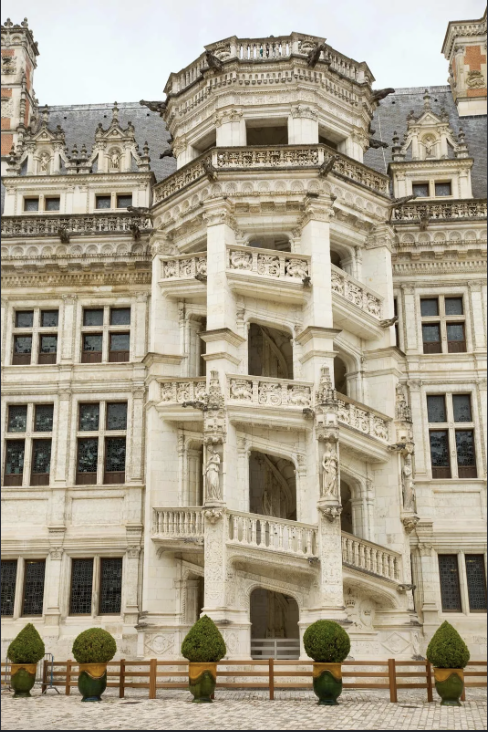
This location illustrates Gothic convention because it is a beautiful place haunted by the history of its past. People still go there specifically for the history and that is what they associate it with. Blois itself also appears haunting. It is a white building, which makes the interior look dark and foreboding. People have died within its walls and you can feel the gravity of the darker parts of its history even if it is beautiful.
Mapping this location on COVE reveals how the history behind this location complicates or depends the novel's plot. It adds more depth to the moment when the narrator is exploring the article on Blois, reveals some of the narrator's personality, and foreshadows Rebecca's history (which at the point Blois is mentioned is unknown).
Research: Rebecca by Daphne du Maurier (book accessed by print), https://www.loirevalley-france.co.uk/discover/loire-chateaux/royal-chateau-blois/, History Extra: "Catherine de Medici: The 'Serpent Queen' who became one of France's most powerful 16th-century rulers", Smithsonian Magazine: "The Many Myths of Catherine de' Medici", and World History Encyclopedia: "Catherine de' Medici".