
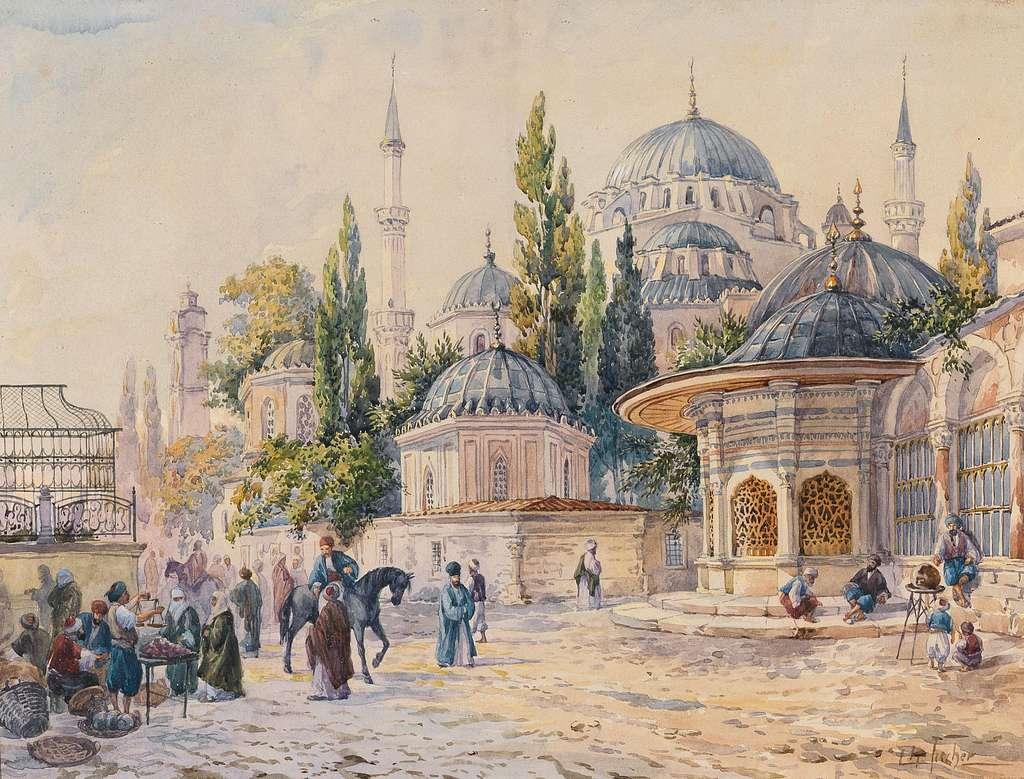
"The Sehzade Mosque in Laleli, Istanbul" by Ludwig Hans Fischer is licensed under Public Domain

In Shelley’s Frankenstein, Constantinople as a location is referenced in Vol. II when the creature is recounting the history of the De Lacey family. Constantinople is where Safie flees her oppressive Turkish father, and takes refuge with the De Lacey family.
During the height of the Ottoman Empire, Constantinople was viewed as the heart of an empire with great imperial power. Now known as Istanbul, the place was at one point exceptionally wealthy thanks to it being a cultural and economic hub. Based on various artworks of people who lived in the region by Europeans, European countries likely viewed it as “Oriental” and exotic, especially given its location in the Middle East– which makes sense given that “Orientalism” was in fact a European invention.
The culture of Constantinople and the Middle East is depicted in Frankenstein through the characters of Safie and Safie’s father, bringing a diverse, worldly perspective to the novel. When Safie first arrives, she does not know the family’s language, but is taken in, given food, shelter, and an education, which acts as a contrast for the creature’s rejection that he faces. Similar to how the creature is constantly viewed as an outsider, Safie can also be viewed as being an “outsider” of sorts as her and her culture is viewed as being different from that of the traditional European way of living.
History.com Editors. “Constantinople.” HISTORY, 6 Dec. 2017, www.history.com/articles/constantinople.
Micklewright, Nancy. “Looking at the Past Nineteenth Century Images of Constantinople as Historic Documents.” Expedition Magazine, 1990, www.penn.museum/sites/expedition/looking-at-the-past/.
“Orientalism in Frankenstein, by Mary Shelley.” Boundless Voices, www.boundlessvoiceshi.org/blog-4/blog-post-title-one-b3nyb-wlxjd.