
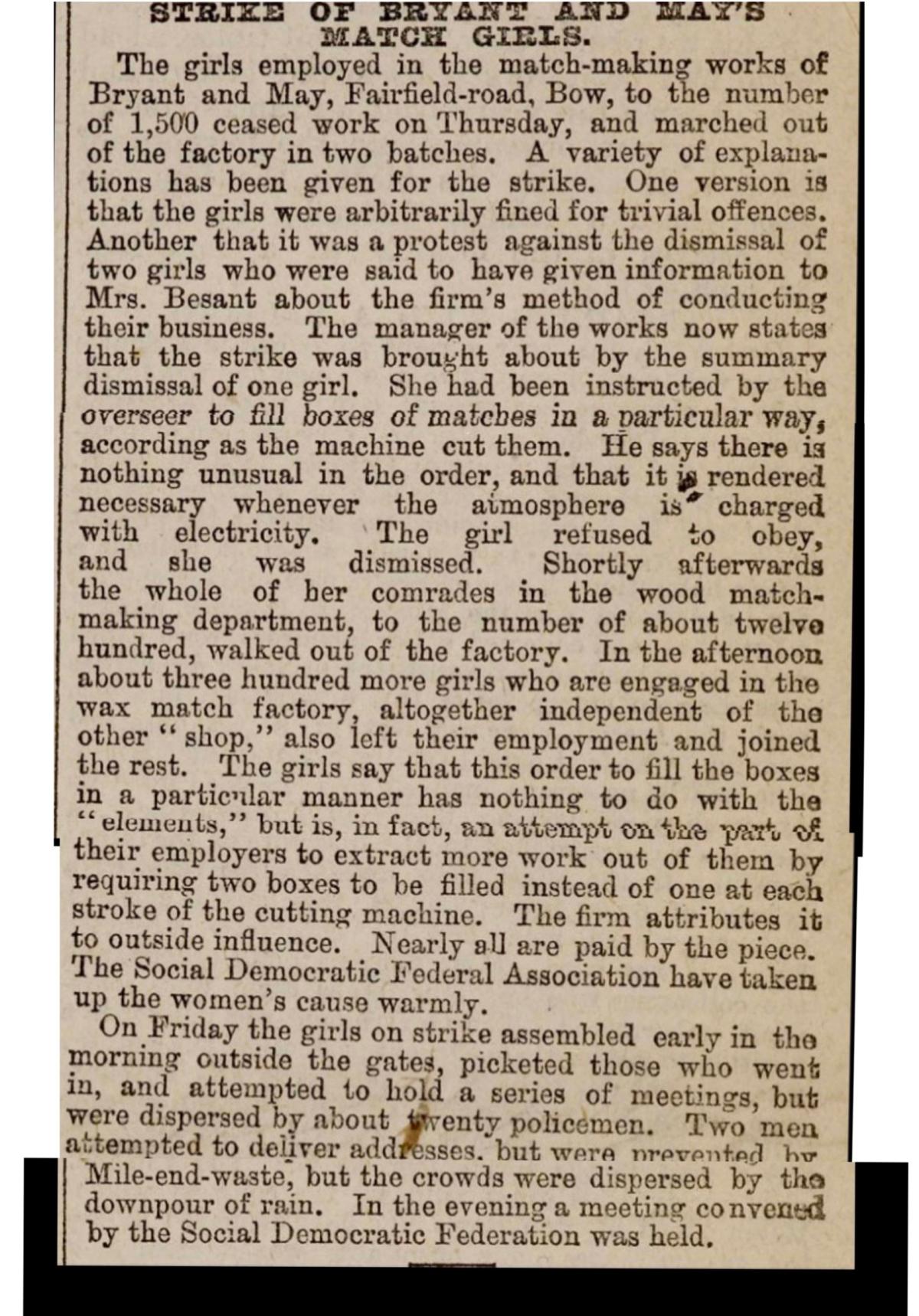
Image Source:
British Library, www.bl.uk/collection-items/newspaper-article-reporting-the-match-girls-…. Accessed 24 Oct. 2023.
Gertrude:
I have been so terribly enveloped in maintaining the photography studio and attending the exhibitions of Mr. Jermyn, Mr. Oakley, and Mr. Darrel that I fear I have had absolutely no time to simply relax and read the paper or any of the numerous magazines that our landlady provides us. I must admit that I have never given much thought to factory work or other women working for their livings, however, this particular report struck me due to my sisters and I current situation now that father is gone. Though there are a significant amount of differences between us and the match girls that the paper speaks of, I had to recognize that we are both groups of women who are breaking away from the traditional life of women and supporting ourselves without the support of husbands or fathers. Creating this studio has had a tremendous impact on my composition as I am constantly stressed and worried about the future, yet it has also been most exciting. This report that I have torn out has reminded me of our luck. Though I doubt that “lucky” is the appropriate word to describe our situation considering the loss of our father and the disapproval of people such as Mr. Darrel and Aunt Caroline. Nonetheless, we are in charge of ourselves, and I must not brush aside how we have been blessed by our upper status connection and opportunities. Had we not had access to these opportunities, I fear that my sister’s and I might have been in the same situation as those poor match girls. It pains me to even imagine poor Phyllis or sweet Lucy deteriorating in the harsh conditions of such a factory. I must not forget to be grateful and approach each day with determination.
Researcher:
It could be assumed from the journal entry that this woman, Gertrude, falls under the umbrella of the New Woman identity due to her personal views on the match girls strike and her own position as a female business owner in Victorian society. During the Victorian era, society began to point out the development of “New Women” as a rhetorical and social movement (Walls 230). These women were seen as unsubmissive, radical women who were not concerned with societies’ standards and roles that women were supposed to follow (Walls 236). Though this description of New Woman is generally true, the New Woman of Victorian society were often defined by the voices of male modernists rather than feminists themselves (Walls 235). Gertrude mentions the fact that she is part of a female run business, and she also describes her personal connection to the match girls of the newspaper cutout. Her reflection demonstrates how her views of women's place in society and the workforce differed from the values that were mainly upheld by society at the time. While it cannot be determined from the journal entry itself whether Gertrude was a very radical woman in terms of supporting women's rights, her break away from the path predetermined by society demonstrates her position as a New Woman.
During Gertrudes time, England was also experiencing a significant amount of technological developments that were changing the economy, the workforce, and women’s identities as seen by society (Felski 54). As technology developed and became increasingly important in the workforce, Gertrudes participation in this evolving aspect of the economy reflects on her own modernity. Additionally, in her entry, Gertrude speaks of other girls, possibly her family, meaning that she was not only working to support herself but others. This hints at a family supported financially by women and not men. All of these factors contribute to Gertrude’s identity as a New Woman in the workforce of Victorian England.
Sources:
Felski, Rita. “Feminism, Postmodernism, and the Critique of Modernity.” Cultural Critique, no. 13, 1989, pp. 33–56. JSTOR, https://doi.org/10.2307/1354268. Accessed 11 Oct. 2023.
Walls, Elizabeth MacLeod. “‘A Little Afraid of the Women of Today’: The Victorian New Woman and the Rhetoric of British Modernism.” Rhetoric Review, vol. 21, no. 3, 2002, pp. 229–46. JSTOR, http://www.jstor.org/stable/3093009. Accessed 11 Oct. 2023.