
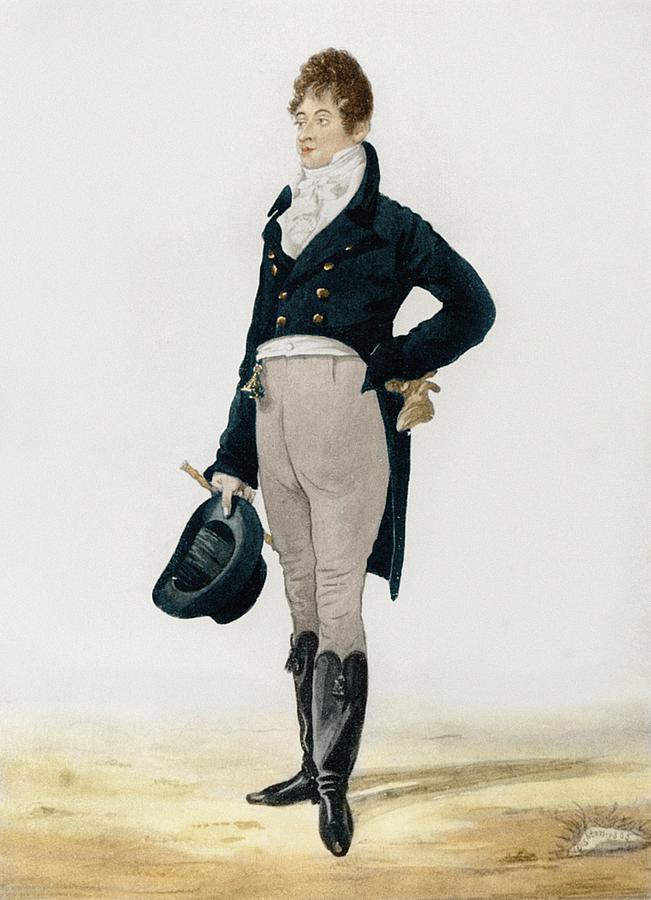

Women’s Fashion was not the only one to make a considerable shift in the Austen’s times, masculine style also underwent a change due to the work of George Bryan “Beau” Brummell. Brummell, portrayed in the above caricature by Robert Dighton, influential figure in the shift of men’s fashion due to hie persona as a self-made “dandy.” Dandy is a term used to describe a man who “studies above everything to dress elegantly and fashionably,” and was coined around 1780 (Nigro and Phillips). In the above picture, Brummel is sporting common clothing for the regency period, ornate white shirt with a chitterlon, or jabot, tucked into a navy waist coat half buttoned up with pantaloons that went into black boots that come to the shin. In one hand he is holding his hat and a cane while the other holds his gloves (Davidson). This signature simplistic and comfortable look associated with men’s wear in the regency period was elevated by Brummell and soon became associated with his “dandy” persona.
In the regency era, men’s fashion was characterized by simplicity and comfort. Some scholars connect this movement towards darker and more simplistic, yet severe and clean fashion to the trend of repressing outward displays of emotions and the changing definition of masculinity (Gentile). But Brummell’s effect on men’s fashion was not color or style where the emphasis was laid. Instead of heavy decoration and embroidery, he emphasized clean, cut, quality, and simplicity. Instead of breeches which stopped at the knee, Brummell preferred to pantaloons that went to the calf and hugged the figure instead of hiding it. He cut his hair short in the fashion of the “Crops” and jacket buttoned to emphasize his figure in a similar manner to women’s fashion. He created a unified aesthetic and was able to perpetuate it into popularity due to his connections with high members of society, such as the prince himself, and the mysterious, witty, elegant dandy persona he curated around himself that got people to listen to him (Nigro and Phillips). Beau Brummell’s effect on masculine style was influenced by his dandy personality which defied the traditional idea of masculinity and embraced feminine traits making him inseparable from men’s fashion in Jane Austen’s time.
Work Cited
Davidson, Hilary. Dress in the Age of Jane Austen. Regency Fashion. New Haven, Yale University Press, 2019.
Dighton, Robert. Beau Brummell. (2024, August 13). In Wikipedia. https://en.wikipedia.org/wiki/Beau_Brummell
Gentile, Kathy. “A Forward, Bragging, Scheming Race”: Comic Masculinity in Northanger Abbey. 2011.
Nigro, Jeffery A., and William A. Phillips. “A Revolution in Masculine Style: How Beau Brummell Changed Jane Austen’s World» JASNA.” Jasna.org, 2015, jasna.org/publications-2/persuasions-online/vol36no1/nigro-phillips/.