
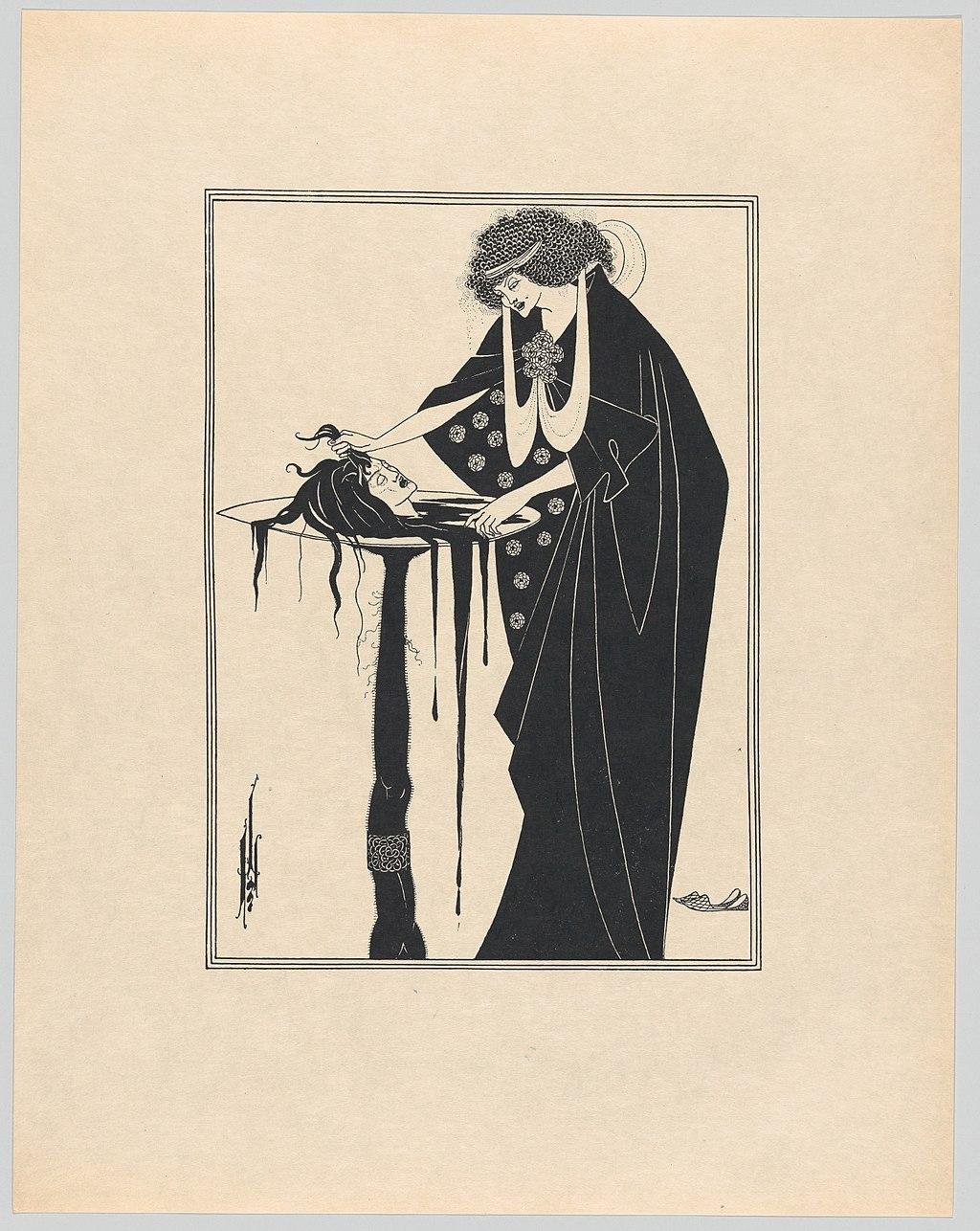
Published by John Lane at the Bodley Head in 1894, the first English edition of Oscar Wilde's Salome: A Tragedy in One Act was embellished with ten controversial illustrations by the art-nouveau artist Aubrey Beardsley (1872-1898). Beardsley was the first artist to draw specifically for the photomechanical reproduction. Beardsley followed the modern idea of "unfettered illustrations." Rather than serve the text, Beardsley made the text he decorated his own with his bold designs and distinctive critical attitudes. As a decadent artist, Beardsley refused to conform to Victorian society, using style as a visible counter-attack to the bourgeois. His sweeping lines, stark tonal contrasts, risqué motifs and sexual themes also participated in, and helped shape, fin-de-siècle cultural politics. In "The Dancer's Reward," as the dancer Salome gloats over her decapitated prize, the head of St John the Baptist, Beardsley expresses contemporary fears about the fate of patriarchal culture at the hands of the aggressive New Woman. Gender anxieties are also implied in the androgynous mirroring of John's and Salome's faces. Beardsley questions authority in the doubling techniques of his design, such as the Nubian arm which is also a pedestal, the snaky hair that doubles as streams of blood, and the white collar that evokes a pair of hanging breasts. "The Dancer's Reward" offers a good comparison with earlier Victorian prison illustrations. While George Cruikshank's "Fagin in the Condemned Cell" for Charles Dickens's Oliver Twist (1838) provides moral perspective on the consequences of crime, and Ford Madox Brown's illustration for Lord Byron's "The Prisoner of Chillon" (1857) illuminates the horror of death as decomposition, Beardsley's "The Dancer's Reward" is stylized, abstract, and ironic. He merely implies, rather than shows, the prisoner's cell with the turnkey's arm rising from the underground cistern to offer the executed man's head to the dancer. Oscar Wilde did not like Beardsley's illustrations for his play. Nonetheless, Beardsley's decadent images linked him with Wilde in the public's mind and when the playwright was arrested the following year (April 1895) for the criminal offense of "gross indecency,” John Lane was forced by his authors not only to drop Wilde from his publishing list, but also to fire Beardsley as art editor of The Yellow Book (1894-1897), a little magazine.
Source: Lorraine Janzen Kooistra, The Artist as Critic: Bitextuality in Fin-de-Siècle Illustrated Books