
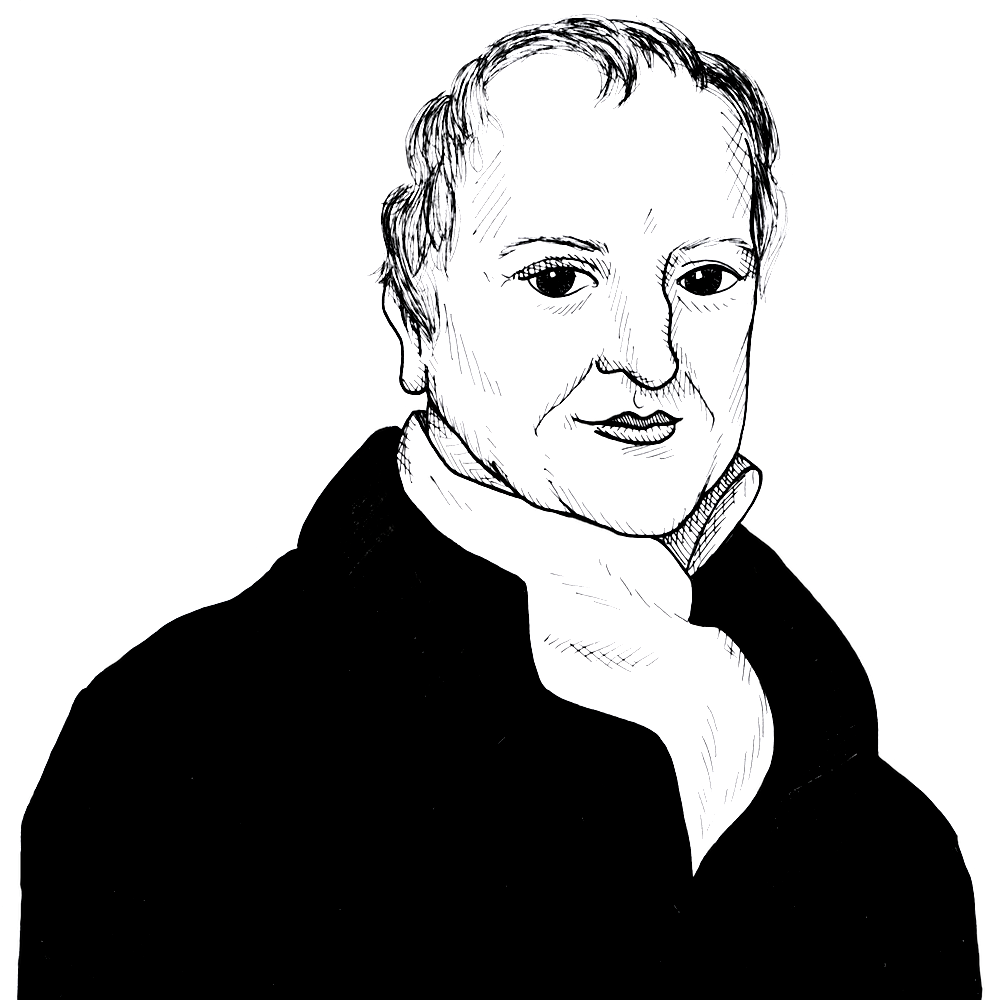
David Ricardo (1772-1823) was a classical economist whose theories influenced many nineteenth century thinkers, including John Stuart Mill. His 1817 work Principles of Political Economy and Taxation which, according to John Stuart Mill, “formed so great an epoch in political economy” (Mill 19) elaborated many of his most important principles, such as a labor theory of value, free trade, and the concept of comparative advantage. His theory of value held that the amount of labor time necessary for producing a commodity determines its price. His arguments for free trade included critiques of the protectionist corn laws, and his concept of comparative advantage encouraged international trade. With this work, “Ricardo took economics to an unprecedented degree of theoretical sophistication… formalized the Classical system more clearly and consistently than anyone before had done.” (Hamlin) Ricardo was a friend of both James Mill and Thomas Malthus. From 1819 to his death in 1823, he represented a rotten Irish borough in Parliament as an independent.
John Stuart Mill recalls the close friendship between Ricardo and his father in his autobiography. He recounts how his father instructed him to read Ricardo’s works and analyze his economic arguments from an early age, shaping him into the thinker he became. He also describes Ricardo’s personality, portraying him as a humble man who was spurred into action by James Mill. For example, he claims that the Principles of Political Economy and Taxation “would never have been published or written, but for the entreaty and strong encouragement of my father; for Ricardo, the most modest of men, … deemed himself so little capable of doing them [his doctrines] justice in exposition and expression, that he shrank from the idea of publicity” (19). He likewise attributes Ricardo’s decision to stand for Parliament to his father’s influence. This interpretation of events emphasizes that James Mill was a dominant character not only in his son’s life but also in the broader political and intellectual moment. The praise of Ricardo’s modesty further aligns with the text’s general attitude towards personal and political ambition as something to be disowned.
Hamlin, John. “David Ricardo.” David Ricardo, www.d.umn.edu/cla/faculty/jhamlin/4111/Ricardo/David%20Ricardo.htm. Accessed 18 May 2024.