
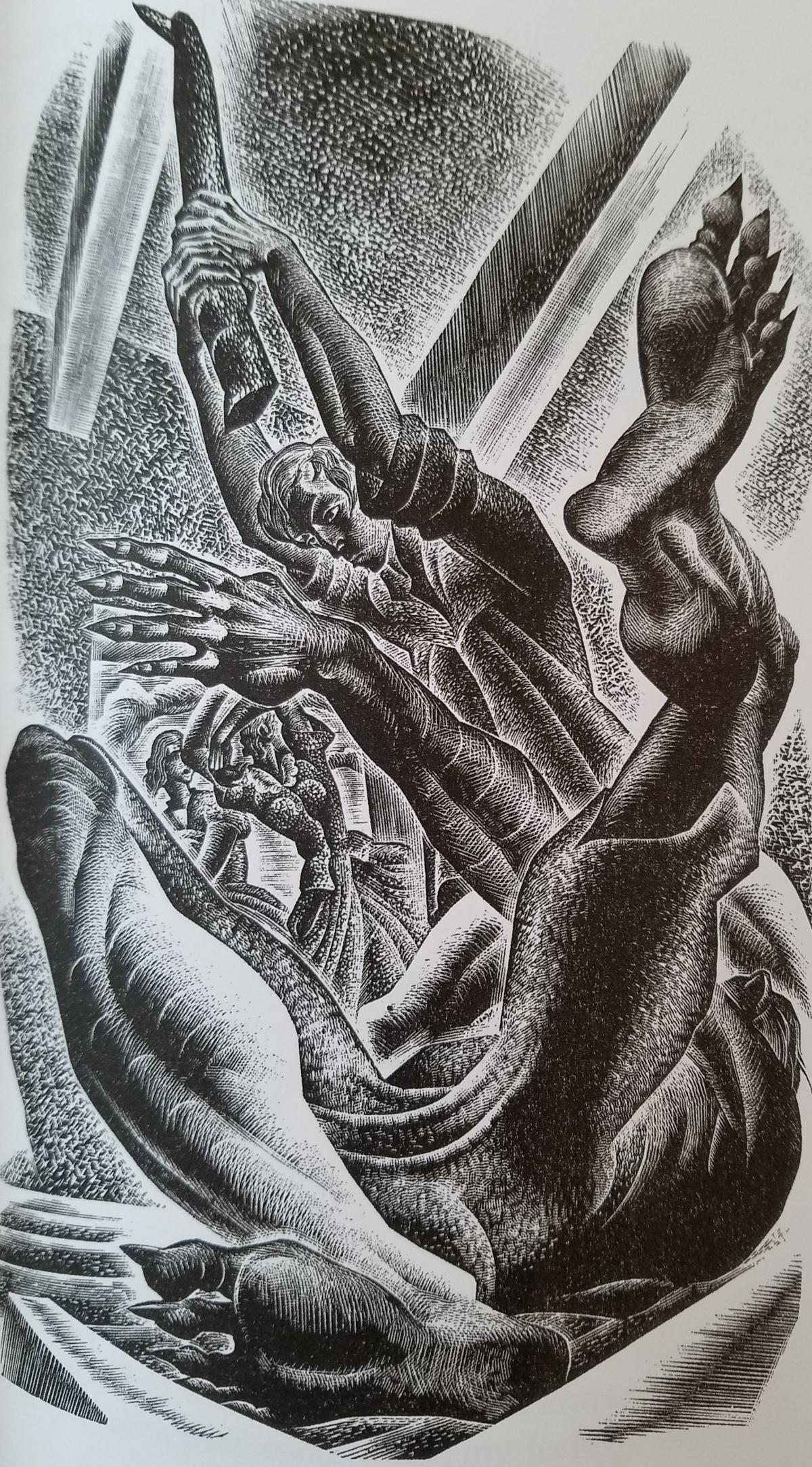
This illustration is first described to us in Volume II, Chapter seven, of Frankenstein by Mary Shelley. In the Illustration, the creature was just attacked by Felix. Before this event, Safie, Agatha, and Felix went on “a long country walk” leaving their father Mr. DeLacy -the old blind man- home alone to play his guitar (Shelley 99). Seeing this the creature decides that it’s his chance to go talk to Mr. DeLacy and prove that he too has a place in society.
However the creature heard the children's footsteps approach. Before Safie, Agatha, and Felix walk into the cottage from their walk the creature begs the father to be a friend and protect him. Shelley describes this as “At that moment I heard the steps of my younger protectors…. save and protect me! You and your family are the friends whom I seek. Do not you desert me in the hour of trial!” (Shelley 99). This is a very important moment because if the creature is not accepted by the DeLacy family, it shows that no family could accept him. This would officially make the creature an outcast in society. As we know he is not accepted which leads to many misfortunes of the creature and civilians.
The children find the creature with their father which was a shock to them. Shelley tells us that “Agatha fainted; and Safie, unable to attend to her friend, rushed out of the cottage” (Shelley 99). Felix rips the creature from his father's knees and starts to hit him with a stick. Shelley describes this as “...Felix darted forward, and with supernatural force tore me from his father, to whose knees I clung: in a transport of fury, he dashed me to the ground, and struck me violently with a stick” (Shelley 99). This makes Felix look unkind and violent. The creature was in his home with his bind father. This creates a sense of fear in Felix making him want to protect his home and father from the creature causing him to beat the creature with a stick. In response to this violent act by felix the creature thinks “I could have torn him limb from limb, as the lion rends the antelope” (Shelley 99). Instead the creature feels “...my heart sunk within me as with bitter sickness, and I refrained” (Shelley 99). As this happens the creature is overcome with sadness, and leaves the cottage in an escape to no longer feel “pain and anguish” (Shelly 99).
In the illustration, the creature appears to be very muscular, and he appears to have pointy fingernails and toenails. It looks like the clothes the creature is wearing do not fit him, and it also shows that he does not wear shoes. This makes the creature look inhuman. Although we know the creature is capable of winning against Felix he lays on the floor and that makes him look like a weak person. He also looks to be protecting himself from Felix’s blows. The background would be the cottage and it looks like the floor the creature is on is falling apart. It also shows that Safie and Agatha are in the background watching as everything unfolds in the image. The illustrator makes the creature look weak and yet strong at the same time. By doing this the illustrator shows us the creature does have human qualities. He can feel pain, anguish, and loneliness which makes you feel sympathy for him. This is also why when you look at the illustration you are on the creature's side. The women in the back look to be horrified by the sight of the creature. You feel more sympathy for the creature because he is defenseless on the ground, and Felix is towering over him beating him. He feels the need to be accepted and loved even when he is constantly rejected by humankind so the creature doesn’t retaliate. Retaliating would make him look to be the foul creature everyone thinks he is. When you read the book by Mary Shelley, and also look at the illustrations by Lynd Ward they make you feel for the creature and sympathize with him.
In the beginning the blind man accepted him because he couldn't see the creature. As a culture, we judge people based on how they look. Which Poole shows us in his book Monsters In America: Our Historical Obsession with the Hideous and the Haunting in several different ways. Poole shows this to us in the introduction and chapters 1-3 by comparing the way Native Americans and African Americans are treated inferior to whites based on their looks. For example in chapter one “Monstrous Beginnings” Poole says “Contrary evidence, however, suggests that such an ambivalent view of the natives had very little traction among most early modern Europeans. The conquerors of the New World saw not simply a savage version of humanity but the monstrous race of their mythology...the creation of monstrosities with the etiology of the ‘darker race.’ Monsters represented the progeny of these supposedly savage peoples, a concept that reappears again and again throughout history” (Poole 29). This shows that people back when Frankenstein was written (1931) judge people based on their appearances which is why Frankenstein could not fit in, and it shows how throughout history Americans have judged people based on their appearances as well. As a culture we use bias and discrimations to judge people, and “place them” wear we think is fit in our society. The creature is viewed as inferior to mankind, which is shown by the DeLacy family’s reaction to him. Felix beats him with a stick and towers over him in the illustration. This is something that would happen to someone of a “darker race” if they were being punished for something, as they were seen to be inferior (Poole 29). The creature does not look to be a “savage person” he is laying on the floor protecting his body (Poole 29). The creature on the floor adds to the idea that as a society we judge people too harshly on their appearances.
Works Cited
Poole, W. Scott. Monsters in America: Our Historical Obsession with the Hideous and the
Haunting. Baylor UP, 2011.
Shelley, Mary. Frankenstein, or The Modern Prometheus. Oxford, 2018.