
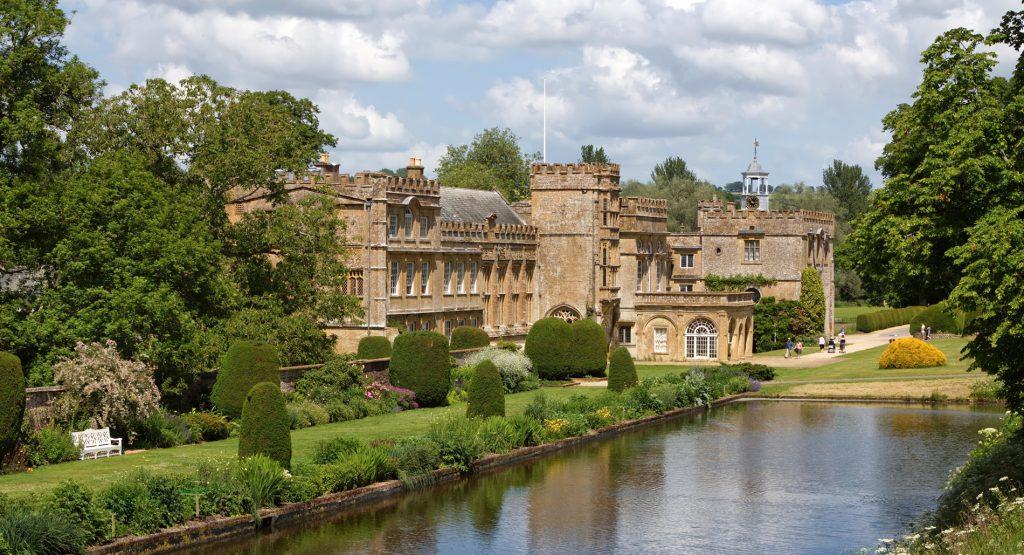
Forde Abbey, located in Somerset, England, was founded in the 1100s and remained a functioning monastery until the 1500s. Thomas Chard, the final abbot of the monastery, ceded Forde Abbey to the British crown in 1539 in the midst of King Henry VIII’s dissolution of monasteries during England’s Protestant Reformation. The following century saw the Abbey occupied by various renters and owners until it was sold to Edmund Prideaux in 1649. Prideaux, a member of Parliament and Attorney General for Oliver Cromwell, created a private residence out of the historical Abbey which remained the home of his family until the early nineteenth century.
When John Fraunceis, Prideaux’s descendent, could no longer afford the maintenance of Forde Abbey, he rented it to Jeremy Bentham from 1814 to 1818. Bentham spent his summers at Forde Abbey, where he enjoyed an organ kept in the chapel and hosted many friends and prominent nineteenth-century thinkers. These visitors included John Stuart Mill with his father James Mill. J.S. Mill recalls in his autobiography that his visits to Forde Abbey were “an important circumstance in [his] education” (Mill ch. II) due to the feeling of freedom that the spacious rooms and grounds afforded him. Mill suggests that exposure to the Abbey’s architecture and natural spaces could “nourish elevation of sentiments in a people” (Mill ch. II) better than the average, smaller spaces common amongst the English middle class. Mill’s sanctuary of the intellectual upper class remains a historical site for visitors as is still owned and used as a place of residence by descendants of Mrs. Betram Evans, who bought the Abbey in 1863. The Abbey still houses art, such as the Mortlake Tapestries, and maintains numerous gardens.
Sources
“Bentham Project Visit to Ford Abbey.” Bentham Project. University College, London, 2003, https://www.ucl.ac.uk/bentham-project/news/archive/2003-archive/bentham-project-visit-forde-abbey. Accessed 20 May 2024.
Cartwright, Mark. “Dissolution of the Monasteries.” World History Encyclopedia, 13 May 2020, https://www.worldhistory.org/Dissolution_of_the_Monasteries/. Accessed 20 May 2024.
“The House.” Forde Abbey & Gardens, https://www.fordeabbey.co.uk/house. Accessed 20 May
Image source