
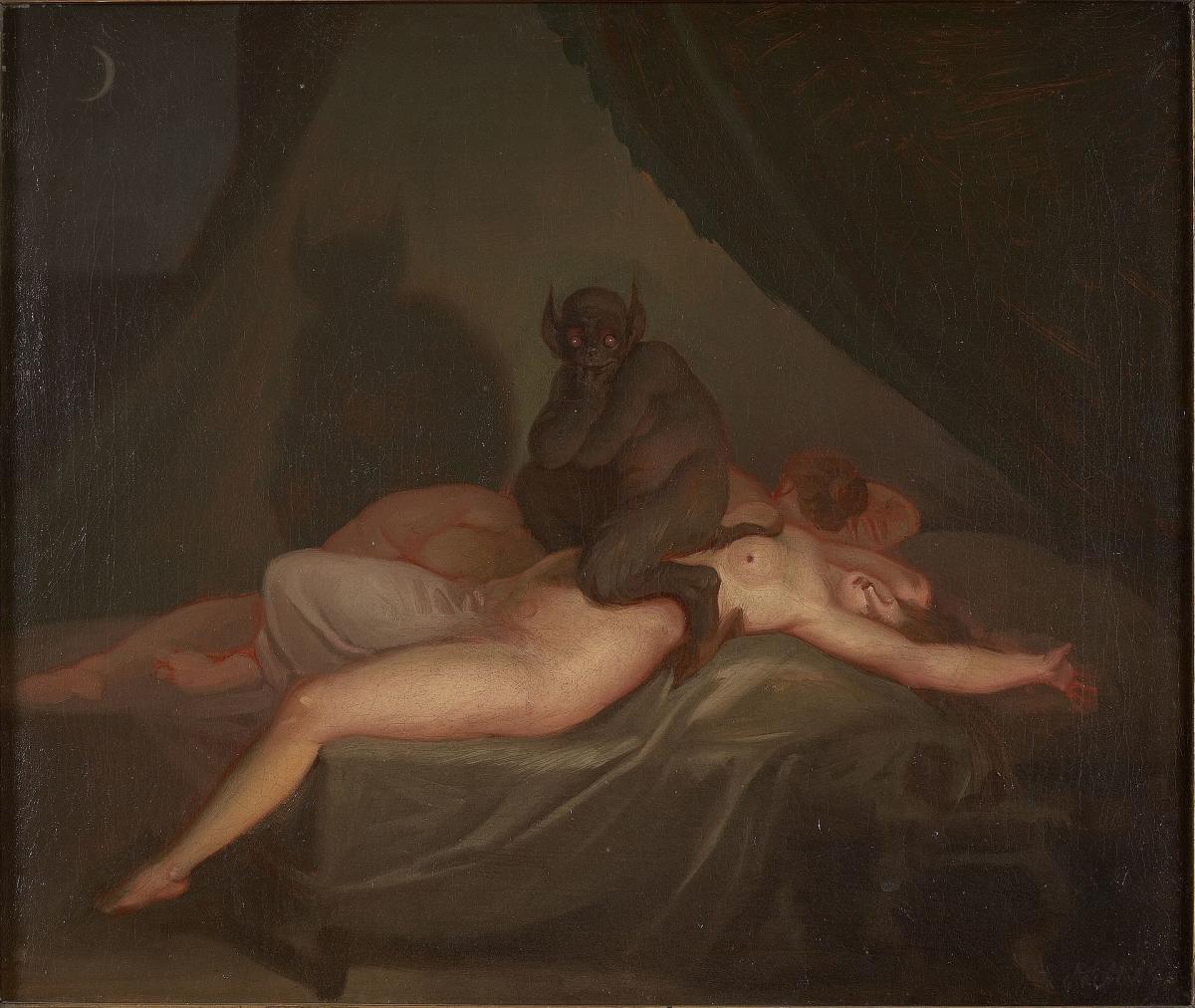
Maybe the most well-known sleep paralysis demon is the night hag (pictured above) who appears as an old woman or demon and sits on one's chest whlie they sleep. Sleep paralysis itself is an interestingly gothic phenomenon in which the sleeper feels the presence of a other-worldly, often malevolent being which immobilizes the person as if sitting on their chest or standing at the foot of their bed. Most depictions of "sleep paralysis demons" are in 18-19th century gothic paintings of demons visting sleeping women. The appearance and names of these demons are heavily influenced and dictated by local folklore. This is inherently gothic as is it a total loss of control over ones body and mind. These demons often appear as things one fears or desires. In a lot of folkore, succubi or inccubi (sex demons) appear to tempt the victim. It is a total collapse of boundaries between the real and the unreal, the known and the unknown, the physical and the supernatural. It is entrapment, concealment of truth and reality, loss of direction and agency. These creatures---perhaps mere fabrications of the mind---intrude into one's most vulnerable place while they're at their most vulnerable and reflect their anxieties about death, the unknown and other-worldy, and the fragility of the human mind.
"The Nightmare" by Henry Fuseli, 1781; Ditlev Blunck's "Nightmare", 1846; Copy by Nicolai Abraham Abildgaard, 1800