


BLM
Historical Context of Black Murders by Police
The Black Lives Matter Movement was founded in 2013, however, violence against black communities and individuals, systematic racism, and white supremacy have been major problems worldwide for centuries. The National Use-Of-Force data collection shows that “Police officers fatally shoot an average of nearly 1,000 people annually in the United States, and Blacks, Hispanics, the mentally ill, and the poor are more likely to be shot by the police than whites” (Lyons 1). BLM was born out of a necessity to address and combat these problems within our society. This gallery series is intended to provide some historical content/context to certain black individuals who died at the hands of police.
Along with a general overview of black murders by police, the featured individuals that the series will focus on are Freddie Gray, Trayvon Martin, and Emmit Till. The tragic end that these young individuals met at the hand of their murderers will not be forgotten.
Freddie Gray died in police custody in Baltimore at the age of 25. The murder of Freddie Gray sparked the 2015 Baltimore protests. Freddie’s story will explore problems of racism at a systemic level. His story will relate back to a map of general housing conditions and locations for the poor and the rich in London in the early 1800s. Elements of this can be seen and can be referenced in a video essay made by the philosopher and YouTuber Natalie Wynn on her channel ContraPoints ( https://youtu.be/GWwiUIVpmNY ). The image that follows Freddie’s story is that of Trayvon Martin.
Trayvon Martin died after being shot in the chest while walking home from a convenience store. He was only 17-years-old. To lose someone so young, unnecessarily, is truly heart-breaking. The violent murders of young Black people affect the families of these individuals in the worst of ways. In this gallery, we will look at how the aftermath of these murders, are at times, deadly.
The final image of the gallery touches on the murder of Emmit Till. Emmit was only 14-years-old when he was murdered in one of the most horrific ways imaginable. For a person to kill another human being in a way that leaves them unrecognizable is something so disgusting as to make that person less than human. We will explore an artistic representation of Emmit’s story in the final image of the gallery.
In addition to the murders of black people by police, this exhibit relates back to the heroic account of Olaudah Equiano as well as a Nobel Peace Prize-winning author failing to acknowledge the BLM movement. It is my hope that this gallery will provide historical information that shows how important the Black Lives Matter Movement is.
Respectfully, Marcus Ramey
Works Cited
Burton, Nylah. “Police Violence is a Health Crisis for Black Families. Marquis Jefferson is the Latest to Die of a Broken Heart.” vox.com. November 12, 2019.https://www.vox.com/first-person/2019/11/12/20961357/marquis-jefferson-…
ContraPoints. Wynn, Natalie. “America: Still Racist.” youtube.com. February 28, 2018. https://youtu.be/GWwiUIVpmNY
Cox, John Woodrow. “Murals of Pain, Anger, and Hope in Freddie Gray’s Baltimore Neighborhood.” washingtonpost.com. December 1, 2015. https://www.washingtonpost.com/news/local/wp/2015/12/01/murals-of-pain-…
Demby, Gene. “A Decade of Watching Black People Die.” npr.com/codeswitch. May 31, 2020, https://www.npr.org/2020/05/29/865261916/a-decade-of-watching-black-peo…
Equiano, Olaudah Or Vassa, Gustavus. “The Narrative of the Life of Olaudah Equiano, or Gustavus Vassa, The African.” studio.covecollective.org. March 27, 1789. Ch. 2 https://studio.covecollective.org/documents/excerpts-from-the-interesti…
Garza, Alicia. Cullers, Patrisse. Tometi, Opal. “Black Lives Matter.” blacklivesmatter.com. 2013 https://blacklivesmatter.com/herstory/
Gluck, Louise. “Nobel Lecture in Literature 2020.” thenobelfoundation.com. December 7, 2020. https://studio.covecollective.org/anthologies/sp22-eng-l302-anthology/d…
Lyons, Christina L. “Police Under Scrutiny.” cqpress.com. October 9, 2020. Vol. 30, Issue 36. https://library.cqpress.com/cqresearcher/document.php?id=cqresrre202010…
Terrence, McCoy. “Freddie Gray’s Life, A Study on the Effects of Lead Paint on Poor Blacks.” Washingtonpost.com. April 29, 2015. Freddie Gray's life a study on the effects of lead paint on poor blacks - The Washington Post
Terrence, McCoy. “How Companies Made Millions off lead-poisoned Poor Blacks.” Washingtonpost.com. August 25, 2015. How companies make millions off lead-poisoned, poor blacks - The Washington Post
Whittington, Lisa. “#MuseumSoWhite: Black Pain and Why Painting Emmett Till Matters.” Nbcnews.com. March 26, 2017. #MuseumsSoWhite: Black Pain and Why Painting Emmett Till Matters
Wray, Christopher. “National Use-of-Force Data Collection.” fbi.gov. July 27, 2020. https://www.fbi.gov/services/cjis/ucr/use-of-force
Names
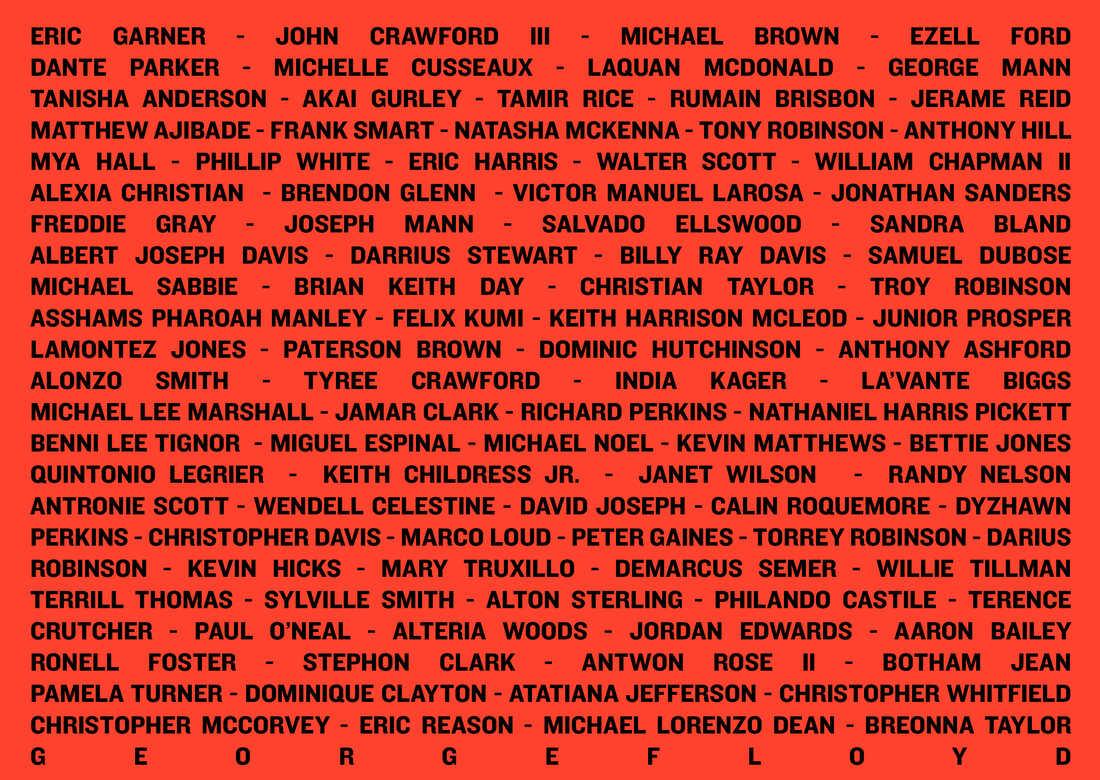
The first image you see is a list of black people who have been killed by police since July 2014. We, as a society, need to raise awareness of this problem. Black people are dying at the hands of police for non-violent crimes. People with the power of a far-reaching platform should, or at the very least make mention of this issue. On this topic, Luise Gluck fails to say anything about this issue during her Nobel peace prize-winning speech for poetry. She instead expresses her belief that two different appropriated poems are two of the best poems ever written.
Freddie Gray Mural
This is a mural that honors the life of Freddie Gray. It is located in the neighborhood he grew up in, Baltimore, Maryland. He was killed by the police at the age of 25. He was arrested for having a spring-assisted knife, beat up, thrown into the back of a police van with 6 police officers, and then was murdered by them. Freddie’s autopsy showed that he had three fractured vertebrae and his spine was 80% severed at the neck. This Mural stands as a reminder of another black life taken by the police and the Baltimore Riots that followed.
Freddie Gray was executed by the police for a non-violent crime, but what else should we know about him? Freddie grew up in poverty alongside his two sisters. Freddie and his sisters were exposed to lead-based paint that peeled off the walls in their rundown row house as children. Exposure to lead can result in permanent cognitive damage in children. “93,000 children were added to the lead poison registry in Maryland around this time and 99.9% of these children are black” (Terrence). Freddie and his sisters ended up getting a settlement which was swiftly taken from them by shark lawyers. These lawyers offered a lump sum payment for entire settlements to the victims of lead poison (some of which were not able to read the contracts these lawyers were having them sign). “Freddie was given $18,300 for his settlement that was worth $146,000” (Terrence).
The reason that 99.9% of the lead-poisoned children were black can be traced back to a residential segregation mandate in 1910. This mandate was to keep black people in bad neighborhoods after W. Ashby Hawkins(A Harvard-educated black lawyer) bought a house in an upscale white neighborhood. Although the mandate has since been overturned, we still see its effects of it today. If you look at a map of downtown Baltimore you can see many similarities to the map we looked at in the first lecture about the 99%.
Trayvon Martin Mural
Here is a mural that commemorates the life of Trayvon Martin. He was 17 when he was shot in the chest and killed in Florida. He was profiled as a criminal simply because he was black. His death, alongside the death of countless other young black people murdered by the police, is why the BLM Movement is absolutely necessary. Seeing this mural makes me think of what his family had to go through after losing him. The violent murders of young Blacks by police affect the families of these individuals in the worst of ways. I would like to include the following two instances where the aftermath of these atrocious murders by police has caused even more black people to die. “58-year-old Marquis Jefferson died after a cardiac arrest and heart complications, a family spokesperson told The New York Times. Marquis was the father of Tatiana Jefferson, a 28-year-old Black woman who was shot and killed by a white police officer while playing video games with her nephew a month prior” (Burton). “The same diagnosis was said of 27-year-old Erica Garner, who died in 2017 of a heart attack not long after giving birth” (Burton).
Emmett Till Painting
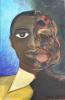
This is a painting that depicts the life and violent death of 14-year-old Emmett Till. Emmett was accused of offending a white woman in a grocery store. He was kidnapped by two white men, tortured, and killed. He was beaten and tortured to a point where he was unrecognizable. I’ve included this painting because what happened to Emmett is still happening today. The brutal killings of black people can even be seen in the 1700s in the Autobiography of Olaudah Equiano. Olaudah was kidnapped from Africa and put on a ship headed back to Great Britain. While on the ship, he witnessed the merciless beatings and murders of other enslaved black people.
The extrajudicial executions of black people by police officers have to stop. Be a part, not apart, and help change our future for the better. Join the BLM movement and help make the world a better place for all.
Thank you for visiting the gallery!