
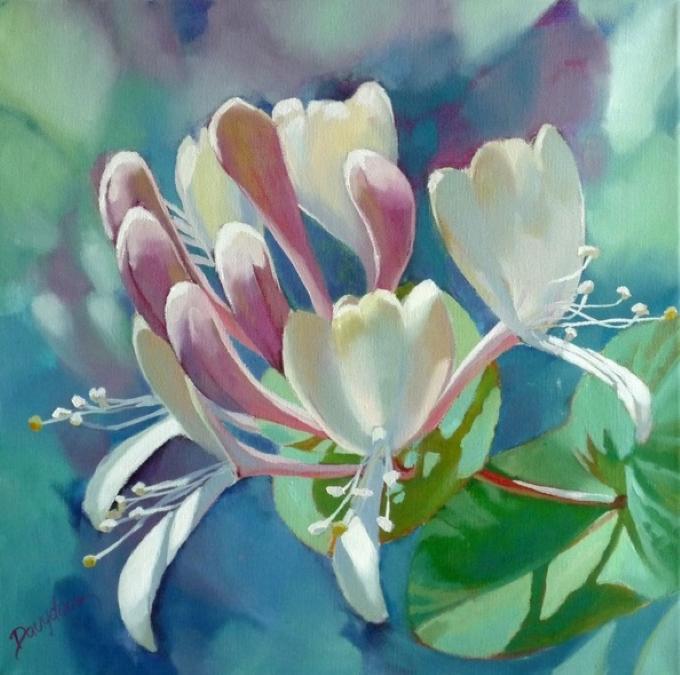

The canvas above depicts the honeysuckle, a flower that symbolizes happiness, love, good fortune, and nostalgia. In addition, they are symbols of beauty and fragility. This fragility represents the “passing of beautiful things” (Arner 58). This theme of fragile beauty in nature is seen widely within the Romantic movement, which originated in Europe in the 18th century before eventually spreading in influence in the newborn American nation. Romantics emphasized characteristics like emotion and nature within their music, literature, and art. One such Romanticist, Phillip Freneau, ventured further and explored nature’s encompassing roots of mortality, death, the fleeting of life, and notably the beauty hidden within this somber truth. One of Freneau’s poems, “The Wild Honeysuckle,” addresses these themes and contemplates the sacrificial beauty of nature as well as the connection to the thus transient lives of humans.
Written in 1786, “The Wild Honeysuckle” depicts a small honeysuckle plant growing within an isolated and protected grove. Without the influence of humans or others, the plant is nourished by nature: “…Nature has cared for her offspring by arraying it in white (a colour that suggests both purity and death), sheltering it, and watering it,…[but] she has also fated it to fade according to the same fundamental laws of life by which she nurtured it” (57). Although nature protects and nurtures, like a caring mother, “she” also causes the inevitable death of all living things. Although the speaker grieves the flower, he too knows that nothing can be done to go against this absolute law of the universe. Yet, the Freneau excuses this sad fate, writing that “If nothing once, you nothing lose. / For when you die you are the same” (Freneau 13-14). His claim is that despite being unable to avoid eventual death, it is the mere cycle of life, and without it, the beauty of nature would lose its light. The poem ends with its famous ending couplet: “The space between is but an hour. / The mere idea of a flower” (23-24). In the grand scheme of things, our lives, however meaningful and beautiful they are, are merely the length of the life of a flower.
Works Cited:
Arner, Robert D. “Neoclassicism and Romanticism: A Reading of Freneau’s ‘The Wild Honey Suckle.’” Early American Literature, vol. 9, no. 1, 1974, pp. 53–61. JSTOR, http://www.jstor.org/stable/25070648. Accessed 22 Mar. 2024.
Britannica, The Editors of Encyclopaedia. "Philip Freneau". Encyclopedia Britannica, 4 Mar. 2024, https://www.britannica.com/biography/Philip-Freneau. Accessed 21 March 2024.
Davydova, Diana. Honeysuckle. 2011. Artfinder.com, https://www.artfinder.com/product/honeysuckle-fc15/?preview=1.
Freneau, Phillip. “The Wild Honeysuckle.” 1786. Poets.org, https://poets.org/poem/wild-honeysuckle. Accessed 18, March 2024.