


Display Explanation:
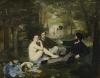
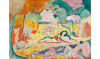
The three paintings that are part of my installation are Manet’s Le Déjeuner sur l'herbe, Matisse’s Le bonheur de vivre, and Corot’s Bacchante by the Sea. All three of the paintings are set in a natural landscape. The settings of these paintings make the outdoors a large component of the installation. For this reason, I would like to have the painting displayed in a very natural environment. In order for the painting to remain protected and in pristine condition, they must remain inside. Therefore, I would like to create a space inside that is meant to look like the outdoors. Specifically, I would like there to be a man-made pond at the center of the room. The pond will draw the attention of the viewer deeper into the room. The water I feel will help calm the visitors' minds and allow them to fully immerse themselves in the present and look at the beautiful paintings. Then, I want there to be a bunch of trees in the space. I want the trees to be dark and have luscious leaves creating a canopy that eliminates the visitor’s ability to see the ceiling. I would like all three paintings to remain near each other because the color pallets of each of them pair well together. Manet’s painting is fairly neutral-toned with some earthy greens incorporated throughout. The earthy tones make Manet’s painting the perfect piece to be displayed first. This way, the viewer will not be overwhelmed by the painting but intrigued. The painting I would like to have displayed after Manet’s is the artwork done by Matisse. Le bonheur de vivre has a similar vibe as the first image because it displays multiple naked individuals outside. However, this image exudes a sense of fluidity that the first image does not. The fluidity of this piece will draw the viewer deeper into the installation like a trance. Also, the pop of color from this piece will keep the viewer interested and break up the more neutral tones of the other two images. The piece I would like displayed last in my installation is Corot’s Bacchante by the Sea. This painting is the only one in the trio that has just one person. The independence of the lone woman creates a great ending point for the installation. Also, the neutral colors used in the painting mirror that of the first painting which I feel creates a nice end piece. All of these paintings will be along a dirt path that goes all around the room. The paintings will be hanging from the trees like swings. The suspension of the images will allow for them to be at eye level for the viewer and sets them apart from the natural landscape while still having them be incorporated. The lighting in the room will be the equivalent of the deep orange that is created when the sun is setting. I believe the sunset lighting will give the viewer enough light to see the paintings in all their glory but maintain the natural feeling of the room.
Installation Note:
The three pieces that I have chosen for my installation are Manet’s Le Déjeuner sur l'herbe, Matisse’s Le bonheur de vivre, and Corot’s Bacchante by the Sea. The three paintings all contain bodies in their most natural form. The lack of clothing bonds these images together in a very intimate way and establishes a common theme throughout the installation. The theme being that nakedness is natural and should be viewed as such. The first image which was painted by Manet depicts a few people enjoying a picnic somewhere outside. There are two women that are naked and one of them appears to be looking directly at the viewer while the other is crouching down in the back. The women are naked, but the sense of sexualization or objectification that often creeps in the shadows of paintings of naked women is not present. The same concept can be seen in the second painting by Matisse. Matisse is able to paint naked people lounging lethargically in the open wilderness in a way that exudes the essence of comfort and stability while making the viewer feel like an onlooker but not in a creepy way. The fluidity of Matisse’s painting further exaggerates the idea of peace and tranquility that being outside has on many people. The last painting included in the installation which was created by Corot also has a naked lady in a natural landscape. The woman looks comfortable and confident. While this image is different from the rest because the woman is alone and not accompanied by others, the essence of the image fits well with the other installation pieces. A surface-level observation of these three images will produce the conclusion that all three paintings are similar and fit together because they all contain naked people and are set in an outdoor environment. However, after looking more thoroughly and deeper into the feelings produced by each image the viewer will find a much more abstract similarity between each painting. First, while all three paintings have naked people, they are not meant to make the viewer feel intrusive or perversive. These paintings create an air of comfort and peacefulness. The naked body is meant to be natural and beautiful and the artists depicted that idea very well. These are not inherently sexual in the way they show off the naked body. Each artist expresses the idea of comfort and peacefulness in different ways. Manet shows the naked body in two different positions and contrasts them with two clothed men. However, the men are not gawking at the naked women, they instead appear to be conversing with each other. Matisse used bright colors and fluid shapes to show the naked body and creates a sense of privacy. The naked bodies in Matisse’s painting are not meant to be sexually gazed at or objectified but instead admired for the beautiful naturalness they represent. Lastly, Corot’s painting is comfortable and tranquil to look at as a viewer because the subject of the painting appears comfortable and tranquil. She is not trying to suggest anything to the viewer. She is simply just being. In the end that is really what all of these paintings represent. The idea of just being.
MLA Entries:
Manet, Edouard. Le Déjeuner sur l'herbe, 1863, Orsay Museum, Paris, France. https://en.wikipedia.org/wiki/Le_D%C3%A9jeuner_sur_l'herbe#/media/File:Edouard_Manet_-_Luncheon_on_the_Grass_-_Google_Art_Project.jpg. Accessed. Feb 13, 2023.

Matisse, Henri. Le bonheur de vivre, 1905–6, Barnes Foundation, Philadelphia, Pennsylvania. https://en.wikipedia.org/wiki/Henri_Matisse#/media/File:Bonheur_Matisse.jpg. Accessed. Feb 12, 2023.

Corot, Camille. Bacchante by the Sea, 1865, The Metropolitan Museum of Art, New York, New York. https://www.metmuseum.org/art/collection/search/435963?pos=5. Accessed. Feb 13, 2023.